
COVID misinformation is rampant among California Latinos. One artist is fighting back
This story is part of the Central Valley News Collaborative — a bilingual, community journalism project funded by the Central Valley Community Foundation and with technology and training support from Microsoft Corp. The collaboration includes The Fresno Bee, Valley Public Radio, Vida en el Valle, Radio Bilingüe and the Institute for Media & Public Trust at Fresno State.
Those who have played the beloved Mexican card game Lotería will recognize the characters in an illustration created by political cartoonist Lalo Alcaraz promoting COVID-19 vaccination.
Alcaraz uses the Lotería characters El Borracho, El Mundo and El Músico — or a drunk, a musician and a man holding up a globe — to convey messages about the benefits of getting vaccinated. Traditionally depicted as a drunk grasping a bottle, El Borracho is now a man flexing his biceps, one of which proudly features a Band-Aid. His new name is captioned La Salud, or health.
Alcaraz’s goal is simple: Fight COVID-19 misinformation and promote vaccination among the Latino community.
“I thought it was kind of powerful to have Mexican immigrant families and Mexican-Americans represented in these cartoons about vaccine hesitancy,” said Alcaraz, an award-winning artist whose work focuses on the Latino community. “That’s what we have to do with this information about COVID, we just have to wear people down with the truth and I think the truth will win in the end.”
Alcaraz’s illustrations focused on COVID-19 will be on display at the Merced Multicultural Arts Center, located at 645 West Main Street in Merced, from Saturday through the end of the year. He will be discussing his advocacy around COVID-19 and vaccines at the arts center on Friday at 10am, in celebration of the Mexican holiday Dia de los Muertos, or Day of the Dead.
Alcaraz started drawing these cartoons targeted at Latinos during the pandemic as part of his work on the COVIDLatino.org project, a Latino-centered education campaign focused on COVID-19 vaccines, safety measures, testing and debunking misinformation. Alcaraz’s cartoons portray Latino characters meant to resonate with and reflect the community, including farmworkers, Mexican wrestlers known as luchadores, and Mexican-American families.
He launched the project with Dr. Gilberto Lopez, an assistant professor at Arizona State University’s School of Transborder Studies. As part of the effort, Lopez surveyed more than 600 Latinos in Arizona and California on their attitudes toward COVID-19 and the vaccine.
Claudia Corchado, a program manager with the health nonprofit Cultiva La Salud-Merced County, said the messages in the cartoons were crafted in response to the fears community members shared through the focus groups and surveys Lopez conducted.
“We are really proud to know that these messages were developed in response to what the Latino community was saying in the Central Valley,” Corchado said. “So Cultiva la Salud is really excited to have Lalo in our community to promote the COVID Latino campaign.”
Corchado, who is organizing the event on Friday, hopes Alcaraz’s work will help raise awareness about the effectiveness of the vaccine.
“We want to bring more attention to his messages,” she said. “We hope that people who are on the fence on vaccination, when they see the art they can relate to it, they laugh a little bit and it pushes them over the line to go ahead and get vaccinated.”
Cartoonist uses art to combat COVID misinformation
Alcaraz, who identifies as Chicano, has advocated for the rights of Latinos and immigrants through his controversial and politically charged daily comic strip “La Cucaracha,” as well as the 2017 film “Coco,” the television series “The Casagrandes,” and the Netflix series “Bordertown.”
When the pandemic hit, he was devastated to see that Latinos were disproportionately affected, he said.
According to the Centers for Disease Control and Prevention, Latinos are nearly three times as likely than whites to be hospitalized from COVID-19 and more than twice as likely to die after contracting the virus. In California, Latinos represent 39% of the population and 47% of all deaths.
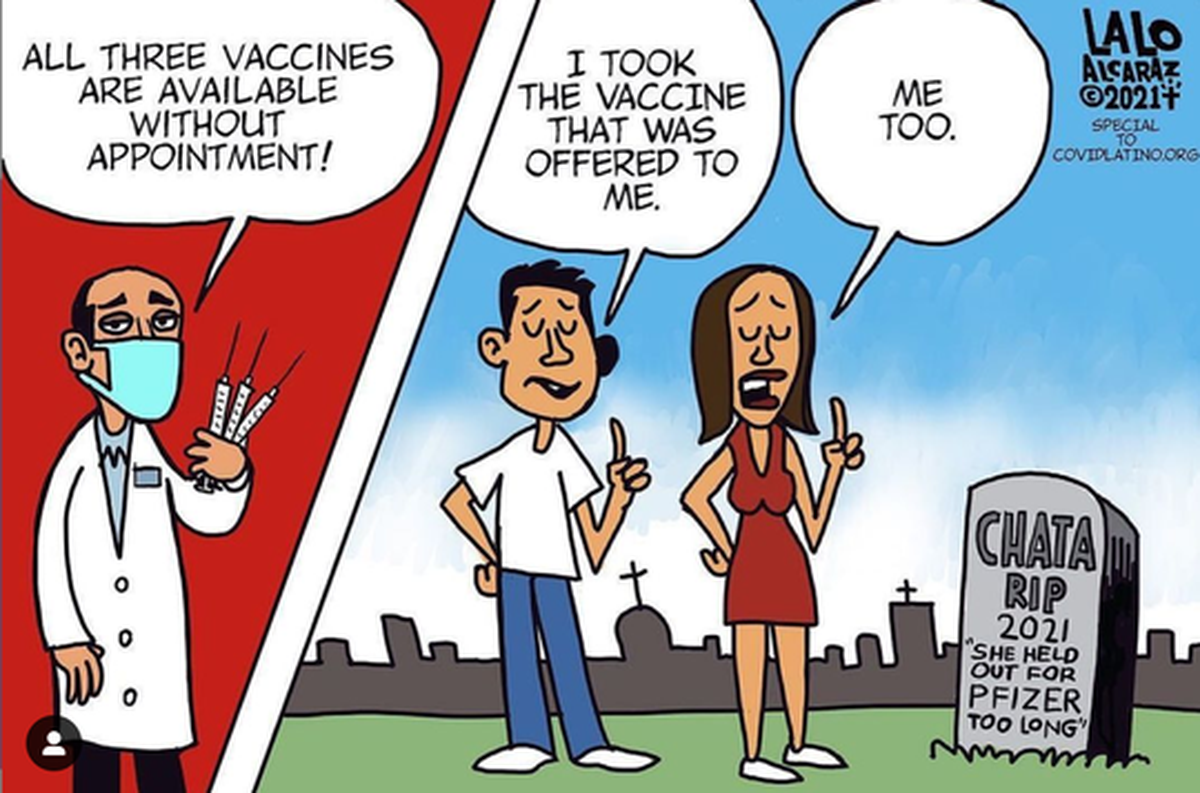
Alcaraz initially struggled to understand why so many of his Latino friends, relatives and neighbors believed conspiracy theories and held widely disputed beliefs about the safety of the COVID-19 vaccine. But he soon recognized how widespread the problem was and how quickly misinformation was spreading within the community. He decided he had to step up and use his platform to fight it.
“I had no idea prior really to teaming up with Dr. Lopez, how bad misinformation (is spreading) in certain smaller communities, like among campesinos or in the Central Valley,” he said. “I had to come out against that because it really affects our community.”
Lopez created the COVID Latino project due to his anger and frustration over COVID-19 misinformation that was spreading within the small, rural farmworker communities in parts of the Southwest. The campaign has primarily focused on reaching out to those communities in Arizona and the Central Valley, which have seen lower vaccination rates and higher cases and death rates than in more suburban and urban areas, he said.
He recruited Alcaraz to join his effort.
The two had first bonded over a bowl of “medicinal menudo” years ago, after Lopez took Alcaraz to a restaurant in Boston renowned for the Mexican beef tripe soup, Lopez said. Alcaraz, ever grateful that the meal helped revive him after suffering a hangover, was eager to team up with Lopez to use art and social media to help boost trust in the vaccine among Latinos.
Project promotes vaccination through art, storytelling
As part of the project, Lopez and his research team found that Latinos apprehensive about getting inoculated were more likely to believe certain myths about the vaccine, including that the government uses it as a tool to track immigrants or that it causes infertility.
Alcaraz tackles these unfounded beliefs with a cartoon featuring a Latino man asking a Latina woman if the vaccine causes infertility. The woman, whose dress is plastered with the word “vaccinated,’‘ is pregnant and surrounded by four young kids. With an unamused look on her face, she simply responds by saying “trust me, they don’t.”
.png "image (2).png")
Their intention, Lopez said, was to take some of the jargony, complex information that medical professionals and public health officials were using, and share it in a simple and easy way that the community could understand.
“Art is storytelling and it’s the best way to portray this unnecessarily complex information,” said Lopez.
The duo have focused the bulk of their efforts on sharing Alcaraz’s work on social media, including Facebook, Twitter, and Instagram, but they’re also partnering with local grassroots organizations like Cultiva la Salud to share his cartoons and animations. The two are hopeful they can continue the project and are seeking a grant to fund additional work countering misinformation, including new animations and short explainer videos.
“This collaboration was very natural because we both come from these communities and we’re very passionate about how to address these inequities,” Lopez said. “The status quo is not working, hasn’t been working, probably never worked for us -- so we’re challenging it. Now that we have more representation in research positions and institutions, you’re seeing us come up because we see the value in connecting to the community in a way that they understand.”
This story was originally published October 29, 2021 at 8:00 AM with the headline "COVID misinformation is rampant among California Latinos. One artist is fighting back."