He survived a stabbing to become Sacramento’s pot king. The story of the ‘Sactown Five’
On a spring evening in 2001, Garib Karapetyan, 17, was lying on the ground outside a Rancho Cordova auto parts store, bleeding from a large stab wound in his right leg after a brawl.
Two decades later, he’s the king of Sacramento’s $142 million-a-year legalized retail cannabis industry.
Karapetyan is the quiet leader of the city’s largest marijuana empire, wealthy enough to purchase a $1.1 million condominium in the Sawyer Hotel near Golden 1 Center. He is a part owner of eight Sacramento storefront pot dispensaries, and his four main business partners control a ninth.
Together they operate nearly one-third of the 30 retail dispensaries allowed by the city, giving them a commanding presence in Sacramento’s legal marijuana industry. They’ve managed to thrive despite fierce competition from both legal and illegal pot vendors, the illegality of marijuana under federal law, and a thicket of city and state regulations.
The 36-year-old Karapetyan also holds the permit for a manufacturing business in Sacramento and has applied for permits for at least four cultivation facilities here, according to city officials. He and his partners have been the main drivers behind a Sacramento pot industry association whose advisory committee includes the head of the Sacramento Metropolitan Chamber of Commerce.
The past few weeks, though, have brought Karapetyan and his four main partners, all of them residents of the Sacramento area, a flurry of unwanted publicity.
The Sacramento Bee revealed that a partner in one of Karapetyan’s Sacramento pot dispensaries is Andrey Kukushkin, a Ukrainian-born businessman who has been charged — along with three men, including two associates of President Donald Trump’s lawyer Rudy Giuliani — in an illegal campaign finance scheme.
Prosecutors said the four men secretly funneled foreign campaign donations to American politicians as part of a plan to jump into the cannabis business in the United States. Giuliani’s two associates, meanwhile, have been linked to the impeachment case against Trump.
State records show Karapetyan and Kukushkin also are partners in a management company. City records show the two men are working to open cultivation sites and a home-delivery cannabis company in Sacramento.
In addition, following The Bee’s reporting, city officials have begun reviewing policies that allowed Karapetyan and his partners to gain such a firm grip on the city’s retail pot industry, despite a city ordinance that prohibits dispensary permits from being transferred or sold.
Finally, the FBI is investigating whether city officials took bribes from Sacramento pot investors, although there are no allegations that Karapetyan or his partners have done anything wrong.
Karapetyan declined to be interviewed for this story, telling The Bee that its previous reporting on his dispensaries was “not very accurate.” He declined to say how so. He added, “I’ve been advised by counsel not to discuss anything with the media in the current environment.”
His four main partners – Joe Karapetyan, Gevorg Kadzhikyan, and Grach and Gayk Serobyan – also declined comment or couldn’t be reached by The Bee. It’s unclear whether the Karapetyans are related; the same is true for the Serobyans.
Brad Hirsch, a lawyer representing the five men, released a statement describing Garib Karapetyan as “a very hardworking businessman who has dedicated a great deal of his personal time to working closely with local communities and with cannabis regulators to assist in the governance of the emerging cannabis industry.
“There are always those who, out of curiosity or for other purposes, find reasons to question his success or who unduly focus on his ethnicity and personal life,” Hirsch added. “That is both unfortunate and unfair but, as a truthful and law-abiding person, those detractors do not concern him and do not deter him from his work.” (Karapetyan is a member of the region’s Armenian community and speaks with a mild Eastern European accent.)
As legalized recreational use of pot spreads across the United States, Karapetyan and his partners have begun looking for new frontiers to conquer. They launched a company in Nevada, where recreational use is also legal, although it’s unclear whether the company is active.
The five men originally called the Nevada company Sactown Five Inc. but changed it to Kolas Holdings Inc.
Kolas is the Karapetyan group’s brand — and the vehicle the men see as a path to success. While their Sacramento dispensaries have individual names, they’re marketed under the increasingly familiar Kolas logo: a purple flower. Kolas has sponsored the Aftershock music festival, the Wide Open Walls mural festival, and various Second Saturday events. Kolas billboards have sprung up around town.
Sometimes the Karapetyan group has gone overboard in its promotion efforts. The city canceled the group’s plans for a “Holiday Budtender Bash” in early 2018 because the party would have allowed public consumption of marijuana, in violation of city and state laws.
Still, Karapetyan is a huge believer in brands. He recently told America’s Cannabis Conversation, an online pot-industry radio show, that with proper branding “you can create your own Coors, you can create your own Pepsi.”
In an industry still laboring to establish itself as legit, name recognition makes a lot of sense. “You always want to build consumer confidence, and that starts with having a brand you can respect,” said Josh Drayton, communications director at the California Cannabis Industry Association.
Branding has brought a few legal headaches. In 2014 tobacco giant Philip Morris USA filed a complaint against Karapetyan with the World Intellectual Property Organization after he registered an internet domain name called marijuanamarlboros.com. Philip Morris said Karapetyan was trying to dupe consumers into thinking the brand was affiliated with the real Marlboro brand. A hearing officer said Karapetyan had acted “in bad faith” and ordered him to surrender the name.
In a sense, Karapetyan has also re-branded himself. In the radio interview, in conversations with other dispensary owners, in an appearance years ago before the City Council, and in a brief telephone conversation with The Sacramento Bee, he referred to himself as Justin.
Life before cannabis
One night while he was 17 and living in Rancho Cordova, Karapetyan met up at a now-closed Kragen Auto Parts store in Rancho Cordova with a man named Yegiazar Karapetyan, according to court records. The two had been feuding, and when they arrived, more than a dozen people were there.
A fight ensued. Yegiazar and his brother Daniel attacked Garib, court records said.
“Garib fell to the ground and the men kicked and punched him for approximately five minutes,” according to the records. “During the beating, Garib was stabbed in the leg.” It’s unclear from court records if Garib is related to his alleged attackers.
While being treated at UC Davis Medical Center, Garib told a police officer the fight was over “cultural differences you wouldn’t understand,” according to the records.
The incident might have been overlooked if not for another stabbing in the Sacramento area two years later, this one fatal. A fight at an auto auction left a man named Andrey Tsurkanu dead. Yegiazar and Daniel Karapetyan fled the country and their father was convicted of second-degree murder.
Court records show Garib was scheduled to testify at the murder trial Sept. 14, 2004, but failed to appear. A Sacramento Superior Court judge issued a warrant for his arrest. He showed up the next day, refused to explain why he skipped his earlier appearance but then gave his testimony. The judge withdrew the arrest warrant. The court records reviewed by The Bee don’t spell out what he said during his testimony.
Three years later, Garib Karapetyan was finding his footing as a business owner. At age 24, he signed the incorporation papers for a company called Hybrid Auto Parts in Rancho Cordova.
The business was taken over by Joe Karapetyan and sometime in the late 2000s, Garib started to move into the medical marijuana business. Speaking in early October to “America’s Cannabis Conversation,” the online radio show, he said he was drawn to the industry through a “very euphoric and exciting opportunity that was presented to me through some amazing, Godly event.” He didn’t say what that event was.
Medical marijuana, in which patients get prescriptions for cannabis, had been legal in California since the mid-1990s but was still struggling to establish its legitimacy. Pot was, and still is, illegal in the eyes of the federal government, and raids of the early nonprofit pot “collectives” by law enforcement were common.
“There was so much uncertainty, from a local level to a federal level,” he told the radio show. “Even with family, you were frowned upon. At the time you were still looked upon as a drug dealer.” California voters approved recreational marijuana use in 2016; the vote took effect in January 2018.
Karapetyan persevered through the tough early years in part because of personal loss. His grandmother died of diabetes, and he was convinced she would have benefited from marijuana if a doctor had prescribed it. “I knew that if my grandmother was to obtain any cannabis products it would have helped her with her blood pressure, with diabetes,” he said.
Entering Sacramento’s pot industry
In 2009, the city of Sacramento allowed medical marijuana businesses to come out of the shadows and register with the city. One of the first to sign up was Alternative Medical Center, just south of Arden Way. State records show it was incorporated by Joe Karapetyan.
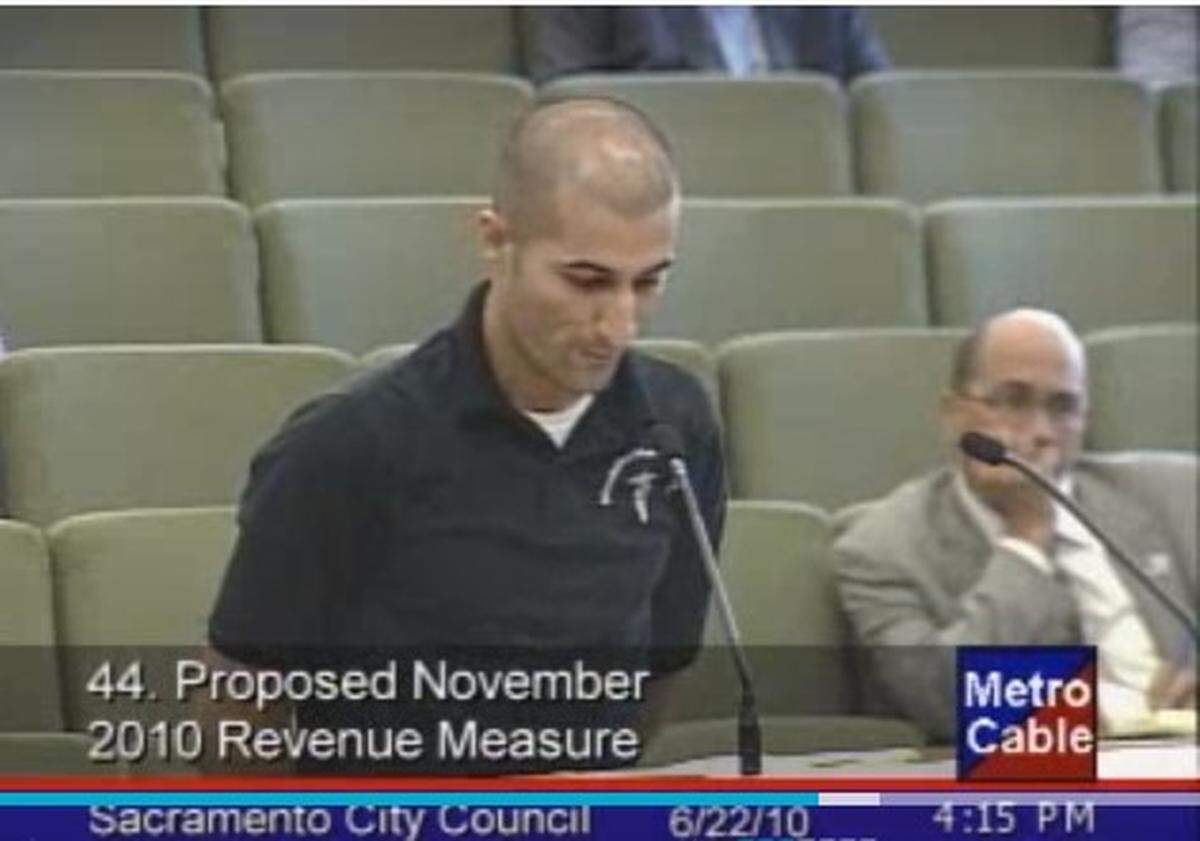
On the afternoon of June 22, 2010, Garib Karapetyan showed up at Sacramento City Hall. The City Council was debating whether to place on the ballot a measure to tax Sacramento’s pot industry. Most of the speakers were medical marijuana patients urging the council not to go ahead; some said the tax would drive the industry back underground.
Garib Karapetyan, though, had a different take. Representing Alternative Medical Center and referring to himself as Justin, he said he wouldn’t oppose the tax measure.
“We’re very much open to it,” he said, sporting a buzz cut and a black polo shirt. “We’re very much open to working with you to find a solution.” He added that Alternative Medical was dedicated to being a good neighbor.

“We’re working very hard on improving our neighborhood as well as our brick and mortar establishment,” he said. “We have a clear focus on advancing public safety.”
For some in the industry, the transition from an underground business to legalized pot hasn’t always gone smoothly. Several pot entrepreneurs have been busted over the years. One of Karapetyan’s partners, Gevorg Kadzhikyan, was arrested in April 2015 on felony pot charges after police raided his home in Citrus Heights and the Cloud 9 dispensary on Florin Perkins Road in Sacramento — one of the dispensaries now under the Kolas umbrella.
Police also seized $63,657, including $31,000 from the dispensary and nearly $24,000 and a BMW from his home. The district attorney’s office said the money apparently “was earned by narcotic trafficking.”
The arrest triggered years of legal arguments over the confusing legal status of pot dispensaries in California. The district attorney said Cloud 9 was making a profit, in violation of state laws governing medical marijuana dispensaries at the time. Kadzhikyan’s lawyers said state law didn’t forbid a dispensary from making a profit.
The criminal case was dismissed in August 2017, a year after voters approved Proposition 64 and legalized recreational marijuana. But Kadzhikyan dropped his fight to recover the money, court records show.
Gradually the empire led by Karapetyan grew. He and his four main partners added dispensaries while their original owners faded from the scene, in spite of city ordinances that prohibited the selling or transferring of permits. The laws were designed to keep one group from accumulating multiple dispensaries.
One former owner, Matthew Davies, has accused Karapetyan in a lawsuit of “stealing” his dispensary while he, Davies, was in prison on charges of conspiracy, manufacturing and dispensing marijuana. Karapetyan, in court papers, has denied the allegations. It’s the same dispensary, Twelve Hour Care, or THC, that Karapetyan co-owns with Kukushkin, the businessman under indictment in the campaign finance scheme.
Hirsch, the lawyer for Karapetyan and the four main partners, said Karapetyan wants to help struggling cannabis businesses.
“His involvement in the legal cannabis business began as part of his effort to help rescue failing businesses by devoting his time and money to turn things around,” Hirsch said. “Over time, by being open and by fully complying with regulations, he has achieved success.”
Competitor Tina Childs, who owns an independent dispensary in Sacramento, said she’s known Karapetyan for years and “I have nothing bad to say about him.”
Karapetyan “has always been supportive of the other clubs,” said Childs, who refers to him by his nickname Justin. “His intent always is to have this be a respectable industry.”
Karapetyan’s group has reached out to prominent business leaders in the city. In 2016 the group’s consulting firm, Capitol Compliance Management, named Matt Haines, general manager of the SRO Inc. restaurant chain (33rd Street Bistro, Suzie Burger and others), as its chief operating officer. Haines couldn’t be reached for comment.
Despite his success, Karapetyan has had his stumbles. He and his main business partners in Sacramento, along with the dispensaries they control, have been served with multiple liens for unpaid taxes in recent years. The IRS filed a $1.25 million lien against Karapetyan last year, although he paid off the lien a few months later. Hirsch said Karapetyan “filed his returns without any action or notifications from the taxing authorities.”
Industry insiders say tax problems are pervasive across the cannabis landscape, partly because most banks won’t do business with pot entrepreneurs and they’re forced to deal solely in cash. The same illegality also prohibits them from making typical business deductions on their taxes.
A player in Sacramento politics
Karapetyan and his partners have also become political players, to a degree. Lanette Davies, owner of a closed dispensary, said she’s seen Karapetyan at City Council meetings and community roundtable events hosted by Kevin McCarty, a former councilman who’s now a state assemblyman.
“I would describe him as very business-savvy,” said Davies, who isn’t related to the man who’s accused Karapetyan of stealing his dispensary. “He has a nice way of talking to people; he’s very personable.”
In recent years Karapetyan and his partners have showered political candidates with donations: $14,150 to McCarty; $5,000 to Mayor Darrell Steinberg; $5,000 to City Councilman Jay Schenirer and another $11,000 to Schenirer’s failed ballot measure that would have imposed a special tax on pot cultivation; and other candidates.
Most of the political figures have told The Bee they’ve returned the campaign contributions or donated them to charity. Steinberg, who has led the call for investigating the city’s pot industry, said through his spokeswoman that he doesn’t know Karapetyan.
The Kolas group has stepped out in other ways. Last year Karapetyan and his partners helped launch the Sacramento Cannabis Industry Association.
Its motto: “Uniting and Empowering Sacramento’s Cannabis Industry.” Its executive director, attorney Robert Baca, says the association’s role is to give the industry “a unified voice” on critical issues. He said it’s also made charitable donations, with beneficiaries including the Downtown Streets Team, which helps homeless people who volunteer to pick up trash around the city.
Critics, though, say the cannabis association is really a front, designed to only help Karapetyan and his partners’ businesses.
Mathew Pasqual, owner of a Sacramento cannabis delivery business, said he was turned down when he applied for membership in the association last year. The association changed its mind recently and asked him to join, but he decided against it.
“They really represent just nine dispensaries under the guise of ‘we are an association,’ ” Pasqual said. “They really are just the voice of cannabis in Sacramento right now. None of us own nine clubs, none of us have an association.”
The only Sacramento dispensaries that belong to the association are the nine Kolas shops. Besides running the association, Baca works for Capitol Compliance Management — a consulting firm led by Karapetyan that helps cannabis businesses deal with regulatory issues.
Baca acknowledged the Kolas group led the formation of the association. But he said the association is trying to reach out to others. The 33 members listed on the association’s website include non-Kolas companies, such as a maker of cannabis products for pets, several Sacramento security companies and Northern California pot growers.
The group’s advisory committee includes officials from the Metro Chamber of Commerce and several ethnic chambers of commerce. The Sacramento Asian-Pacific Chamber, using city money, hired the association to teach classes to participants in a city program designed to provide job opportunities to residents of neighborhoods that had been disproportionately targeted by the police when pot was still illegal.
Frank Louie, COO of the Sacramento Asian-Pacific Chamber and an association advisory committee member, said the classes did not steer participants toward working in Kolas dispensaries.
“This has nothing to do with Kolas at all,” Louie said. “It has to do with broad training to allow them to pursue jobs or opportunities anywhere in the city of Sacramento.”
Legal marijuana struggling in California
To hear Karapetyan tell it, success has been a bittersweet experience. He told the “Cannabis Conversation” interviewer that he’s reluctant to boast about his achievements because it makes him a “bigger target.” He remains anxious about the federal government’s continued anti-pot stance.
“That fear is still here. At the end of the day, when you think about it, we’re still a Schedule I narcotic,” he said, referring to the U.S. Drug Enforcement Administration’s designation for marijuana, which lists it in the same category as LSD and heroin.
BEHIND THE STORY
MOREWhy we did this story
Three years ago, California transformed a once-criminal enterprise, the sale and cultivation of marijuana, into a legal, regulated industry.
In Sacramento, that means city officials under the Office of Cannabis Management, have the responsibility to permit and monitor the 30 storefront shops allowed to operate here. This is a $142 million industry that has already had a huge impact on the city. The Sacramento Bee wanted to find out how these shops are regulated, and who is behind them.
The story took on new meaning when four men were indicted for allegedly funneling foreign money into U.S. campaigns and attempting to secure cannabis licenses in Nevada and “other States,” as the indictment said. It turned out, one of the men who was indicted was a Ukrainian-born businessman named Andrey Kukushkin who was co-owner of a pot dispensary in Sacramento.
Read more by clicking the arrow in the upper right.
How we did this story
Our stories in this series are the result of several weeks of reporting by Bee staff, numerous public records requests and interviews with regulators and people associated with the cannabis industry.
We first began this series after hearing from sources that the City of Sacramento’s licensing system for pot dispensaries was only loosely regulated and effectively shut out people who were trying to obtain a permit to operate a storefront shop in the city.
The first and hardest task was dislodging the permit and ownership records from the city. That required multiple requests under the California Public Records Act and frequent negotiation and prodding. Once we obtained most of the records, we got a clearer picture of how ownership is transferred in Sacramento.
We scoured other public records as well, including state business documents, federal records, tax forms and court filings, and interviewed sources throughout the city. Those sources include current and former city officials, attorneys, cannabis dispensary owners, and many others connected to the industry. We also visited several of the storefront shops to obtain public business records, but in a few cases we were turned away by employees.
Support local journalism like this
Your subscription to The Bee makes investigations like this possible.
Please encourage others to support local journalism with a digital subscription at this link.
The Sacramento Bee is here for you, and because of you. We’re grateful for your support.
Owning a pot shop would seem to be a lucrative business. Based on the taxes they paid to the city, Sacramento’s cannabis storefront retailers generated $142 million in sales during the most recent fiscal year.
Nonetheless, these aren’t heady days for the legal marijuana industry. In May the California Department of Finance slashed its projections for excise tax revenue from cannabis businesses around the state by $70 million for the current fiscal year. That was a drop of nearly 14 percent.
What’s gone wrong? Industry experts said competition from black-market pot dealers remains fierce, a problem that’s been exacerbated by federal tax policy.
Because the drug is still illegal from the standpoint of the federal government, the IRS won’t let legal marijuana companies deduct their business expenses. That’s bloated the industry’s cost structure, which inflates prices at the retail level.
Drayton, from the California industry association, said the cost problems are tougher on retail dispensaries “than other parts of the supply chain.” Compared to plant growers and cultivators, the retailers generally have higher costs for rent, labor and other expenses — all of which they’re forbidden to deduct from their federal taxes.
“That cost differential drives a lot of these consumers into the illicit market,” Drayton said. “It’s kind of a perfect storm of issues.”
The tough market conditions have also made people like Karapetyan and his partners — homegrown entrepreneurs who were around before recreational use was legal — increasingly rare.
“The pioneers that got this industry off the ground are not the ones running it,” Drayton said. “We’re seeing an influx of tech folks, attorneys and corporations.” In February, for example, a Canadian cannabis firm called Vibe BioScience paid $2.8 million for a Sacramento dispensary, one of several Northern California pot businesses it purchased this year.
In the online radio interview, Karapetyan said struggles in retailing prompted him to diversify into marijuana production and cultivation. The Kolas website promotes Kolas-branded marijuana, edible cannabis and other products.
He added that diversification was a lesson he’s learned the hard way. In the late 2000s, he told the radio interviewer, he was working with his father in the garment business, selling leather goods mainly to motorcycle clubs and their members.
The recession clobbered the business. “I saw that industry in 2008, 2007, literally get decimated over a six-month to 12-month course,” he said.
“I realized there was a uniqueness to being diversified,” he added. “Our motto for our business that we live by is ‘vertically integrated and horizontally diversified.’”
The Kukushkin partnership
When it comes to business partners, Karapetyan rarely strays outside the orbit that includes Joe Karapetyan, Gevorg Kadzhikyan, and the two Serobyan men.
In early 2017, however, he took on a new partner in a company called Sharp Source, the corporation that owns a pot dispensary on Fruitridge Road called Twelve Hour Care, or THC. That’s the same dispensary that Karapetyan has been accused in a lawsuit of stealing from former owner Matt Davies.
The new partner’s name: Andrey Kukushkin, the Ukrainian-born businessman who was indicted in October in the campaign-finance scheme linked to the Giuliani associates.
State and city records reveal other connections between Karapetyan and Kukushkin, who lives in San Francisco and has pleaded innocent to the indictment. The two are partners in a business called Next Phase Holdings LLC, which is attempting to open a home-delivery pot business from a building a few doors away from their THC dispensary on Fruitridge.
They are working to open pot-cultivation sites in Sacramento and have been partners in two management companies: KKMC Management LLC, based in San Francisco, and Legacy Botanical Company LLC of Sacramento. Only KKMC is still active, according to state records.
Kukushkin and Karapetyan have had a third partner in the two management companies: a Russian-born businessman named Andrey Muraviev.
Muraviev, whose last name is sometimes spelled Muravyev, founded a cement company in Siberia and has been a major shareholder in Qiwi, an online payment business that’s been described as Russia’s PayPal.
How Karapetyan’s world collided with Kukushkin and Muraviev is unknown. Karapetyan’s lawyer, Hirsch, told The Bee in October, soon after Kukushkin was indicted, that he wanted Karapetyan and the other Sacramento businessmen “to formally disassociate” themselves from Kukushkin.
So far, there’s no public record showing they’ve followed his advice.
This story was originally published December 26, 2019 at 5:10 AM with the headline "He survived a stabbing to become Sacramento’s pot king. The story of the ‘Sactown Five’."