Valley bioindustry startups pitch ideas in ‘Shark Tank’ style. Melon rind candy?
Six entrepreneurs took turns showing how to cash in on the abundant waste from Central Valley food processing.
They gathered near French Camp on Thursday, May 22, for a conference hosted by BEAM Circular, based in Modesto. It aims to create tens of thousands of jobs in making fuel, building materials and other goods from grape skins, nut shells, cattle manure and the like..
The speakers had been selected in February for the BEAM Circular Accelerator. Each received a $30,000 state grant and a chance at up to $100,000 from venture capitalists involved in the cause. They also got mentorship and access to office and lab space over three months.
Thursday, they made live pitches in the style of the “Shark Tank” television show. Each took about five minutes to explain the product and the market it would serve. There was no judging, but the presenters did get to mingle with experts in agriculture, manufacturing and finance.
Two of the presenters were from Turlock: Dion Skaria touted his candy based on watermelon rinds. Edgar Perez has an eco-friendly herbicide derived from almond hulls.
Others were from Sacramento, Davis, Berkeley and Tennessee. Two of them produce sustainable fuels, among other goods. Another offers lab-grown caviar and other delicacies. The last breaks down cellulose in rice stalks and other plants to make plastics.
The BEAM Circular Accelerator is a tiny part of the region’s bioindustry push, which has about $25 million in public and private funding to date. The largest portion will be a site where promising technologies can be tested on a large scale. The effort also supports small businesses in general, including home-based child care and job training.
Melon rinds are ‘an undiscovered superfood’
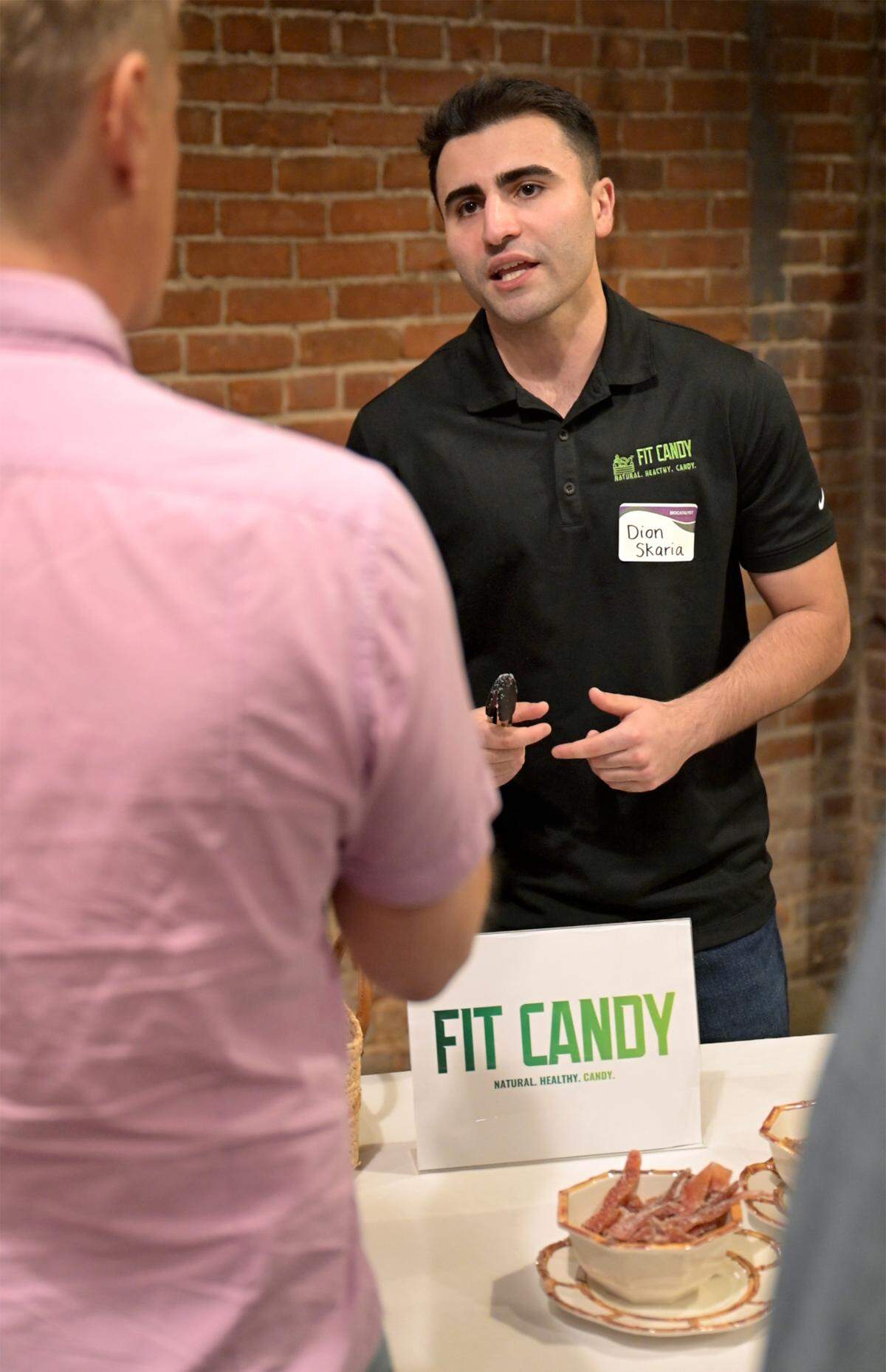
Skaria, a recent college graduate, calls his company Fit Candy. He softens and sweetens the melon rinds, using a sugar substitute called allulose. One of the two product lines has strawberry blended with the melon flavor. The other adds a peach-mango mix.
Skaria does only online sales for now, at $3.99 per package. He hopes to sell them soon at Mango Crazy, which is already a source for the rinds. The Modesto-based chain offers fruit cups and other sweet and savory fare at 10 shops in the Valley and another in San Jose.
“Watermelon rinds are an undiscovered superfood,” Skaria told the audience. “They’re packed with nutrients like fiber and antioxidants. They’re also upcycled, making them cheap for us to source, and help reduce food waste in our local communities.”
Skaria earned a bachelor’s degree in food safety last year from the University of California, Davis. He is already the food safety manager at the Frito-Lay plant in Modesto. Fit Candy is a sideline for now, run out of his parents’ home under a county permit for “cottage food” ventures.
Another presenter from Turlock
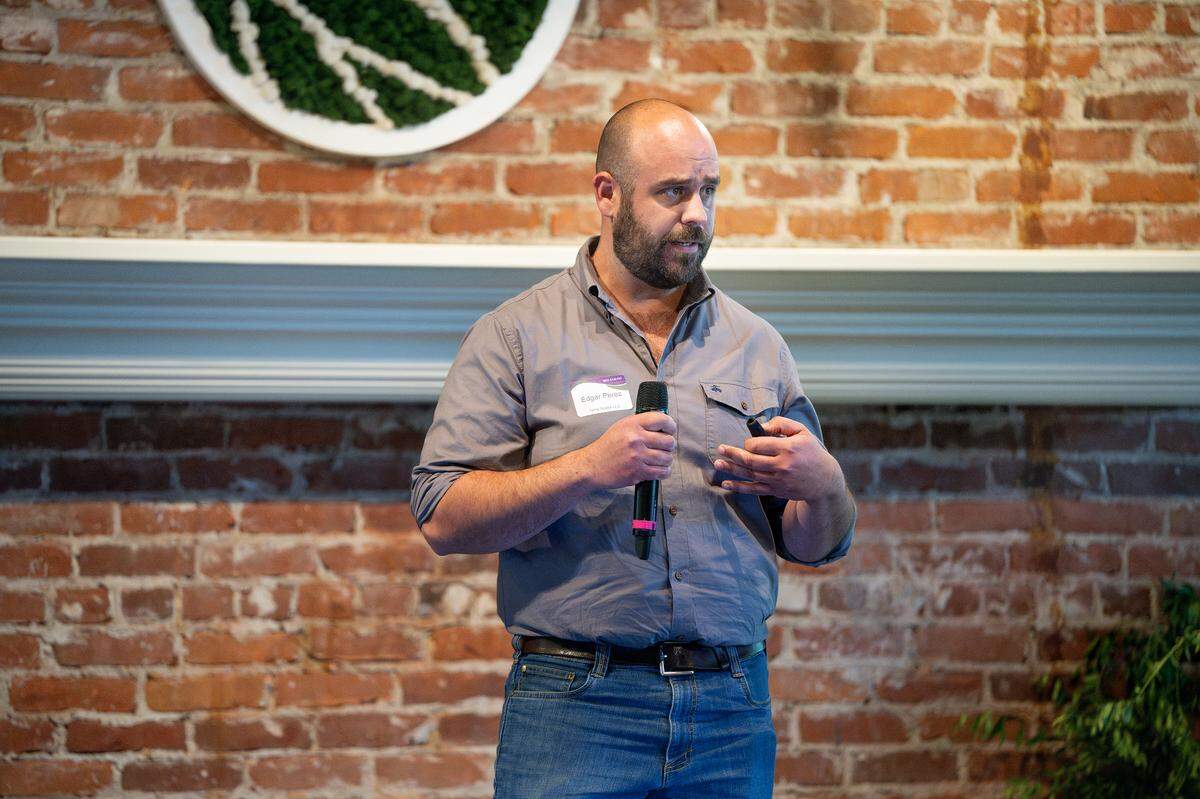
Perez still is doing field trials for his herbicide derived from almond hulls. Hulls surround the shell and are widely used as a dairy feed, at prices far below what the kernels bring to farmers.
Perez calls his company Terra Rossa and its initial product Blanco Max. He said it is not toxic like chemical herbicides and will cost much less to bring to market. He added that chemical sprays tend to become ineffective as weeds evolve to resist them.
“Our mission is to revolutionize novel herbicide products by harnessing Mother Nature’s natural ingredients,” Perez said on the stage.
This is among many possible byproducts of almonds, one of the state’s top crops. The conference was put on with help from the Almond Board of California, based in Modesto. It also promotes tilling of chipped-up limbs into the soil when orchards are retired. This material used to be burned in the open, adding to local pollution and global warming.
‘No-kill caviar’ and more from Davis
Details on the other four presenters:
- Chief Product Officer Thomas Hart delivered the pitch for Optimized Foods, based in Davis. It uses fungi to break down various food wastes that in turn nourish new products. One is a cocoa-like item much cheaper than the original. Another is a “no-kill caviar,” from eggs grown in a lab rather than extracted from sturgeon in overfished regions.
- Founder and CEO Danielle Pascoli described the work of Verde Nanomaterials of Sacramento. The company extracts cellulose fibers from numerous sources, including grain stalks and invasive plants. They could supplant petroleum-based plastics in packaging, car bodies and more.
- CEO Abhijeet Borole presented for Electro-Active Technologies, based in Knoxville but working in California. It uses modular units to turn various food wastes into hydrogen fuel and fertilizer. One of the tests involves grape-crushing residue from a Madera plant owned by E.&J. Gallo Winery of Modesto. Most hydrogen production is not considered sustainable because the process involves petroleum. Biomass and other renewable sources can change that.
- Berkeley is the home to another startup, Oleo Sustainable Palm Oil Solutions. Co-CEOs Kelly Redmond and Gabriella Dweck told how they decompose various food wastes to make oils for use in food and jet fuel. They said this would reduce the need for palm plantations that have replaced tropical rainforests.
Some bioindustry is well under way
Bioindustry is happening at companies well beyond the startup stage. The most prominent is Aemetis Inc., which has made ethanol from Midwestern corn in Keyes since 2011. The site now also supplies PG&E with gas from dairy manure. The company has approval in Riverbank to make truck and jet fuel from woody waste, used cooking oils and animal fats.
Aemetis is an adviser to BEAM Circular. The acronym stands for BioEconomy Agriculture and Manufacturing. It grew out of the 2022 release of the Stanislaus 2030 report, which aimed for 40,000 well-paying jobs here and in Merced and San Joaquin counties.
The main funding so far is $10 million from the federal aid that helped Stanislaus County government weather the COVID-19 pandemic. About the same amount has come from businesses and philanthropists. The National Science Foundation granted $1 million. An additional $3.6 million is from the CA Jobs First program, including the Accelerator.
Thursday’s gathering took place at the River Mill, built in 1873 along the San Joaquin River. It began by processing chicory root, a coffee substitute, and today is an event center.
The competition drew 102 applicants, 51 of them getting interviews before the six were selected. BEAM Circular had help from gener8tor, an investment network based in Madison, Wisconsin, and from Monterey-based HawkTower.
BEAM Circular has other grants for businesses, schools and workforce training programs. More information is at www.beamcircular.org.