New jobless numbers are out, and here’s what’s ahead for Stanislaus County residents
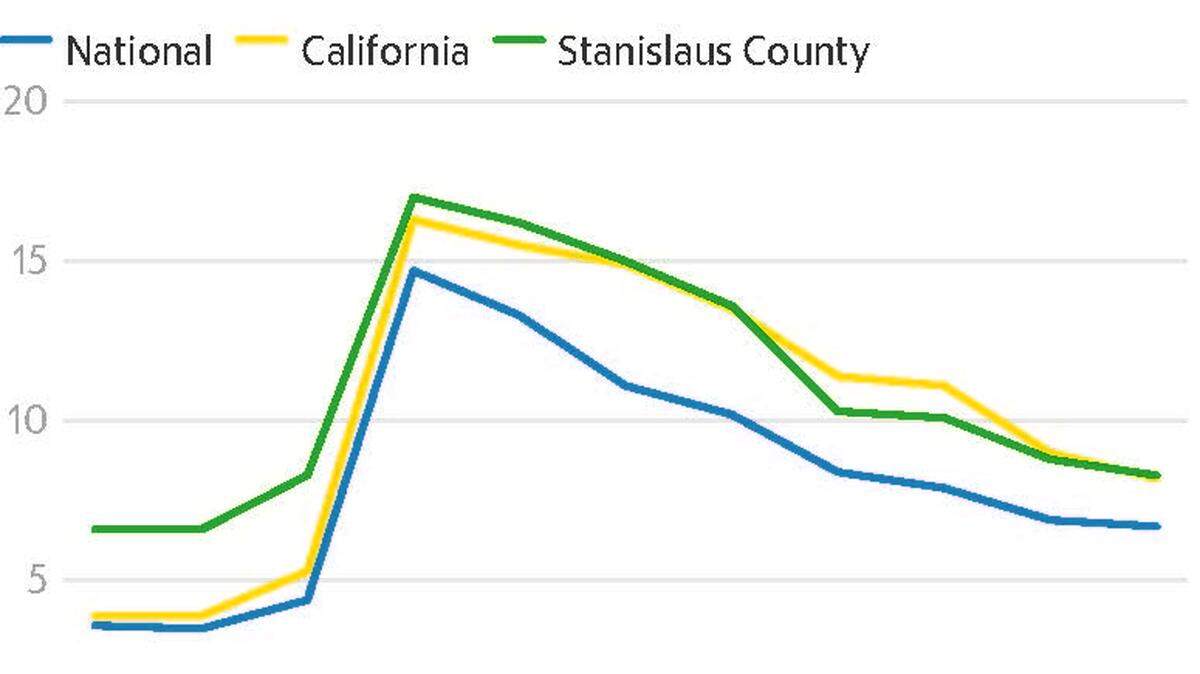
Unemployment numbers in Stanislaus County dropped to 8.3% in November, marking another month of decrease since the COVID-19 pandemic hit.
But due to the nature of month-by-month unemployment data, economist Jeff Michael, the director of the Center for Business and Policy Research at the University of the Pacific, warns that what looks like steady recovery may in reality be masking a “stall.”
“Usually unemployment starts to pick back up in the Modesto area for seasonal factors, as the (agriculture) sector starts winding down for the year,” Michael said. “This year, the unemployment rate has declined because we’ve seen people withdraw from the labor force in November at a faster rate than (there has been) employment, and so the unemployment rate is a very deceptive indicator at the moment.”
According to data from the state’s Employment Development Department, November’s unemployment rate is lower than October’s 8.8%, though it’s an unadjusted figure. California as a whole measured 8.2% unemployment that month, down from a previous rate of 9%. Nationally, data from the Bureau of Labor Statistics place the November unemployment rate at 6.7%, down from 6.9%.
Michael said the reason unemployment numbers are decreasing, despite a continued economic crisis, is partly in the nature of how this month-to-month data is gathered. Rather than rely on tax documents, monthly jobless numbers are survey-based, and thus don’t always accurately capture the state of the labor force.
A recent report from the Government Accountability Office revealed issues with unemployment data on a federal level, and California has been dealing with a massive backlog of unemployment claims. Fraud issues, backlogs and frustrated individuals making multiple filings in hopes their applications will be processed sooner all contribute to inaccurate data, Michael said.
“Particularly this early data that comes out at a local level, as always, should be taken with a grain of salt because the sample sizes are not as large as we would like,” he said. “There’s always a lot of uncertainty in this, and in these conditions, it’s even greater.”
As data continues to be refined and adjusted — and based on tax documents and payroll information rather than surveys — it becomes more accurate, giving economists a better picture of employment and spending trends.
An underlying stall
Because of this, Michael said, November’s surface-level recovery isn’t what it seems.
Consumer spending and employment growth have both flattened in the fall, and Michael warned of renewed declines in employment as December and January’s data roll in. January and February usually result in an increase in unemployment as seasonal hires are laid off, before the numbers fall again in the spring.
Additionally, Michael said, there’s been virtually no recovery in the two industries most hard-hit by the pandemic — hospitality and personnel services — which further speaks to the underlying reality of an economic stall.
Despite anticipating more recovery in the spring, Michael said one of the reasons the progress has been so slow is Congress’ lack of timely economic support. Following the passage of the roughly $2 trillion CARES Act in March — which provided financial help for individuals and businesses — Congress waited months before leaders in Washington reached an agreement on a second wide-ranging package on Sunday night.
The $900 billion stimulus bill, passed by Congress on Monday and sent to President Trump, will provide enhanced unemployment benefits, among other assistance. But Michael said it may be too little too late.
“Over the next few months, we’ll be fortunate if we can maintain the stall,” he said.
The recent roll-out of the Pfizer coronavirus vaccine, as well as the recent approval of another from Moderna, are cause for hope, Michael said, as well as increased public health guidance under the next administration.
As more and more people get inoculated, consumers will have more confidence in their safety and be willing to spend more money, leading to further economic growth.
“It’ll be an incremental process but the combination of the vaccine and the public health measures and the warming weather should all lead to some improvement as we head to the spring,” Michael said.
Though he anticipated a decline in the numbers in the coming months, Michael said no one should expect a drastic increase in unemployment like at the beginning of the pandemic.
Rather, the decline will be modest but stretch further into 2021, as the last stages of recovery begin to take shape.
“Increasingly, economically, it looks like there’s going to be some permanent and lasting scars to business and economic activity,” Michael said. “The last bits of the recovery can be pretty challenging and it can take quite a bit longer. It’s a real disappointment, what’s happened this fall and winter. But, having said that, expect very strong growth through the spring in the summer.”
This story was produced with financial support from the Stanislaus Community Foundation, along with the GroundTruth Project’s Report for America initiative. The Modesto Bee maintains full editorial control of this work.
To help fund The Bee’s economic development and children’s health reporters with Report for America, go to https://bit.ly/ModestoBeeRFA
This story was originally published December 21, 2020 at 5:00 AM.