How will turning waste into energy help military? Central Valley leaders find out
AI-generated summary reviewed by our newsroom.
- Commission links Central Valley waste-to-product projects to national defense.
- Caribou deploys portable systems to convert farm, forest and landfill waste.
- Panel recommends billions in federal investment to scale bioindustry jobs and tech.
Stanislaus and nearby counties have been working for a few years to turn their massive crop and livestock wastes into consumer goods.
The effort also could help defend the nation from foreign threats, experts said during a visit Wednesday.
They are on the National Security Commission on Emerging Biotechnology, created by Congress in 2022. It issued an April report calling for a $15 billion federal investment in energy, medicine and other sectors. The panel warned that China in particular could gain an unfair advantage in the marketplace and on the battlefield.
Two commissioners and their staff members spent the morning at UC Merced, hearing from researchers, farmers and students. They paid an afternoon visit to the VOLT Institute in Modesto, which teaches various manufacturing skills.
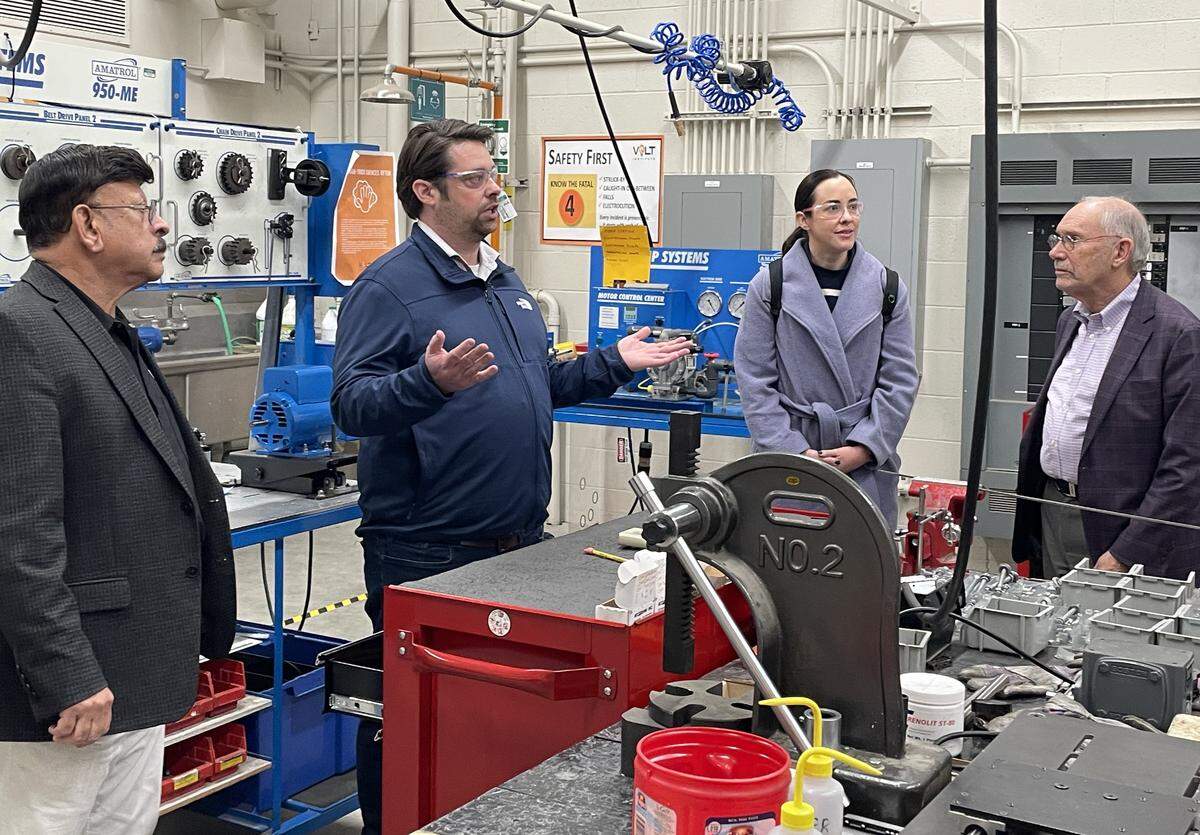
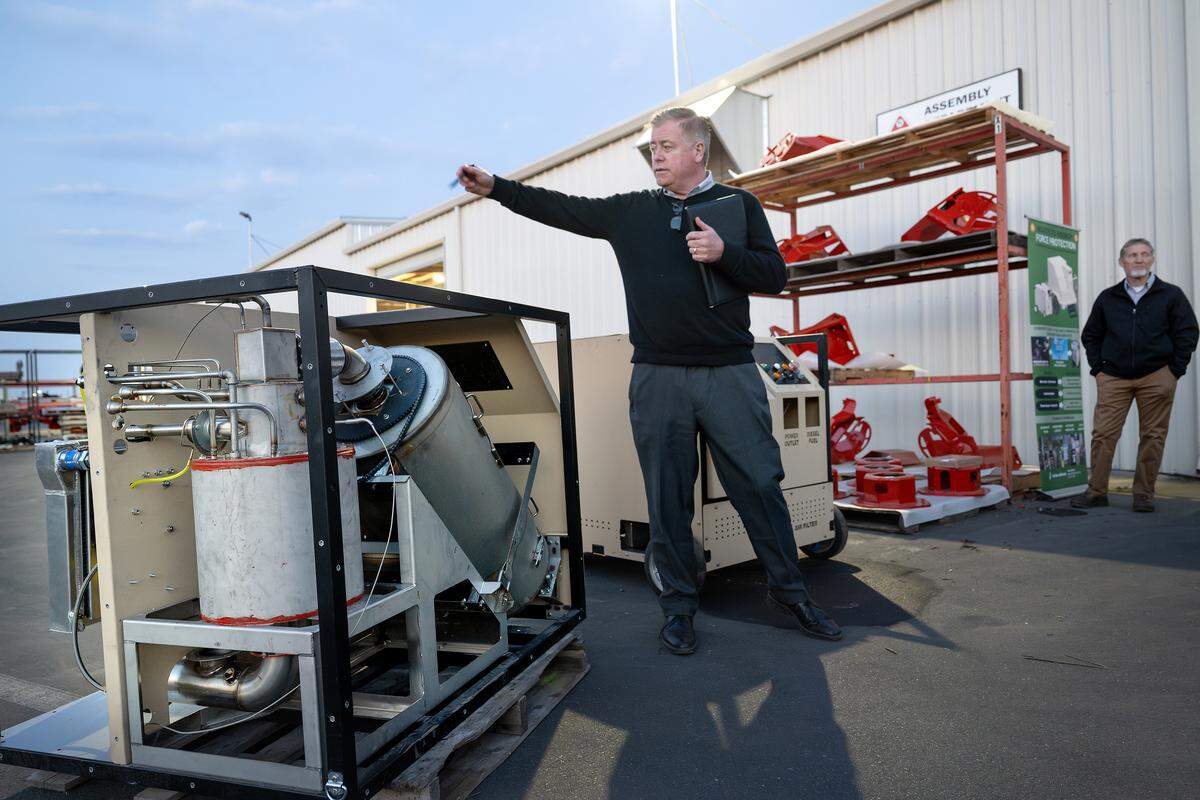
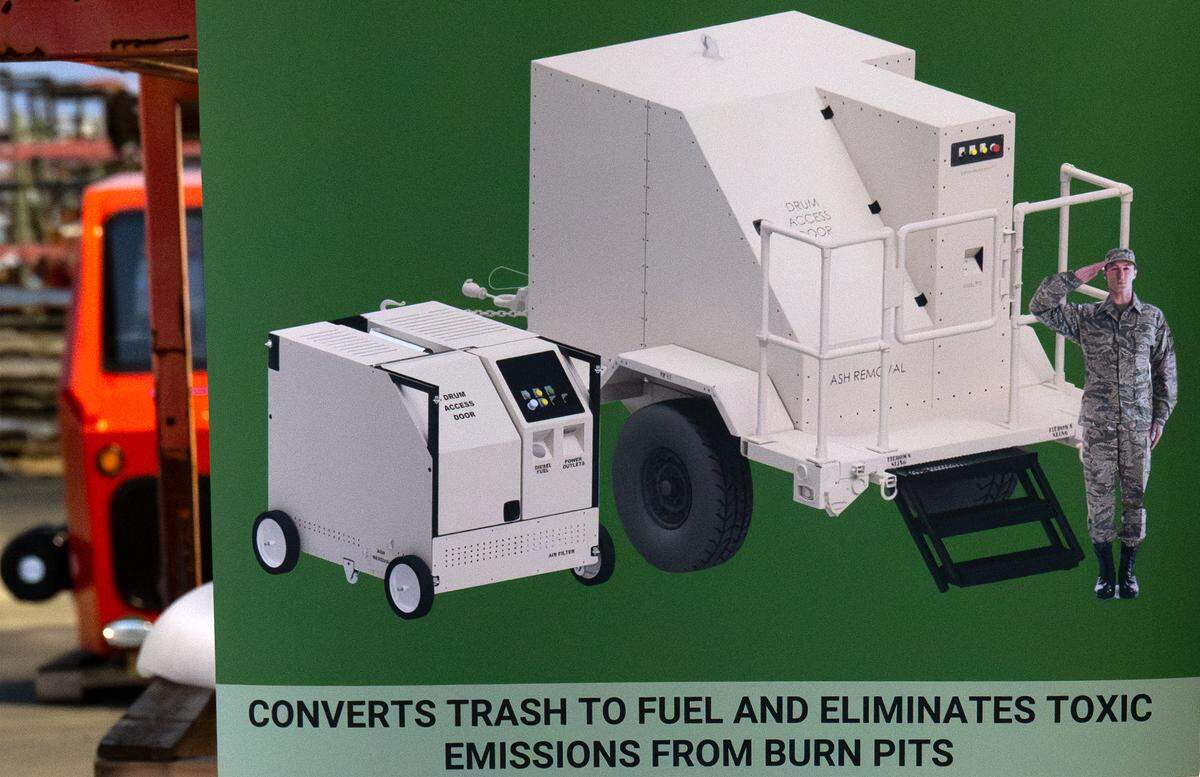
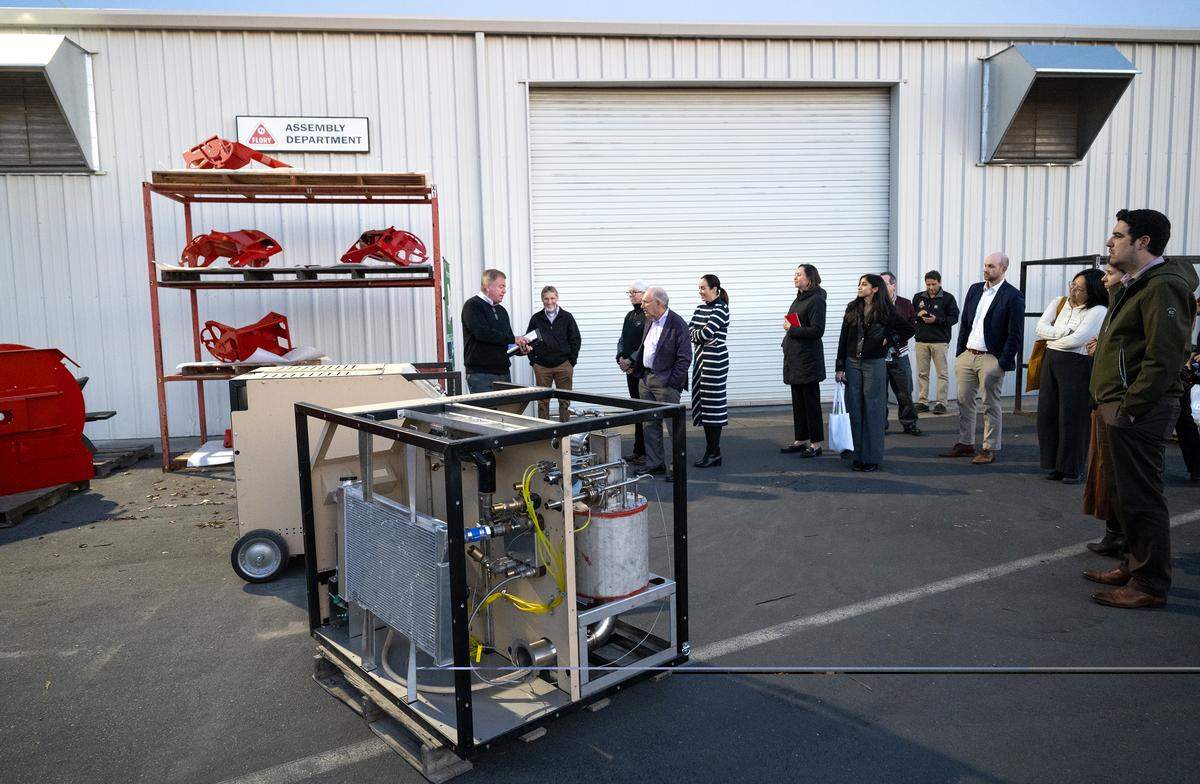
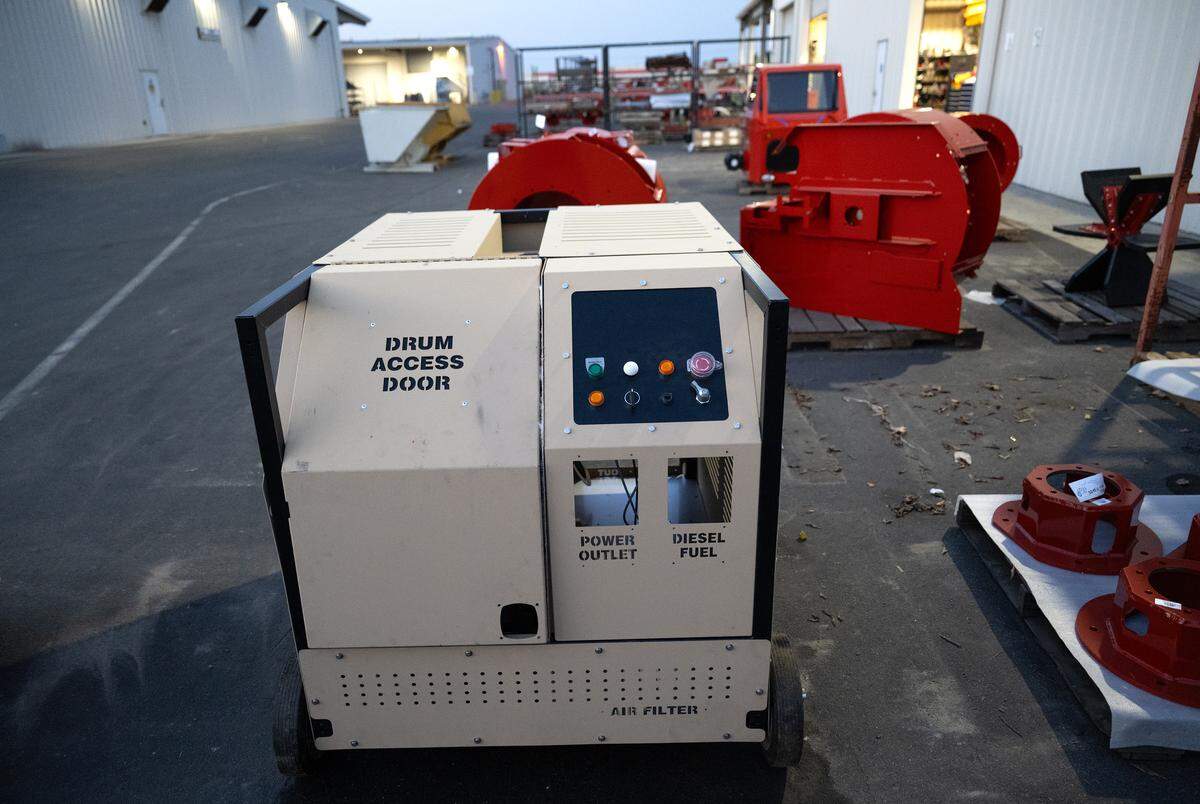
The tour ended at Caribou Biofuels in Salida, which uses portable machines to convert farm, forest and other waste. It also has a pilot project that helps the military safely turn trash into energy at remote bases. This avoids the notorious “burn pits” that sickened many troops in Iraq and Afghanistan.
Caribou employs 10 people so far on the grounds of Flory Industries, a longtime maker of nut-harvesting machines. Employment could reach 1,000, said Kieran Mitchell, the startup’s chief executive officer.
Caribou is working with Cal Fire to thin over-dense forests. It plans to use walnut shells in place of coal in activated-charcoal filters for air and water.
The commission’s vice chairwoman, Michelle Rozo, was impressed, “Biotech can help us create jobs that produce more with less, give more value to farmers,” she said at the Caribou stop.
Rozo earned a doctorate in molecular biology and has held leadership roles at the Department of Defense and the National Security Council.
The other commissioner on the tour was Dov Zakheim, who rose to undersecretary of defense and oversaw the Pentagon budget. He earned a doctorate in economics and politics.
“Today’s visit in Merced and Modesto made clear that California’s Central Valley is a critical contributor to our food security and biotechnology leadership, and therefore to our national security,” Zakheim said in a follow-up news release.
Four of the nine members are lawmakers. The senators are Alex Padilla, D-California, and Todd Young, R-Indiana. Reps. Ro Khanna, D-Fremont, and Stephanie Bice, R-Oklahoma, are also commissioners.
12th stop for Biotech Across America Roadshow
The visit was the 12th stop on the commission’s Biotech Across America Roadshow. It began in North Carolina in June.
The visit was organized by BEAM Circular, a Modesto-based nonprofit. It seeks tens of thousands of well-paying jobs in reusing waste from orchards, vineyards, forests and dairy farms. The effort takes in Stanislaus, Merced and San Joaquin counties.
The biggest piece will be a site where startups can bring their ideas close to commercial scale. The location and design could be announced in early 2026. The effort also involves home-based child care businesses, separate from BEAM Circular.
The VOLT Institute opened in downtown Modesto in 2016 to train mechanics, electricians and other workers for nearby companies. It recently added lessons on bioindustry, Executive Director Eric Neuenfeldt said on the tour.
Flory Industries had its own history of innovation before housing Caribou Biofuels. It began as a dairy farm in 1909 and claims to have had the first milking machine in Stanislaus County. Flory later helped develop the harvesting machines that have turned almonds and walnuts into major Central Valley crops. It employs about 350 people today, some at a Sutter County site it acquired in 2023.
Mitchell is a native of Ireland who got help on Caribou’s technology from the State University of New York. It can generate power from municipal landfills along with the farm and forest sources.
Caribou’s military contract involves small devices that can produce electricity from trash for far-flung soldiers. Mitchell said this could lessen the chances of enemy attacks on supply lines, as well as the effects of burn pits. The Veterans Administration estimates that about 3.5 million soldiers were exposed to the pits.
“They burned trash and got cancer,” Mitchell said. “... When you breathe in all these particulates, it gets into your lungs. It never leaves.”
A 2022 law directed $5 billion to care for affected veterans and research on burn pit alternatives.
What threats are on the horizon with biotech?
The commission report did not see an imminent threat of the United States being attacked with biological weapons. It did suggest that China might someday find a biotech cure for cancer— and keep it from other nations. It also warned that China already violates patents on biotech products invented elsewhere.
“First, they steal,” the report said. “Then, they scale. Once they have cornered the market, they strangle.”
BEAM stands for BioEconomy Agriculture & Manufacturing. Circular means capturing waste that otherwise could worsen climate change.
Other speakers on the tour included:
- UC Merced professors Victor Muñoz, Rebecca Ryals, Joel Spencer, Gerardo Diaz and Joshua Viers
- Alondra Robles, a Modesto Junior College student planning to be an environmental engineer
- Ripon High School student Jonathan Salinas, a youth ambassador for BEAM Circular
- Laurie Weiss, dean of MJC’s schools of Science, Engineering and Mathematics and of Business and Computing
- Keyes-area almond grower Christine Gemperle
- Turlock-area dairy farmer Lisandra Vitorino, who works for the California Dairy Campaign
- Kaitlin Mogentale of Divert Inc., which turns surplus food into energy and fertilizer in Turlock
- Roger Isom, leader of cotton and tree-nut industry groups
- Undersecretary Christine Birdsong at the California Department of Food and Agriculture
- Peter Ansel, director of state policy and advocacy at the California Farm Bureau Federation
- CEO Kate Gordon of California Forward, a statewide nonprofit working on sustainability
- Erick Serrato, executive director of North Valley Thrive and director of workforce development for Merced County.
This story was originally published December 5, 2025 at 10:32 AM.