
How big an impact do Amazon fulfillment centers have on a community? It depends.
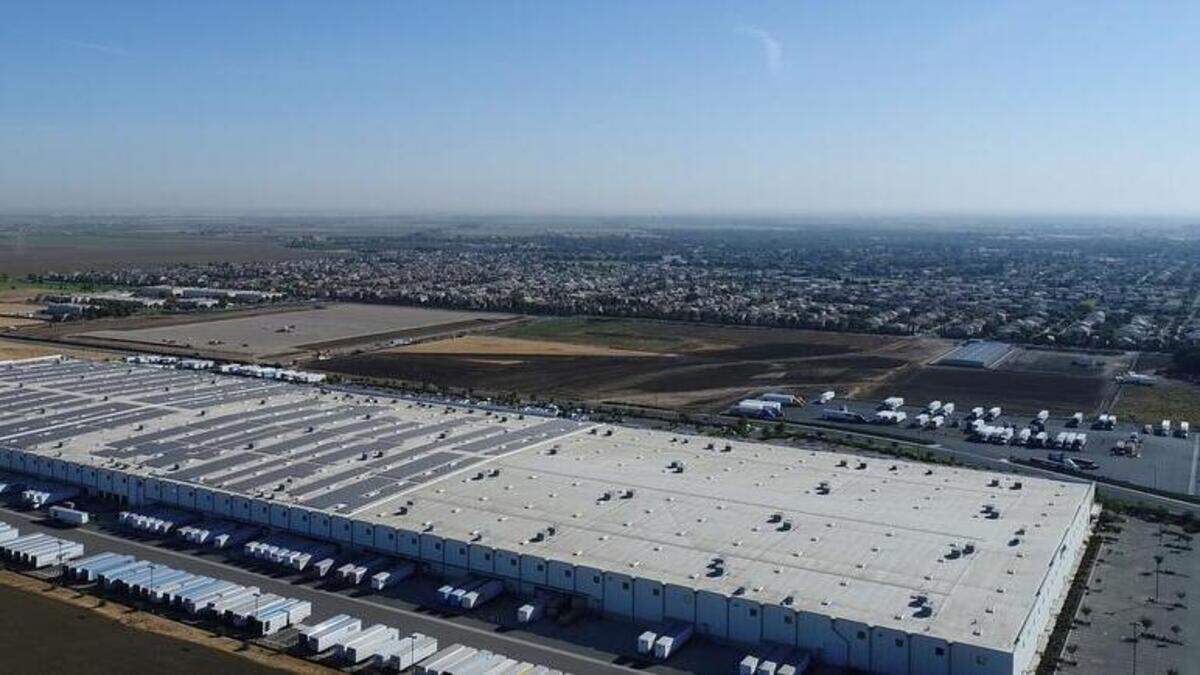
Amazon's new fulfillment center under construction in southwest Fresno will employ 1,500 workers when it opens this year. The company's decision last summer to locate the center in Fresno came only after the city affirmed a package of economic incentives that will be worth up to $30 million over the next 30 years.
The rebates the company will get on property and sales taxes are among the types of job-growing strategies used by communities across the country to entice Amazon and other companies. But the effectiveness of such incentives is being questioned by a Washington, D.C., think tank's economic analysis of the employment effects of Amazon's fulfillment centers.
In the Economic Policy Institute's report entitled "Unfulfilled Promises," EPI economist Ben Zipperer and economic analyst Janelle Jones concluded that on average, "Amazon's fulfillment centers are ineffective at providing net job growth."
"When Amazon opens a new fulfillment center, the host county gains roughly 30 percent more warehousing and storage jobs but no new net jobs overall, as the jobs created in warehousing and storage are likely offset by job losses in other industries," the report states.
Zipperer told The Fresno Bee that while Amazon certainly generates job growth within the warehousing industry sector when it opens one of its massive order-filling centers in a community, it does not appear to translate into employment gains across the entire local economy.
"It seems to be shifting the composition of employment in some places," Zipperer said. "You do see more warehousing workers. They are definitely hiring."
In Stanislaus County, where total employment amounted to about 243,000 workers across all industries in February, the latest month where figures are available, warehouse employment is a relatively small component. According to the state Employment Development Department, warehousing, transportation and utilities collectively employ roughly 7,700 workers in the county.
Patterson's Amazon distribution center, opened in 2013, employs more than 500 people year-round with hundreds more during the holiday rush periods.
But the EPI researchers suggest that in a community's overall economy, the effects of an Amazon warehouse coming to town may not be all they're cracked up to be. The overall number of people employed in a county after Amazon arrives is relatively flat when compared to before the company opened a center.
In the report, the EPI economists offer two possible explanations: "That the jobs created in the warehouse and storage sector are offset by job losses in other industries, or that the employment growth generated by Amazon is too small to meaningfully detect in the data."
The report asserts that instead of providing millions in tax rebates and other economic incentives to lure Amazon in hopes of stimulating job growth across a local economy, "state and local governments should invest in public services (particularly in early-childhood education and infrastructure) that are proven to spur long-term economic development."
"These (economic incentive) strategies sacrifice future tax revenue and hope there is some kind of payoff," Zipperer said. "They're taking revenue that we would have had to spend on something else and instead spend it on Amazon in the hope that it will result in more jobs for everybody.
"What we're finding is, that sacrifice is a very risky bet," he added. "A lot of the things we know communities want their governments to spend that money on that generate employment – things like education and infrastructure – tend to have much higher job multipliers."
Said Fresno Mayor Lee Brand: "It's hard to take any study seriously that only does enough research to get the answers they want, and clearly EPI wanted to try to disprove Amazon's economic benefit to the communities where they locate. Any Fresno high school student can tell you that the addition of 2,500 jobs starting at $15 an hour with benefits at the full operation of the Amazon fulfillment center will increase employment and reduce poverty in the area."
Patterson, unlike many communities, did not need to offer tax breaks or other perks to attract Amazon to its industrial park along Insterstate 5.
"There were no incentives provided to Amazon to locate here," City Manager Ron Irwin said in an email. " I think our proximity to I-5 helped them make their decision."
The company also has taken an active role in the community, partnering with the local schools to provide both job training programs and technology for students.
Economist Jeffrey Michael, director of the Center for Business and Policy Research at Stockton's University of the Pacific, said he generally agrees with EPI's policy conclusion about communities throwing tax incentives at Amazon. "There isn't good justification for public subsidies for Amazon fulfillment centers," he said. "They are going to locate in places that allow them to best serve California population centers regardless of these subsidies."
In San Joaquin and Stanislaus counties, "I have no doubt that Amazon fulfillment centers are net creators of jobs," Michael added. "Amazon fulfillment centers are displacing some traditional retail jobs, but it is also true that they are creating new economic activity – basically as acting as an errand-running/shopping service for households."
Michael noted that increases in warehousing employment in a community also create more transportation jobs and non-payroll jobs for independent contractors.
With its proximity to the Bay Area over the Altamont Pass, San Joaquin County in the northern San Joaquin Valley has two Amazon centers in Tracy and one in Stockton. Before the first one opened in 2013, warehouse employment was fewer than 5,000 jobs and the average wage was about $915 a week. Last summer, employment had grown to more than 12,600 workers. But the average wage had declined by almost $90 a week, to about $826.
Shelley Burcham, economic development manager with the city of Tracy, said no economic incentives were offered to Amazon to build there, but the city did expedite its planning and permitting processes for the company.
Burcham said that when the first center opened, it started with about 1,500 workers, and now Amazon has about 3,500 in one of the centers. "It's not just entry-level jobs," she said. "They work with folks to train them and encourage them to move up the ladder in the company."
Amazon weighed in on the EPI study, insisting that its warehouses do stimulate additional jobs in communities beyond the company's direct hiring. "In addition to the 200,000 Amazon employees in the U.S., we know … Amazon's investments led to the creation of 200,000 additional non-Amazon jobs, ranging from construction jobs to healthcare industry positions."
Zipperer acknowledged that the EPI study's conclusions are averaged based on counties nationwide, and that some communities might have experienced overall job growth in the wake of Amazon.
"What we did is not only look at before and after an Amazon warehouse opens, but we try to compare it to before and after in similar places where Amazon didn't open," Zipperer said. "We try to form a good comparison between a county that looks (economically) like that county, but doesn't have Amazon."
"I'm pretty agnostic on how much of an effect that economic incentive packages have" in job creation, he added. "Research shows that they're pretty much a mixed bag. … I think I would have been surprised had we found a result that showed either a very strong (positive) or negative effect."
The Modesto Bee's Patty Guerra contributed to this report.
This story was originally published March 30, 2018 at 5:32 PM with the headline "How big an impact do Amazon fulfillment centers have on a community? It depends.."