
Unspectacular work marks first high-speed rail project
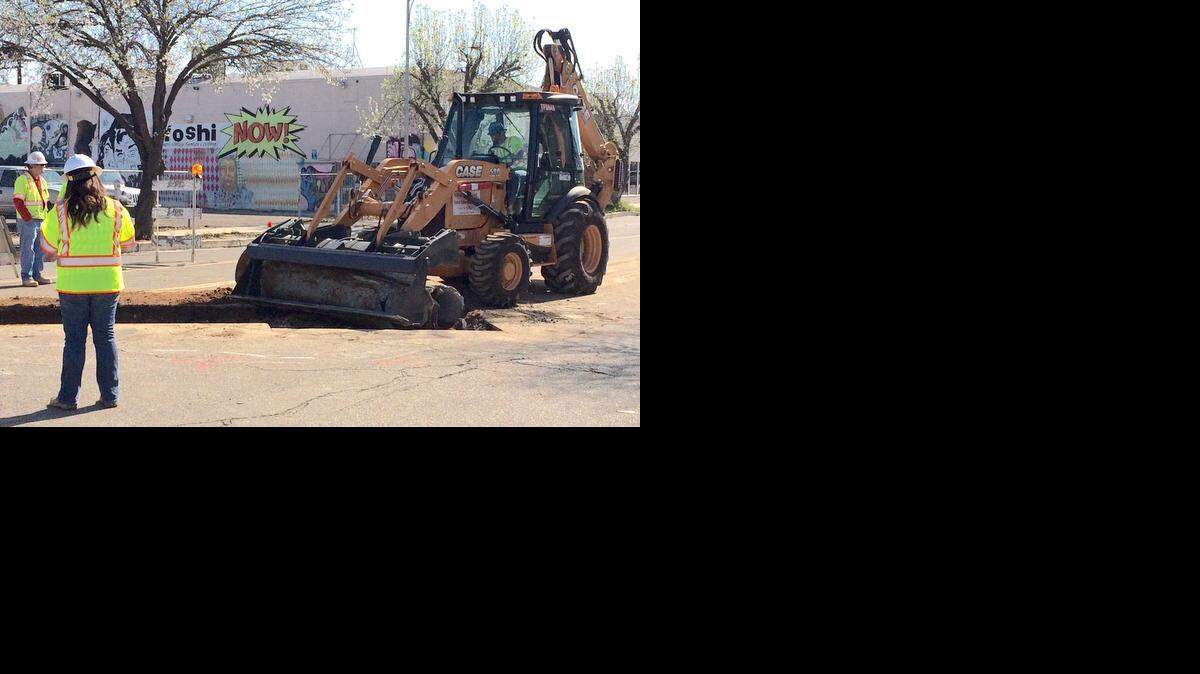
It’s not as spectacular or as visible as building a bridge or an overpass, but after years of delays, some construction finally is happening on California’s ambitious high-speed rail project.
Crews with a Southern California construction firm began digging up a section of storm-drain pipe beneath the downtown Fresno intersection of Mono and Broadway streets on Tuesday, in preparation for laying a new pipe down Broadway to Ventura Street.
Alan Hoffman, general manager for the Fresno Metropolitan Flood Control District, said the California High-Speed Rail Authority needs to re-route the drainage line to make way for a new Ventura Street underpass to carry traffic below the new high-speed rail tracks and the adjacent Union Pacific Railroad freight tracks.
“We have to do all of this detail work before any major construction,” said Diana Gomez, the rail authority’s Central Valley director. “Things like storm drains, sewer and water lines, all of that has to happen before we can start building underpasses, at least in the downtown area.”
Demolition of structures in the path of the project began last summer, but the unglamorous utility relocation represents the initial work on building things instead of tearing things down.
Fresno County Supervisor Henry R. Perea, who has been among the most ardent local supporters of the high-speed rail project, was happy to learn that construction — such as it is — has commenced. “You have to start with the infrastructure so that you have a solid foundation for the project, and that’s what this finally signals,” Perea said Tuesday. “It’s a great feeling.”
Fresno City Council Member Steve Brandau, however, isn’t convinced that the drain work is all that important. “To me, little measures like this don’t mean anything in the big scheme of things. I’m waiting to see if California is serious about funding this entire project.”
Construction in the San Joaquin Valley from Madera to Bakersfield is expected to cost about $6 billion, and the 520-mile statewide line from San Francisco to Los Angeles has an estimated price tag of about $68 billion.
“They can take baby steps forward, but right now they still only have about 10% of the money that’s needed, and that’s if it stays within its own budget,” Brandau said. “The long-term funding for this is still very suspect. … I still have my doubts that overall completion of this project is going to happen.”
As the myriad utilities are re-routed out of the way, Gomez said, work can begin in earnest on new underpasses for Ventura and Tulare streets, just south of where Fresno’s future high-speed train station will be located. “By August, we could see multiple locations of major construction,” she said.
Gomez said the first major construction for high-speed rail remains likely to happen in Madera County, where a new elevated bridge is planned to span the Fresno River, Raymond Road and Highway 145 at the eastern edge of Madera. Tutor Perini/Zachry/Parsons, the prime contractor for the first 29 miles of the rail route between Fresno and Madera, is awaiting approval of its proposed bridge design and could start building the structure in May, Gomez added.
Valverde Construction of Santa Fe Springs, a state-certified small business, is the subcontractor handling the relocation of Fresno’s city-owned utilities for the high-speed rail project. The work to install a new storm-drain pipeline under roadway between Mono and Ventura streets is expected to take about two weeks.
The work in downtown Fresno comes about two months after Gov. Jerry Brown and a parade of federal and state officials trumpeted their support at a ceremonial groundbreaking event a few blocks away. But it’s been a long time coming. When the Federal Railroad Administration announced in late 2010 that it was providing billions of dollars in federal stimulus and railroad transportation money to the state for high-speed rail construction in the San Joaquin Valley, state and federal officials predicted that work would commence in late 2012.
That didn’t happen. The project has been beset by delays: slower-than-expected approval of environmental assessments for two San Joaquin Valley sections of the statewide rail line; a gantlet of legal cases (some of which are still pending) that hampered the state’s ability to sell high-speed rail bonds approved in 2008 by California voters and challenge the validity of the rail authority’s rail plan; and the molasses-like pace of buying land necessary for construction of the railroad right-of-way and associated structures like bridges and overpasses.
“You’d like to see things happen quicker, but it takes time to answer questions and deal with folks who have concerns,” Perea said. “But at some point, the reality is that it’s going to happen, and I think we’ve finally reached that point with high-speed rail.”
Getting started
▪ A storm-drain line is among the utilities being re-routed in downtown Fresno by contractors for the California High-Speed Rail Authority.
▪ The utility work sets the stage for major construction to come this year on new high-speed rail underpasses at Ventura and Tulare streets in downtown Fresno.
▪ “We have to do all of this detail work before any major construction,” said Diana Gomez, of the California High-Speed Rail Authority.
This story was originally published March 4, 2015 at 11:16 PM with the headline "Unspectacular work marks first high-speed rail project."