
Turlock’s Foster Farms offers these tips for safely cooking its Thanksgiving turkeys
Thanksgiving chefs can get food-safety advice right from the source of most California-grown turkeys: Foster Farms.
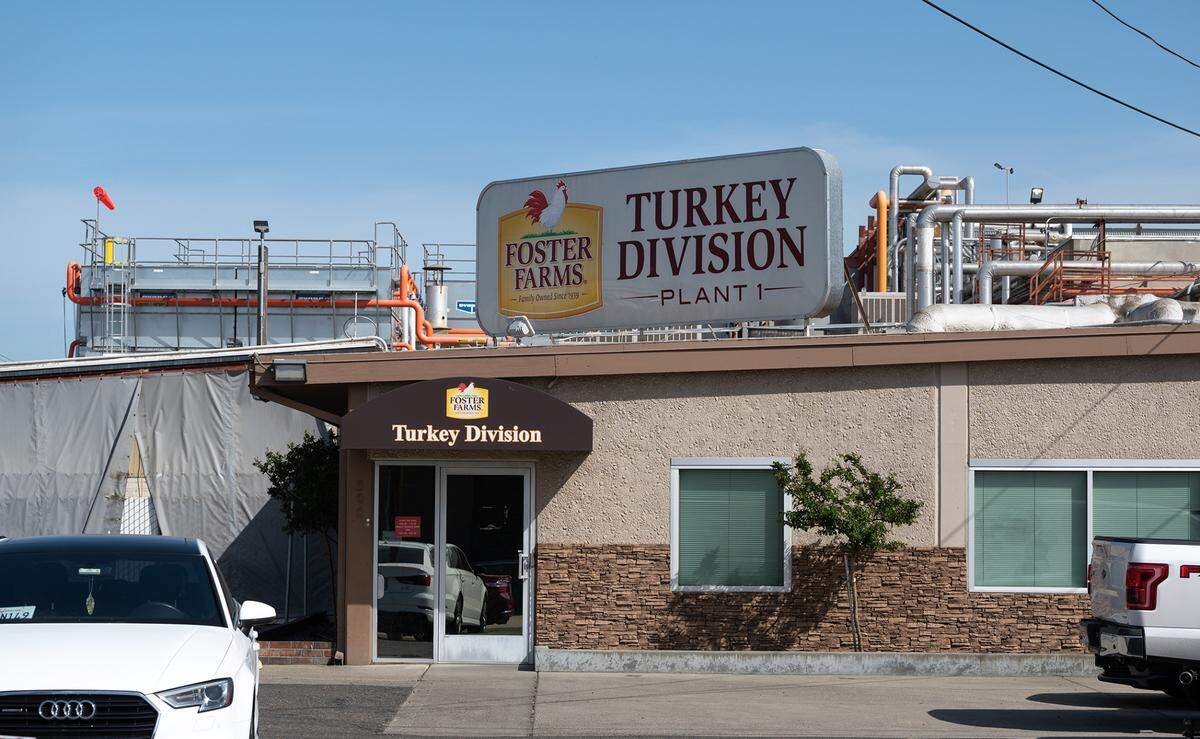
The Livingston-based poultry company processes all of its turkeys in Turlock. It knows a thing or two about keeping food-borne illness from spreading among family and friends.
Among the tips from the Foster Farms website:
- Thaw a frozen turkey in the refrigerator over a few days. Doing it at room temperature could promote harmful bacteria.
- A turkey also can be thawed by immersing it in cold water, or in a microwave oven, following the owner’s manual.
- Do not rinse a raw turkey, which “can cause germs to splatter around your food prep area.”
- A meat thermometer shows when turkey is cooked to a safe temperature. For whole birds, it’s 180 degrees as measured in the deepest part of the thigh (not touching the bone). Boneless or ground turkey is fully cooked at an internal temperature of 165 degrees.
The U.S. Department of Agriculture advises against stuffing a turkey. It offers these safety tips for cooks who do it nonetheless:
- Prepare the wet and dry ingredients separately and refrigerate until ready to stuff into the turkey. Mixing them too early can encourage pathogens.
- Stuff the turkey loosely, about three-quarters of a cup per pound of meat.
- A stuffed turkey will take 50% longer to cook. The dressing should reach an internal temperature of 165 degrees.
The USDA also has advice on keeping the kitchen workspace clean:
- Wash your hands for at least 20 seconds with soap and water before and after handling food.
- Use one set of utensils and cutting boards for anything that touches raw meat, and another for vegetables and other foods.
- Clean and sanitize any surfaces that have touched raw turkey and its juices and will later touch food, such as counters, sinks, stoves and tabletops.
- Cleaning with soap and water physically removes the germs, and sanitizing kills those that remain. The latter can be done with commercial sanitizer or wipes, or with a gallon of water with a tablespoon of liquid chlorine bleach mixed in.
- Thanksgiving leftovers are safe to eat for up to four days when refrigerated in small, shallow containers. They can be frozen indefinitely but decline in quality after six months.
More information is at usda.gov.

John Holland
The Modesto Bee