‘Total war zone.’ Yosemite area hit hard by wind that toppled trees. What happens now?
Lindsay Stevenson was in a camper van in the Yosemite National Park community of Wawona this week when strong winds toppled hundreds of trees, snapping trunks in half and ripping roots out of the ground.
She said her husband, a U.S. Army veteran, described the wind event as “100 times worse” than the Afghanistan War.
When the sun rose Tuesday morning, a “total war zone” was revealed following a terrifying night of non-stop crashing sounds.
Powerful winds here, known as Mono winds, aren’t unfamiliar to those living in the Yosemite area. But this time, wind speeds reached higher-than-normal levels – in some places, over 100 mph – and resulted in unprecedented, widespread devastation. Hundreds of trees in the Sierra Nevada were toppled Monday night into early Tuesday, and dozens of homes and vehicles were crushed in rural mountain towns.
Yosemite National Park remains closed as a result of the wind damage. Much of it was reported in Mariposa and Madera counties. Wawona, and Bass Lake farther south, were among communities hardest hit.
Many residents were still without electricity Friday and scrambling to patch up damaged roofs ahead of this weekend’s rain and snow. No injuries have been reported in Yosemite and its surrounding communities from the wind event.
.jpg "Image from iOS (2).jpg")
Emergency proclamation in Mariposa County
Mariposa County Sheriff Jeremy Briese, also the county’s director of emergency services, issued a local emergency proclamation on Tuesday requesting state and/or federal assistance.
It was ratified by the Mariposa County Board of Supervisors during a special meeting Friday and will go to the state for review. It seeks assistance under the California Disaster Assistance Act.
“Businesses were already in an emergency situation and revenue is already drastically impacted due to COVID-19,” said Mariposa County Economic Development Specialist Tara Schiff, “so this disaster just adds one more layer of financial stress.”
Madera County Supervisor Tom Wheeler, who represents eastern Madera County, said his county is still assessing damage and hadn’t made an emergency declaration because of wind damage.
He said he was told emergency funds via the state won’t be available unless damage to county property reached $700,000, and that Mariposa County’s threshold is lower because it’s a smaller county. Wheeler said national forest damage isn’t figured into that number, and neither is personal property damage. Financial help for personal property would have to come from a separate federal designation, he said.
Resident Steve Arata said there was “total devastation” in Bass Lake and he hopes his community gets more help soon.
“The governor needs to get here and declare a state of emergency,” Arata said Tuesday, “because there’s at least 40 homes that are destroyed with trees. ... There’s multiple gas leaks. Thank God we don’t have a big fire or an explosion right now.”
Sheriff offices share damage updates, warnings
The Mariposa County Sheriff’s Office shared a number of resources on its Facebook page for those affected by the wind event. The office reported Tuesday that trees and debris were across most roadways.
Madera County Sheriff’s Office spokeswoman Kayla Serratto said her office received 93 reports of property damage in Madera County caused by wind – three of them considered major. She said tree removal on private property is the responsibility of homeowners.
Wheeler said a sheriff’s report he received Thursday night showed 68 homes damaged by the wind event just in the Bass Lake basin, with two a total loss and eight of them 60 to 70% destroyed.
.jpg "Image from iOS (1).jpg")
Serratto said sheriff deputies responded to 20 calls in Madera County related to downed trees, along with coordinating evacuations for a wildfire in North Fork, fueled by the strong winds. Wheeler said there were numerous other small wildfires in eastern Madera County during the wind event, including Bass Lake, North Fork, Oakhurst and more rural areas just south of Yosemite.
Less than a week later, snow returned to the mountain area. Snow could fall as low as 2,000 feet this weekend and blanket Coarsegold, Serrato said.
Madera County Sheriff Tyson Pogue shared this warning: “Based on everything going on right now, including risks from falling trees, severe weather, and strained resources, we are urging our citizens and visitors to consider staying home out of the weather this weekend.”
Fresno County Sheriff’s Office spokesman Tony Botti said Fresno County didn’t experience wind damage like Mariposa and Madera counties did. He said a contracted company doing Creek Fire cleanup work in eastern Fresno County was paused earlier this week due to safety concerns, “but fortunately the threat never arrived.”
A National Weather Service meteorologist at the Hanford office said their reports showed at least one tree down across a road along Huntington Lake, however, indicating that area likely “had their share of problems, too.”
Residents’ stories of falling trees, damaged homes
Stevenson, a native of Florida, said the wind event in Wawona was “very reminiscent of hurricanes – with a bunch of trees thrown into the mix.” But there was no rain Monday night.
Some roofs in Wawona were sheered off by the force of the winds, Stevenson said. She called parts of Wawona “unrecognizable” now.
The van that she and her husband, James Stevenson, hunkered down in emerged unscathed, but her Honda Element was crushed by a tree. The couple eventually sought shelter from crashing trees in Wawona’s Pine Tree Market, owned by friend Michael Henderson.
Winds damaged market property and the Hendersons’ home beside it. A tree that fell punched a handful of holes in the roof of their house, which are now covered with tarps. Snow started falling in Wawona on Friday afternoon.
Henderson called cleanup and repairs already done by workers and residents “miraculous.” Wawona is still a “train wreck,” he said, but much better than what it looked like Tuesday morning.
Wheeler said rental properties his fiancée owns were hit by fallen trees. The house they were at together Monday night in Ahwahnee wasn’t struck, but they were “scared to death.”
“It sounded like a freight train,” Wheeler said of the wind. “It sounded like thunder rolling. It was like an earthquake coming in the distance from miles away. It shook our house.”
Wheeler has spent his life in the mountain area and said the last big comparable wind event was in 1979.
Among those whose homes were destroyed is an Oakhurst hairstylist and single mother of twins. Her sister made a GoFundMe to help with expenses not covered by home insurance.
Kent Tracy, owner of Advanced Tree Service based in Oakhurst, offered free emergency services Tuesday clearing driveways and cutting pines and oaks off cars and roofs.
He said it was most damaging wind event he’s seen over 30 years in the mountains. He said the damage is widespread, and trees fell in places as low in elevation as Coarsegold. Many that toppled were green and healthy, not just those hit hard by drought, bark beetles and fires. Tracy said the bigger, bushier trees caught the wind like a sail. He saw a mix of snapped and uprooted trees.
Yosemite and Sierra National Forest information
Yosemite National Park spokesman Scott Gediman said the park hopes to reopen Tuesday, but Yosemite’s south entrance via Highway 41 will be closed to visitors past that date for safety reasons as crews work to repair downed electrical lines. All areas south of Yosemite Valley will also remain closed until further notice. Damage assessment continues in the park.
Gediman called the Mono winds’ event the park’s biggest in terms of wind speed and damage caused over his 25 years in Yosemite.
Stevenson said the historic Wawona Hotel, which has been closed since last year for repairs, and the nearby Pioneer Yosemite History Center buildings didn’t appear to be damaged, except for a horse corral.
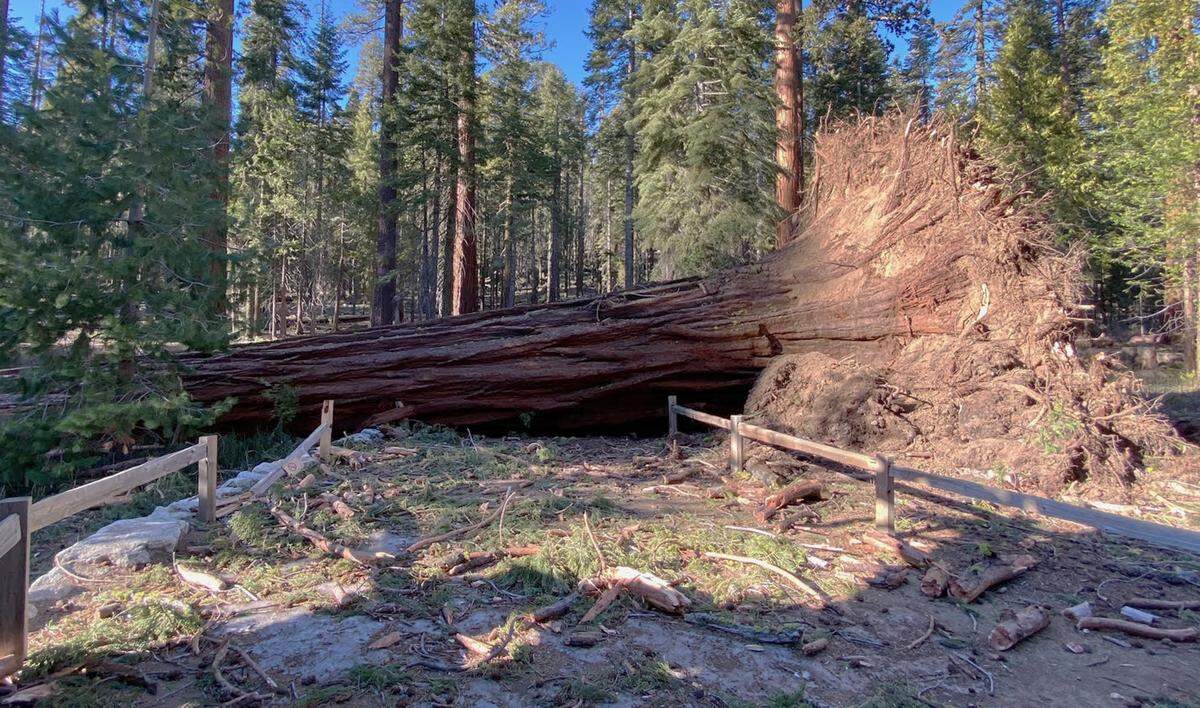
Sierra National Forest spokesman Alex Olow said the winds toppled hundreds of trees in the forest, and that some facilities in the Bass Lake Ranger District sustained serious damage.
Crews continued to clear downed trees off forest roads Friday. Olow said Beasore, Forest 81, and Sky Ranch roads were among the most affected.
Over a 48-hour period, 97 trees were removed from one 2-mile stretch of the Miami Creek area road system alone, he said.
“Visitors to the forest should be aware of the risks of more trees falling after being weakened by the winds,” Olow said, “and this would not just include trees that have already died.”
He said those recreating in the forest should not park under trees, and should avoid areas with downed trees.
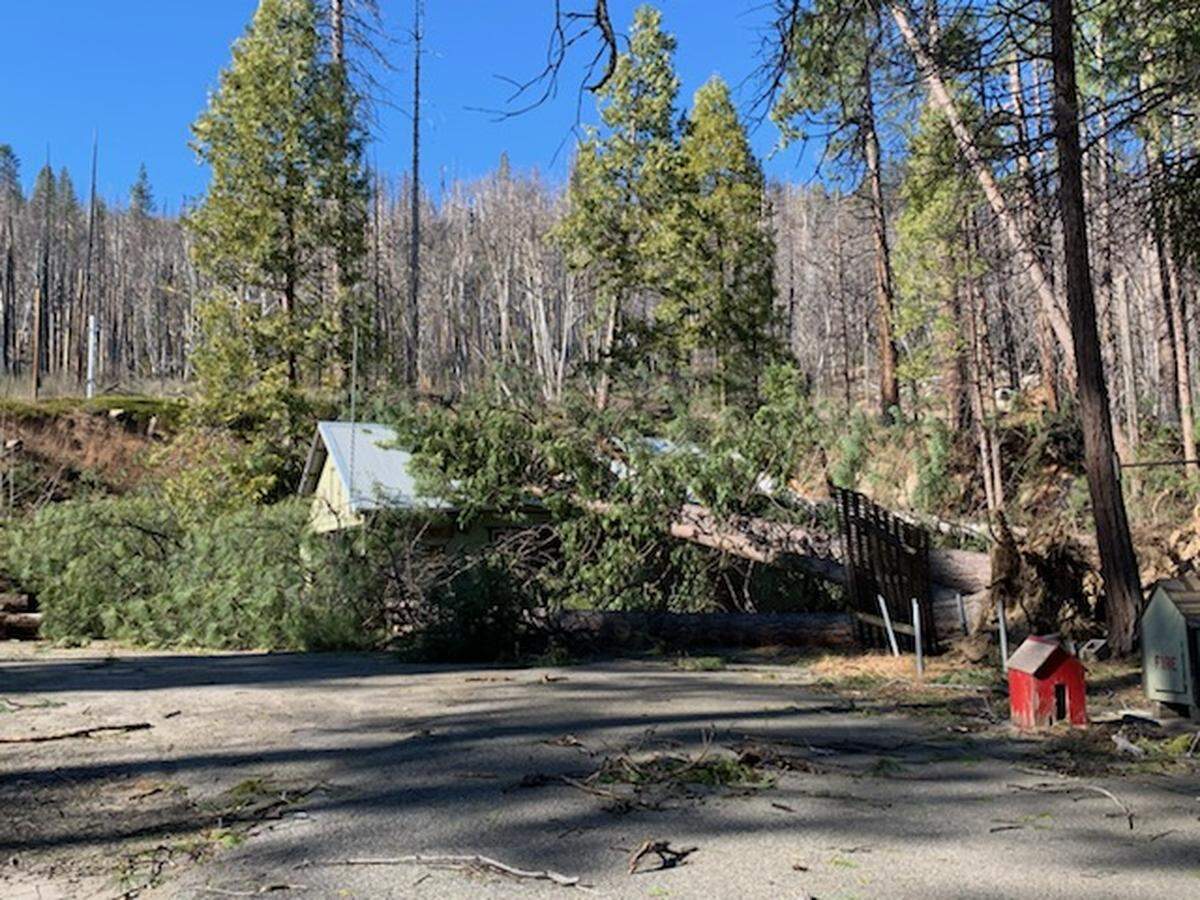
PG&E working to restore power
Wawona residents were still without electricity on Friday afternoon.
“I don’t see power lines in town that are untouched,” Stevenson said. “Most are totally down. There are transformers all over the roads and wires everywhere, power poles snapped in half. Basically they have to redo all of Wawona’s power.”
In neighboring Madera County, Serratto with the sheriff’s office said electricity lost due to wind damage and public safety power shutoffs was expected to be restored in Madera County on Friday night.
Pacific Gas & Electric Company’s outage map on Friday night showed electricity was expected to be restored Saturday in many places. In some areas around Bass Lake, there was still no estimate for when power would be back.
PG&E on Tuesday afternoon reported nearly 21,700 wind-related power outages in its Yosemite division, portions of most counties between Madera and Modesto, in addition to around 2,500 public safety power shutoffs in that area.
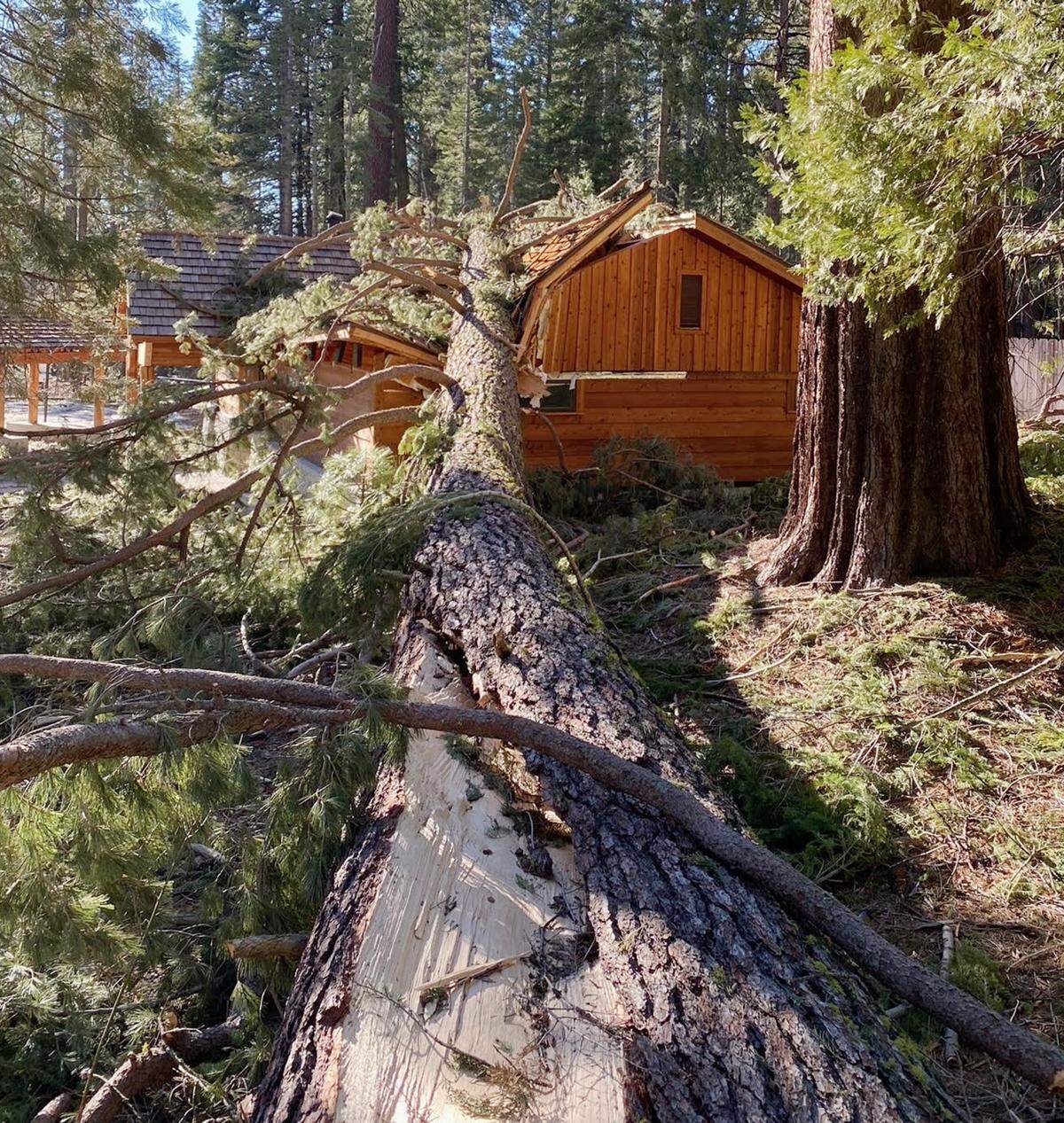
On Thursday afternoon, around half of those customers, 10,500, were still without electricity due to wind damage, said PG&E spokesman Denny Boyles. Damage in Mariposa and Madera counties was described as “substantial and devastating.” There were 95 PG&E crews in that area Thursday working to restore power.
“Our crews are finding trees blocking roads, trees into houses and other damage that is far more serious than we would normally see from a winter storm where branches or other debris might damage power lines, but not entire trees,” Boyles said.
Tracy with Advanced Tree Service said he’s grateful for public safety power shutoffs during the wind storm. Without them, the mountain area could have easily experienced a devastating wildfire like the 2018 Camp Fire that destroyed Paradise, he said.
Boyles said wind speeds and fuel conditions are factors in determining whether to implement a public safety power shutoff.
PG&E said there are community resource centers to help affected residents, located at Yosemite High School in Oakhurst, and New Life Christian Fellowship in Mariposa.
Across California, PG&E reported restoring electricity by Thursday to more than 93% of customers who lost power due to high winds earlier in the week. The company said people should never touch downed wires and always assume they are energized and extremely dangerous. Downed power lines should be reported immediately by calling 911 and PG&E at 1-800-743-5002, the company said.
What are Mono winds?
The National Weather Service said Mono winds were reported up to 110 mph on Monday night in Cascadel Woods above North Fork.
NWS meteorologists compared the weather pattern to a destructive 2011 Mono wind event that hit Devils Postpile National Monument in the Eastern Sierra.
“Mono winds have seemed quite mysterious in the past because the winds suddenly swoop down the west slopes of highest ranges of the Sierra Nevada to their lowest slopes,” a Weather Service report from 1976 reads. The report states Mono winds can begin as early as September, but the strongest have occurred in December and January.
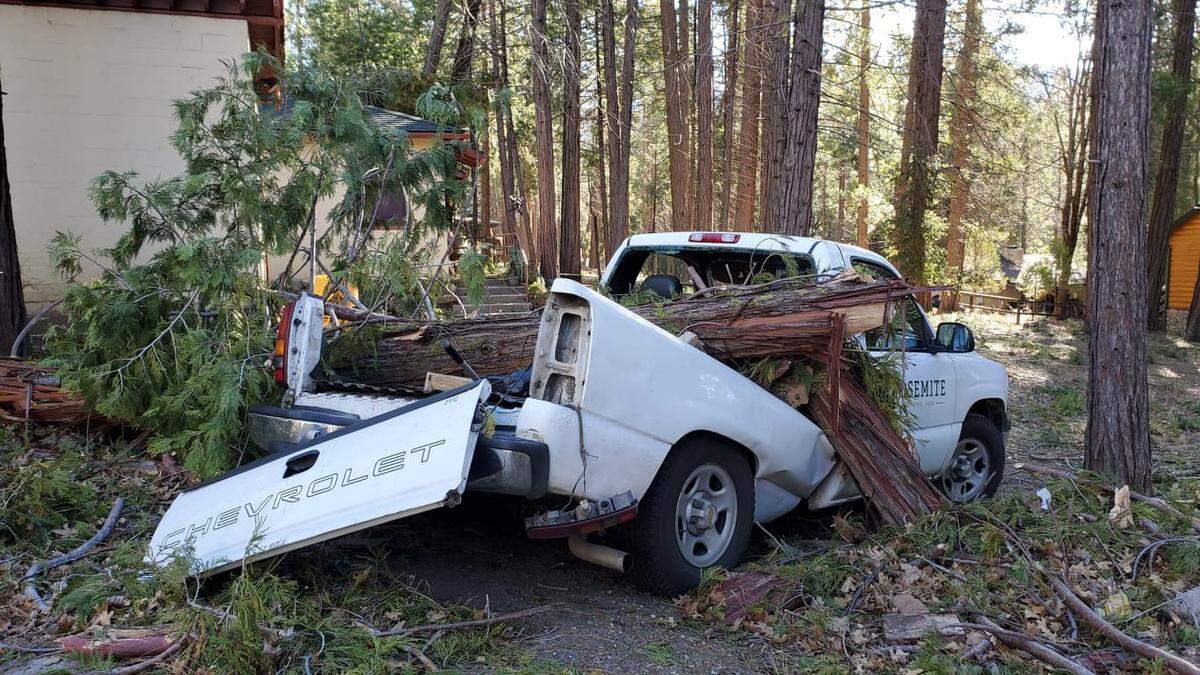
Jim Bagnall, a NWS meteorologist at Hanford, said Mono winds like the ones that hit this week might come once every 10 years. A similar wind event is not forecast for the region in the immediate future, which will be marked instead by rain and snow.
Bagnall said normal Mono wind speeds have highs from 40 to 50 mph. During this week’s wind event, 50 to 60 mph was common, with some gusts at least 70 to 80 mph “and higher,” he said.
Mono winds are caused by the interaction of different air pressures, he said. “It has to line up just right to get really strong Mono wind events. ... The wind blows strongly from high pressure to the low pressure.”
Faster winds are common at higher elevations while cresting over a mountaintop, Bagnall said, but winds can also speed up farther down a mountain. Topography and the orientation of canyons play into Mono wind speeds, too.
This story was originally published January 23, 2021 at 9:00 AM with the headline "‘Total war zone.’ Yosemite area hit hard by wind that toppled trees. What happens now?."