
Denham among eight running for Congressional seat. How do they all stack up?
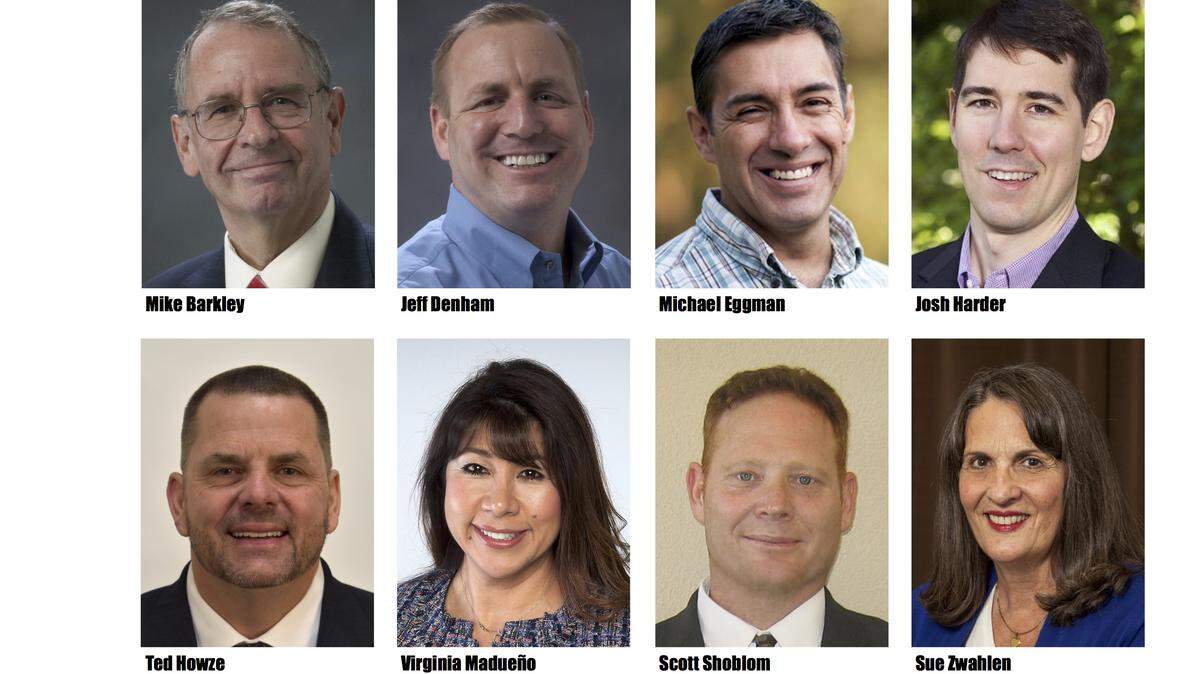
Political drama is thick in this year's race for the 10th Congressional District, where a host of challengers eager to unseat Rep. Jeff Denham think they smell blood in the water.
All seven of his opponents — five Democrats, an independent who thinks like a Democrat, and one fellow Republican — say Denham, first elected to the House in 2010, has grown distant and unresponsive to the Valley. Most portray him as an enabler of President Donald Trump, who won fewer votes here than Hillary Clinton in November 2016.
Anxious to retake control of the House, Democratic leaders put a bull's-eye on this district covering Stanislaus and south San Joaquin counties, identifying it as among those most likely to flip toward Democrats. A liberal blog, the Daily Kos, says no other GOP representative in the entire United States is more likely to lose than Denham, based on local party registration — leaning slightly left — plus Denham's narrow margin of victory in 2016 (3.4 percent.)
Democrats know history may be on their side. Since the Civil War, the party winning the White House has lost an average of 32 House seats in midterm elections two years later.
The result this year: 10 Democrats announcing they would run against Denham. With so many, none could consolidate support and the party is forced to hold off an endorsement until seeing who comes out on top in the June Primary.
Half eventually saw the writing on the wall and left the race — including T.J. Cox, who switched his candidacy to a district to the south to challenge Republican David Valadao. But five remain in the local contest: Mike Barkley, Michael Eggman, Josh Harder, Virginia Madueño and Sue Zwahlen. And that's still a dangerous number because California's open Primary rules put the top two vote-getters from June on the November ballot, regardless of party.
In other words, the fractured Democratic vote could be so diluted that none advance, now that a second Republican — Ted Howze — is in the hunt, too. The Democratic Party's inability to produce a single strong contender with a coherent message has Republican strategists almost gleeful.
"Democrats will limp out of these huge primaries with baggage and depleted resources, seriously hurting their ability to compete in a general election," wrote Jack Pandol, National Republican Congressional Committee spokesman, in February.
Only a few weeks ago, concerns about the strength of the Democratic field prompted Eggman, who lost the past two elections to Denham, to enter for a third try. It's highly questionable whether that did much to consolidate Democratic support, as the other four have continued campaigning with vigor. Some were openly annoyed that Eggman seemingly fancied himself the Democratic savior, essentially ignoring their months of hard work.
"I was shocked and disappointed. He was the one who recruited me to run!" said Madueño, reflecting on Eggman's former position as founder of Red to Blue California, an organization targeting seven congressional Republicans in California deemed vulnerable this year.
"This late in the game, he decides to jump in? It makes no sense to me," she said.
Harder said Eggman told him long ago "that he didn't have the appetite and the support" to run again. "It would be a tragedy to try something three times and fail," Harder added.
Michael Eggman
Eggman acknowledged his previous role as head cheerleader for the others. "I applaud every single one," he said. "All are good people, or I wouldn't have recruited them.
"That said, I believe we are in dire times," he continued, "and I'm afraid of what the country is going to look like in 2020 if we don't stop the Trump agenda in 2018."
Eggman voices disdain for the president much more in conversation than the others, and usually portrays the incumbent congressman as Trump's patsy. It's the same message he sounded two years ago.
"Jeff Denham has been a rubber stamp for Trump, and he continues to turn his back on what matters most: the needs of struggling families here in the valley," Eggman said.
The 53-year-old Turlock beekeeper did not fare well in his first try, losing by more than 12 percentage points in 2014. The gap narrowed to less than 4 in 2016.
As a late entry in the race, Eggman's fundraising ability this time remains to be seen. He says supporters are responding.
"There is a different type of activism than I'd seen the last two cycles," Eggman said. "People are fired up and understand the need to do something to get the country back on the right track. I want to finish what I started."
Josh Harder
At 31, Harder by far is the youngest of this year's candidates. His resume, however, will impress many: Stanford and Harvard degrees, nonprofit farming work in Africa, venture capitalist whose success stories include Blue Apron. And he's clearly the top money raiser, next to Denham; at year's end, Harder had collected $935,000 from supporters, followed by $207,000 for Zwahlen and $150,000 for Madueño. Denham's campaign machine had amassed just shy of $2 million.
Harder quit the big-city rat race and moved back to Turlock, where he was raised, to run for Congress, the first public office he's sought. He teaches business at Modesto Junior College.
In frequent messages to supporters, Harder's targets include the NRA, oil and gas lobbies and vice president Mike Pence's contributions to Denham.
"I don't think (Denham) is an evil guy. He just misrepresents the interests of this district," Harder said. "He's somebody who says something here to pacify the district, then goes back to DC and votes the exact opposite. If there's one thing people hate, it's hypocrisy."
Last week, a flap between Harder's campaign and Stanislaus County election officials ended up in the news. They made him remove references to Trump and health care from Harder's candidate's statement, to appear in a voter information guide.
Harder says he is the front-runner among Democrats, with support from 700 volunteers, including 120 interns.
"It's exciting that people want to get involved in politics," Harder said.
Sue Zwahlen
Zwahlen, 63, believes she is "uniquely qualified to tackle issues in Congress" that matter to valley residents. Why?
None of the others has been a schools trustee; she served eight years on the Modesto City Schools Board. Understanding education, and its link to good jobs, is important, she says.
No other candidate has six children and six grandchildren. Understanding families is important, she says.
Zwahlen, an emergency room nurse at Modesto's Doctors Medical Center, is the only candidate working in the human medical field. That affords her unique perspective on the health care system, she says.
"My work in this community speaks for itself," Zwahlen said. "People know me and they appreciate my dedication to this community."
Although it rarely comes up, Zwahlen's ancestry is part Portuguese and she comes from a dairy family.
Virginia Madueño
Madueño, by contrast, never misses an opportunity to note that she is the daughter of immigrant farm workers from Mexico. A bit more than 43 percent of the 10th District's residents are Latino; whites are a little less than 43 percent.
"I've been given labels my entire life. I try to find common ground," she said.
The 52-year-old became familiar with Modesto Bee readers long ago as a young spokeswoman for Stanislaus County before founding the public relations firm she still runs. She served on the City Council and as mayor of Riverbank, but narrowly lost a re-election bid in 2012, then lost a race for state Assembly claimed by Heath Flora, R-Ripon, in 2016.
On social media, Madueño has asked people to sign petitions challenging Denham's stances on tax reform and gun-violence research. Although others also criticized the House's tax bill, Denham took to Twitter to call out Madueño for "lying to voters."
She was in the audience, she said, when Denham last year reportedly pledged to support the Affordable Care Act, whose provisions were under attack in Washington, D.C. ACA, championed by former President Barack Obama, provides benefits to more than 100,000 people in Denham's district.
"Two weeks later, he voted to repeal (ACA)," Madueño said. "That was my call to action."
Madueño acknowledges that her progressive message doesn't always resonate with a rather conservative district. But she has an ability to connect with people, she said.
"I was born and raised here, I've worked here, I raised a family here," Madueño said. "I know how to best relate to everyone in the room."
Mike Barkley
Barkley, the only candidate from San Joaquin County (he's lived 30 years in Manteca), likely would say he's even more progressive.
When a former candidate, Terra Snover, a transgender independent, was not invited to debates among Democratic candidates, Barkley refused to participate (Snover since has left the race). "They missed an opportunity to embrace the LGBT community. Instead, (Democrats) flipped them off," Barkley said. "We can't win this district without independents. We need to not insult them."
In the district, "no party preference" voters account for more than 20 percent of the total, according to the California Secretary of State's office; Democratic registration is 38.6 percent, and Republican, 36 percent as of Jan. 2.
Barkley, a 72-year-old retired computer programmer, has become more of a perennial candidate than Eggman, having run every two years for the last four cycles, including this one, never progressing beyond the Primary. He takes encouragement from small improvements: Barkley received 5,028 votes in 2012, 11,005 in 2014 and 18,576 in 2016.
"I do keep after it, and each time I do better," Barkley said.
Scott Shoblom
Scott Shoblom, the sole independent candidate, is banking on hopes of attracting many of those nonaffiliated voters.
"That's why I'm in the race," the 52-year-old Modesto civil attorney said. "If there were not so many Democrats, I would have (run as one). I don't know any issue the Democrats have that I don't agree with."
Being independent allows Shoblom (pronounced Show-blum) to "think outside the box," he said. "When you're not picking a fight, it's kind of easy to see solutions."
He's realistic about his chances, however. "I hate the idea of having to fly to Washington," he said.
Ted Howze
Some Democratic candidates were cynical when Howze (pronounced Hows) joined the race at the last minute. A second Republican candidate, the theory goes, could seal victory for Denham by simply capturing more votes in the Primary than the strongest of the watered-down Democrats.
Howze said he wasn't induced to run, but got in the race because he's also put off by Denham.
"He's impossible to nail down on an issue," Howze said. He said he tried to contact Denham, without success, before Denham voted for the tax bill, which Howze is convinced — like all Democratic candidates — will prove disastrous for California families.
As for Trump, "I agree with many of the conservative policies he sets forth, but personally, I don't like the man," Howze said.
The 51-year-old livestock veterinarian served on the Turlock City Council from 2006 to 2010, an era marked by council discord.
In 2016, he moved to Stockton after marrying a woman who teaches school there. He still maintains his office in Turlock because he travels up and down the valley for work. Stockton is not in the district, but no rule requires a representative to live in his or her congressional area.
"I'm not trying to make it a secret, so nobody says I'm a carpetbagger," Howze said. "I spend as many hours a day in the 10th District as I spend out of it."
Questions of residency come up periodically for half the candidates.
Eggman owns a home in Kingsburg, south of the 10th, but he says he lives and works in the rural home he grew up in, in Turlock, where he is registered to vote. Harder left the Valley to find success in school and business, returning a year ago. And Denham owns a place here but spends most of his time with his wife and now-adult children back east.
Jeff Denham
Denham, 50, was the only candidate who failed to respond to The Bee's interview requests. He is serving his fourth two-year term.
The Air Force veteran began representing this area in 2002 from a California State Senate district that stretched to his Salinas home, and later bought an almond orchard and home near Turlock. He also has a business building plastic farm containers, and was sixth on a recent Los Angeles Times ranking of the wealthiest members of Congress from California, with a worth of at least $6.2 million. His wife is Latina and he speaks Spanish.
The incumbent emails weekly newsletters to constituents who sign up, providing updates on his focus areas: taxes, health care, veterans, water storage, the farm bill and immigration. The last issue is where he breaks most often from conservative Republican colleagues; Denham for years has sought immigration reform, including citizenship for those in our military, joined bipartisan legislation helping so-called Dreamers in December, and tried to force the House to choose among four immigration bills only a few days ago.
Although he's a fierce opponent of California's high-speed rail, Denham chairs a subcommittee on railroads, pipelines and hazardous materials and is a top contender to become chairman of its umbrella, the powerful House Transportation and Infrastructure Committee, although the position won't become open until after the fall election. Stanislaus officials last week credited Denham for helping to secure $9 million for a future Highway 132 bypass west of downtown Modesto.
In February, fundraisers for Denham's campaign in Sacramento and Yuba City both charged $500 per person.
Garth Stapley: 209-578-2390
This story was originally published March 17, 2018 at 5:08 PM with the headline "Denham among eight running for Congressional seat. How do they all stack up?."