
Establishing ‘quiet zones’ for trains isn’t easy
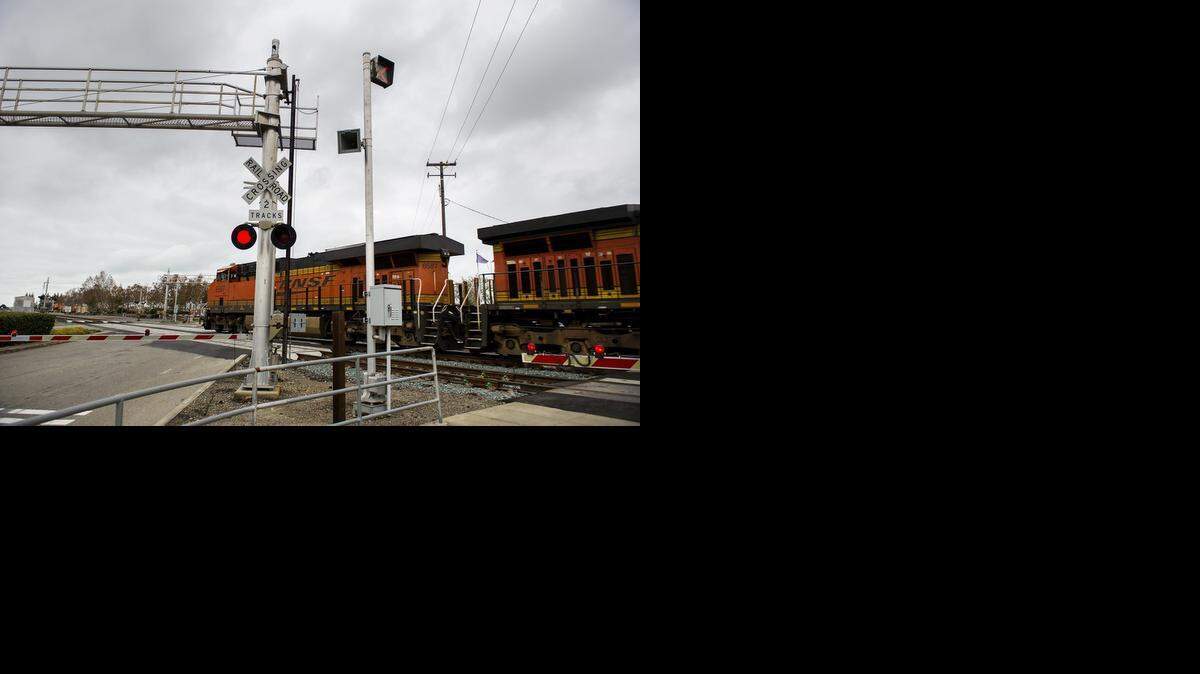
As a train approaches in the distance, the sound of its horn can conjure romantic images of a foggy London train station or the Polar Express with a conductor on board ready to serve you hot chocolate.
But if the horn is blaring by your home in the middle of the night, startling you from sleep, you might have a different take.
Any city that has a railroad running through it gets its share of citizen complaints.
Federal regulations require a locomotive to sound its horn for 15 to 20 seconds before entering a crossing.
The horn pattern goes two long, one short and one long blow at a maximum volume of 110 decibels. The engineer will repeat the pattern as necessary until the train clears the intersection and can vary it for crossings that are close together.
The requirements pertaining to pattern, distance and decibel levels are part of a rule established in 2005, but the Federal Railroad Administration has required locomotives to sound their horns in crossings since 1994.
The 2005 rule also laid out criteria for communities that want to establish “quiet zones,” which silence train horns in crossings, except when the engineer determines there is a safety concern.
That sounds like the answer to all those noise complaint problems, right? So why don’t Modesto, Riverbank, Turlock and every other train-heavy municipality get on board?
In short, nothing is easy or inexpensive when you combine local, state, federal and private interests, which all must agree to make changes to a crossing that are contrary to the federal norm.
The train horn is a universal warning for anyone near a railroad track that the train is coming and has been long before there were federal mandates about its use.
Without it, the risk has to be mitigated with additional safety measures.
What measures the administration considers sufficient depends on factors like the location and layout of the crossing. They include barricades that prevent a vehicle from circumventing the standard crossing arm, such as a four-arm gate system or center median; full road closures to vehicle traffic; or gates on one-way streets.
Modesto’s Economic Development Committee has been studying what it would take to get a quiet zone. In a presentation to the City Council in January, estimates on these safety improvements range from $465,000 at one crossing to over $1 million at another.
A less common option is one Escalon adopted in 2008, and it remains among just five California cities to do so. It installed wayside horns at four of its crossings.
The horns act as a substitute to those on the locomotive. Mounted on a pole at the crossing, they direct the sound at traffic instead of letting it resound for miles. It is at a lower decibel level, in the mid-90s.
Escalon City Manager Tammy Alcantor said horns that once blared over the crowd at the high school football field a few blocks from one of the crossings now can’t be heard at all.
Of course, Burlington Northern-Santa Fe Railroad, which owns the tracks in Escalon, has the authority to sound the train’s horn, just like in quiet zones, if there is a safety issue or the wayside horns are not functioning properly. A flashing “X” at the intersections tells the train crew that they are.
Alcantor said a battery issue with the system recently shut it down for a few days and the noise complaints of the past started coming into her office again.
“I think people forget how convenient the system is,” she said.
Escalon paid about $140,000 per intersection for the wayside horns.
The start-up costs for both quiet zones and wayside horns could be considered nominal, though, compared to the potential liability assumed by the cities, which is why some have rejected or tabled the idea.
The Manteca City Council found the liability issue “prohibitive” because Union Pacific would require the city to assume all responsibility in the event of a lawsuit.
“Union Pacific Railroad believes quiet zones compromise the safety of railroad employees, customers and the general public,” reads a statement in both Manteca and Modesto staff reports.
UP spokesman Jeff DeGraff said the railroad understands the quality-of-life issues associated with blaring train horns, but said, “Any attempt to limit the use of these horns has to be taken very seriously (and is) a deviation from protocol, in a sense.”
Rick Buys, a liability manager for the Municipal Pooling Authority of Northern California, which provides insurance for Manteca, said the contract required by Union Pacific has “a very oppressive set of requirements that transfers liability not just for what could happen if the horns don’t sound, but anything that could happen” at the crossing.
Assuming that liability would require authorization from the authority’s board.
Modesto, on the other hand, is self-insured for the first $1 million of a claim, so the powers that be have the freedom to take on additional liability and are more willing to do so.
“Risk is always analyzed, but just because there is a risk doesn’t mean we won’t do it; you weigh that with the benefit to the public,” said the city’s risk manager, Mary Akin. “Putting a sidewalk in can be risky. They settle and shift over time … There are claims associated with (trips), but you have to have sidewalks.”
Modestans in favor of quiet zones may have an ally in the new city manager, Jim Holgersson. He was city manager in Arlington, Texas, when it established its quiet zones.
Furthermore, he’s been living at the DoubleTree Hotel in downtown Modesto since moving here in May and has experienced first-hand the nuisance of the horn.
After receiving the report on quiet zones in January, the council advised staff to seek grants to establish them. None has been secured yet, but those plagued by train horns can rest easier – though not undisturbed at this point – knowing the city is working on it.
“This is an evolution of citizens wants and desires and, as servants of our population, we should be addressing those issues,” Akin said.
Have a question for the Bee Investigator? Email etracy@modbee.com
This story was originally published December 21, 2014 at 7:04 PM with the headline "Establishing ‘quiet zones’ for trains isn’t easy."