Should Modesto again try to grow? This time could be different with Wood Colony and Salida
An intriguing potential compromise — between those who think Modesto must grow to stay healthy, and those who want unincorporated Wood Colony and Salida left out of that vision — is beginning to come into focus.
Both sides will find parts of the deal absolutely repugnant. Some will see benefits.
Whether pros outweigh cons for enough people involved may determine whether we put this long fight to rest.
The Modesto City Council is expected Tuesday to start the ball rolling, with nothing set in stone and many meetings and much outreach yet to come.
The council hasn’t had much luck with this in this past, igniting political firestorms with talk of absorbing neighboring communities. Intense opposition previously forced Modesto to retreat, but left the question unsettled. Wood Colony and Salida have been in limbo since — no longer under immediate threat of annexation, but neither permanently protected.
What’s different this time?
First, the vehicle for discussion. The current debate arises because farmland protection advocates are moving to ring Modesto with an urban limit, a line beyond which the city could not grow without a vote of the people. It’s an uncommon but effective tool in preventing sprawl.
Although a previous urban limit proposal called Measure I narrowly failed in 2015, most prior debates occurred when Modesto contemplated amending the city’s general plan, a document showing where Modesto might grow in the next few decades.
This time, rather than Modesto initiating the controversy, city leaders are being forced into one. Tuesday could represent a chance for them to get out in front of it. Modesto voters could decide on an urban limit as soon as November 2020.
Second, there may be more hope this time for compromise.
Both sides — farmland advocates and development interests — have been quietly negotiating. Their work has brought us to this point.
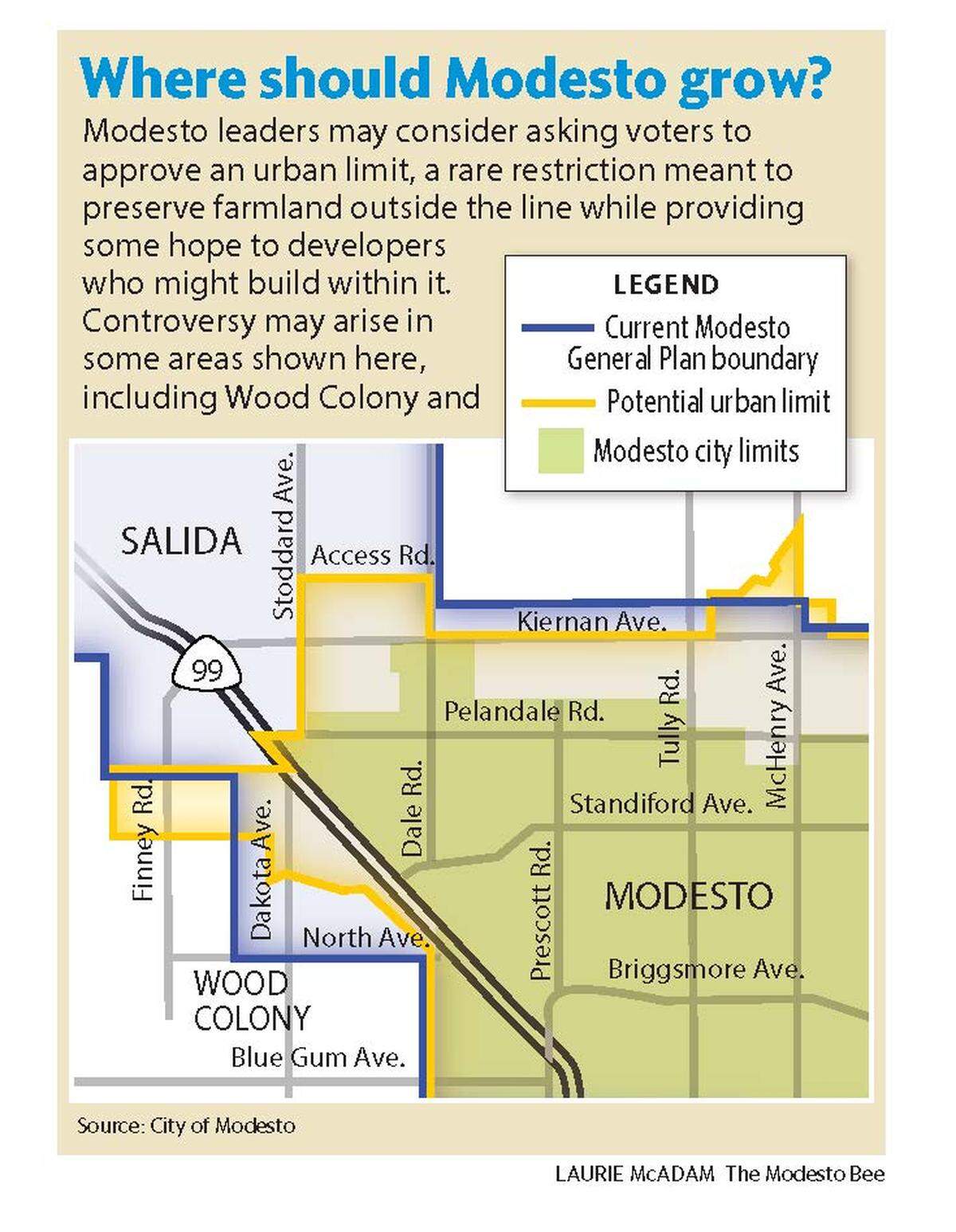
Third, negotiations are producing new lines for all to consider. They’re best understood when you look at a map, so The Modesto Bee has prepared one reflecting these talks.
Around most of Modesto, the tentative urban limit largely follows a previous growth plan, or general plan, adopted back in 1995. Exceptions are at Modesto’s northwest end:
- Instead of Modesto absorbing the entire so-called Beckwith triangle, a 1,000-acre portion of Wood Colony west of Highway 99 straddling both sides of Beckwith Road, the urban limit envisions Modesto taking a strip fronting on the freeway, protecting ranchettes and farmland to the west. The proposal, however, would allow Modesto more land than previously thought south of Salida along Murphy Road. Net difference: Modesto would gain 900 acres instead of 1,000.
Development interests say this land is mostly owned by people who want to sell or build. It will be interesting to hear from both those who do, and those who don’t.
- Instead of Modesto swallowing Salida and expanding north all the way to the Stanislaus River, the tentative urban limit would exclude almost all of Salida. Proponents will claim that this allows Salida to relax and determine its own destiny, which is code for maybe incorporating into a real city.
But the proposed limit could hand to Modesto some of the area’s most promising land for future business and industrial development, on both sides of Kiernan Avenue between Dale Road and Stoddard Road. Without that land, Salida — by far the largest unincorporated town in Stanislaus County — may never have a large enough tax base for incorporation.
The tentative limit also would allow Modesto someday to annex Empire, which long has been the plan and for some reason has not proved controversial. Perhaps more interesting is a new bulge in the tentative limit just northwest of McHenry Avenue, near a future intersection with the planned North County Corridor.
It isn’t hard to envision this erupting into another tooth-and-nail battle to the death. Some on either side will not budge from all-or-nothing positions. They have a right to express themselves, and they should.
But they should not attack those who have thoughtfully approached compromise.
Despite what we’re seeing on a congressional stage, opening one’s mind to see what the other side has to offer is not selling out.
This Modesto-Wood Colony-Salida issue is intriguing because we’re finally seeing some give on both sides.
An urban limit is simply odious to the development community. Reluctantly, they now are talking. It’s in their interest to know the rules about where they can build and where they can’t, rather than launching a new fight at every proposal.
Giving up some rural land to development is revolting to farmland advocates. They’re also talking because the notion of a rare urban limit would provide uncommon comfort, knowing that some of the best soil on earth has far greater protection.
Because the urban limit shown today on The Bee’s map is still in flux, it’s too early to say whether this is the best compromise, or even better than none. It is the right time to urge all to ask questions, become involved and let their voices be heard.