
CA high-speed rail plan puts country’s first bullet train on correct track | Opinion
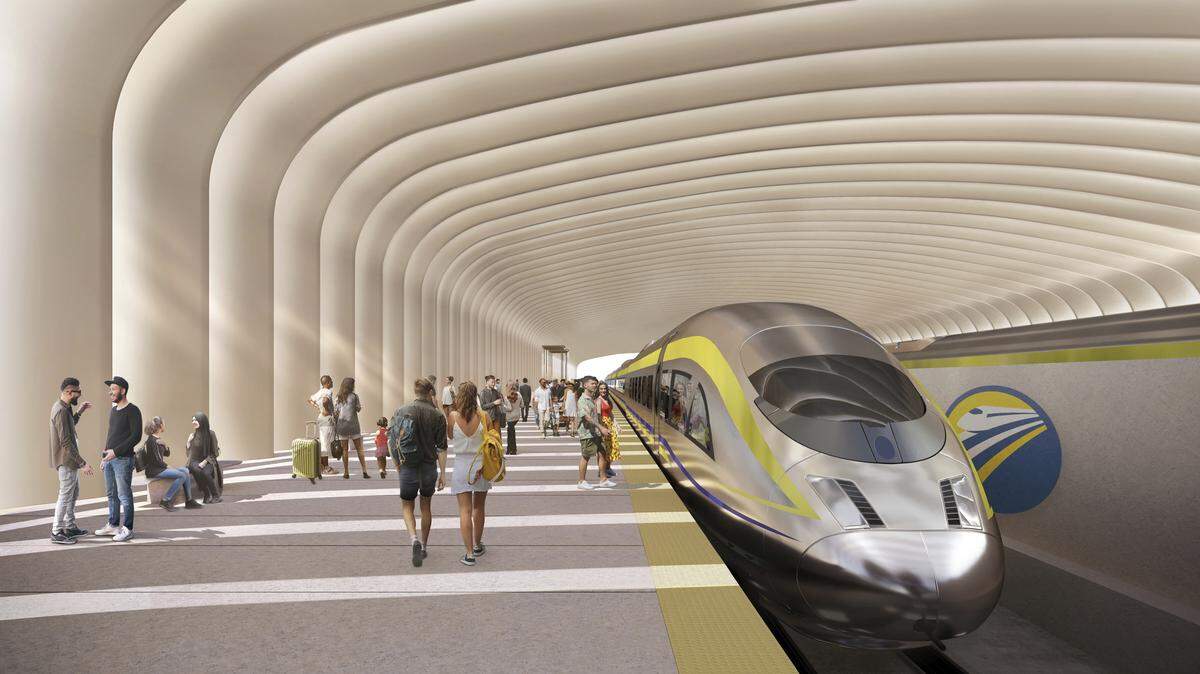
AI-generated summary reviewed by our newsroom.
- Rail authority proposes earlier Palmdale-Gilroy link to boost ridership, revenue
- Revised plan seeks long-term legislative funding and regulatory streamlining
- Estimated $1.6B annual revenue hinges on connecting key population centers
The California High Speed Rail Authority, in an updated business plan released Friday morning, has signaled it is on track to start whisking passengers from Bakersfield to Merced as early as January 2032.
Another sign the authority is thinking business first is the possibility of generating revenue as quickly as possible by focusing on a Palmdale-to-Gilroy connection ahead of a northward push to Merced. This would connect the country’s first bullet train to its two largest population centers by 2038, which the 90-page report predicts could generate up to 18.02 million passengers annually and revenue of up to $1.6 billion.
“I see clearer now more than ever the potential for this transformational project, one that can reshape the state and our society for the better,” said Ian Choudri, the authority’s CEO, in the report. “I see a future — by 2038 to 2039 — when operations are already connecting the Central Valley to population centers and innovation hubs, offering new career opportunities, economic mobility, affordable housing and a cleaner environment.”
The report, which was signed off by Gov. Gavin Newsom, provides a more optimistic view of the high-speed rail project than what the Trump administration has called “a train to nowhere” with no “viable path” to completion. Transportation Secretary Sean Duffy announced he was pulling $4 billion in federal funds from the project.
Earlier this week, House Committee on Oversight and Government Spending Chair James Comer opened an investigation into the rail authority for “apparent repeated use of misleading ridership projection” in getting federal funds.
In June, Duffy released a 300-page report by the Federal Railroad Administration finding that the authority missed deadlines, had budget shortfalls and overrepresented projected ridership. Choudri, responding to the report, said the reports claims were “cherry-picked and out of date, and therefore misleading.”
We believe the high-speed rail’s new business plan addresses concerns by the federal government and realistically calls for the state Legislature for long-term funding and policy changes. Choudri said the project, since its inception, has “faced almost unprecedented hurdles, including a lack of continuous political support to insufficient jurisdictional authority, costly and duplicative regulatory requirements and chronic underfunding.”
State lawmakers should read the report, hold public hearings and address concerns by the rail authority. The skeleton of the high-speed rail is there in plain view. It is time to start putting some meat on those bones.
A road to financial stability
The report makes clear that a Bakersfield-to-Merced connection will fail to generate revenue to offset expenses. However, the rail authority is required to spend its funding on this connection. It would prefer to invest in the Palmdale-to-Gilroy connection that would allow passengers to connect at the southern end to existing rail and transportation services to Los Angeles and at the northern end to Caltrain and other existing connections.
It does make sense to have a rail service that generates the most revenue so that the public — and naysayers — can see that high-speed rail is not a pipe dream.
Legislative approval will be needed for the rail authority to reprioritize its work.
“It means deferring segment delivery,” the agency told Fresno Bee reporter Erik Galicia. “Building first to Gilroy, where the resulting ridership and revenues are substantial and sufficient to help fund future segment deliveries, like Merced, where farebox recovery is insufficient to cover operations and maintenance costs.”
The 90-page report provides the most comprehensive plan of how high speed rail will become a reality a quarter of a century after voters passed a 2008 ballot measure authorizing $9.95 billion for the project.
The plan provides a realistic view of how project Choudri envisions “a clear path to achieve commercial success at the earliest possible stage, ensuring the system begins generating compelling economic return and maximizing the value of California’s investment.”
The rail authority is counting on $1 billion annually for the next 15 years from the state’s cap-and-trade program, $4 billion the Trump administration is trying to claw back and additional funding from the private sector.
It is also looking at additional revenue from parking, billboards, train station naming rights, advertising, baggage fees and the sale of excess property.
California voters approved a high-speed rail project in 2008 by passing Proposition 1A. This ballot measure authorized $9.95 billion in bonds to fund the project. The goal was to connect major cities like San Diego, Los Angeles, the Central Valley and the Bay Area with high-speed rail.
Choudri’s reassessment of the entire project puts high-speed rail back on track. Legislators must now do their part.
This story was originally published August 23, 2025 at 5:30 AM with the headline "CA high-speed rail plan puts country’s first bullet train on correct track | Opinion."