
In Memoriam: The Bee’s Peter Schrag was one of the great minds of California journalism
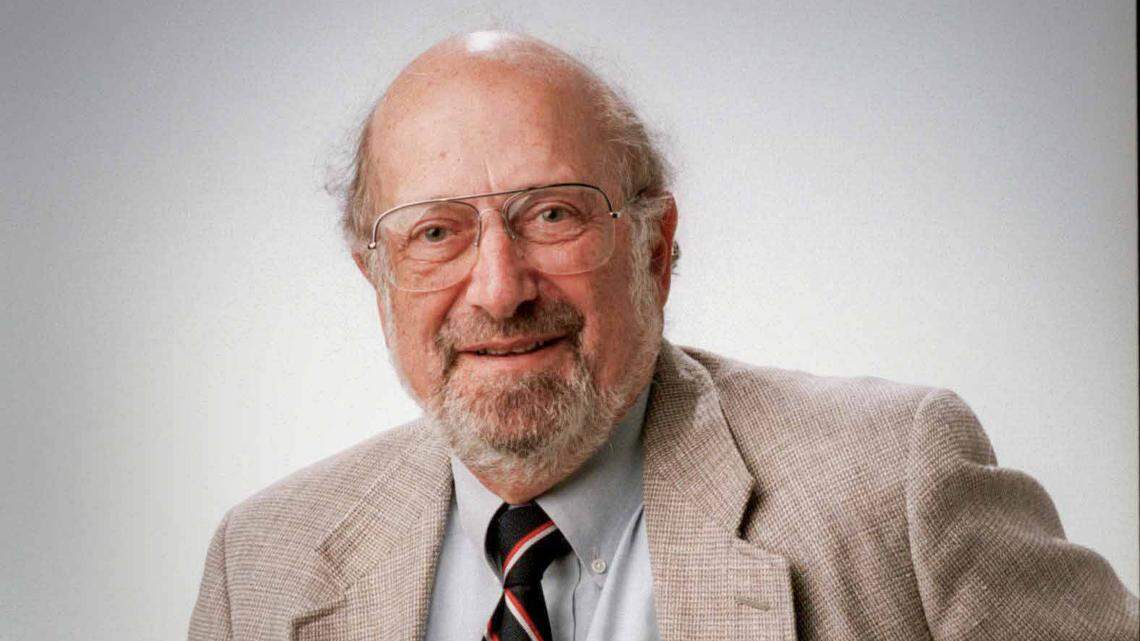
Peter Schrag, a former editorial page editor of the Sacramento Bee who died at age 94 on March 19 in Davis, was one of the intellectual giants in the history of California journalism. Yet pigeonholing Schrag to this city and state doesn’t begin to capture the many dimensions of an extraordinary life that began as a child refugee fleeing Nazi Germany.
Schrag was The Bee’s thought leader from 1977 to 1996. I was the first hire onto The Bee’s editorial board in 1997 after his departure. Schrag’s presence still loomed large. He couldn’t resist returning to the newsroom for a meeting with some dignitary — leaning back in a conference room chair, hands behind his head, unless his gray beard needed a scratch.
Possessing a stunning breadth of knowledge, Schrag couldn’t help but be intimidating, with seemingly no subject left unresearched. Yet above all, he was always so downright nice.
“I will forever remember him telling me to ‘turn it over one more time,’” recalls one of his last Bee hires, Susanna Cooper. What did he mean by that? “Be both more analytical in your thinking and precise with your words,” said Cooper, who became and remains a respected voice in California education policy. “This mantra will be with me always, as will his kindness and humor.”
Peter Ludwig Schrag’s ascent in California journalism came about by opportunity rather than design. Born in Germany in 1931, Schrag grew up on the East Coast. A graduate of Amherst College, Schrag’s first job out of college was reporting at the El Paso Herald-Post. He returned to Amherst two years later, working in communications and spending time frequently in New York. There he became a fixture in the New York publishing world, freelancing for the likes of Harper’s and Saturday Review, where he became a contributing editor.
He temporarily resided in Los Angeles in 1973 to cover the trial of Daniel Ellsberg, the military analyst charged by federal attorneys of the Richard Nixon administration with espionage and conspiracy for leaking documents detailing the failed Vietnam War. The documents were known as the Pentagon Papers. The case against Ellsberg, ultimately dismissed, became the subject of one of Schrag’s multiple books.
Four years later, a longtime friend, Frank McCulloch, had become a top editor at The Sacramento Bee, owned by the McClatchy family. McCulloch suggested that Schrag meet with the family’s patriarch of that generation, a man known simply by his initials — C.K.
C.K. McClatchy was looking for someone to lead opinion writing. “I’d never thought about editing an editorial page,” Schrag, more accustomed to long-form writing, recalled in his memoirs. “So I wasn’t sure I could do it.”
In search of minds with ‘policy chops’
What an understatement. Schrag did not assemble some traditional editorial board of journalists attempting to occasionally ponder the news. Instead, he created the equivalent of a post-doctorate program to study California, the United States and the world.
Rather than produce term papers, this team produced daily analyses to share with readers. “He hired people with policy chops,” said one of his great recruits, Mark Paul, who rose to become his top deputy. Other scholar/writers included Rhea Wilson, Robert Mott, John Jacobs, Ginger Rutland and Bill Kahrl.
Schrag started when the Bee still arrived on Sacramento doorsteps in the afternoon. The static news cycle gave Schrag’s editorial board a rhythm that continued long after I arrived.
On the second floor of the now-demolished brick building at 2100 Q Street, editorial board members in their offices would finish and distribute drafts by 10 a.m. The meeting in the boardroom, lined with historical Sacramento photos, began at 10:30. Discussions could become tense, even heated, before landing on the consensus opinion. Mott in particular was savage about bad writing.
After retreating to our offices to polish our drafts for editing, the board in unison would head to the third-floor cafeteria for lunch. Newsroom reporters would look at us like some wayward herd.
“It was a wonderful, collegial situation,” Paul said.
The pace was “shockingly difficult,” said Rutland. Schrag “made me smarter.”
In terms of pure writing prowess, nobody could keep up with Schrag. “He was there before everybody,” Paul said. “He was writing four days a week,” an astounding level of production for a scribe, an editor and an office manager. “Plus a weekly column.”
Schrag could barely suffer the sleepy and parochial politics of Sacramento, gravitating to the debates inside the Capitol. He loathed California’s initiative process, fueled by money and narrow influences. His book, “Paradise Lost: California’s Experience, America’s Future,” made The New York Times’ notable book list. His passing was worthy of a Times obituary, a rarity for a Sacramentan.
“He brought both a journalist’s skepticism and a refugee’s gratitude to his work,” remembers his son, David. His father was “always striving to understand and improve the society he had come to call his own.”
His son remembers how Schrag could write about anything, from his usual diet of weighty policy matters to “high school football in Chico, to Willie Mays turning 40 or the first black football player in the Southeastern Conference.” But his passion was undoubtedly education and the betterment of California’s children. Cooper, a fellow Amherst graduate, gravitated toward the same subject; Schrag loved California “for all its promise, shortcomings and complexity,” Cooper said.
Schrag is survived by his wife, Patricia Ternehan, and his children, Mitzi, Erin, David, Ben and Sky. His life will be honored at a private memorial service.
This story was originally published April 15, 2026 at 5:00 AM with the headline "In Memoriam: The Bee’s Peter Schrag was one of the great minds of California journalism."