California House candidates spar on prices. What it means for tossup election
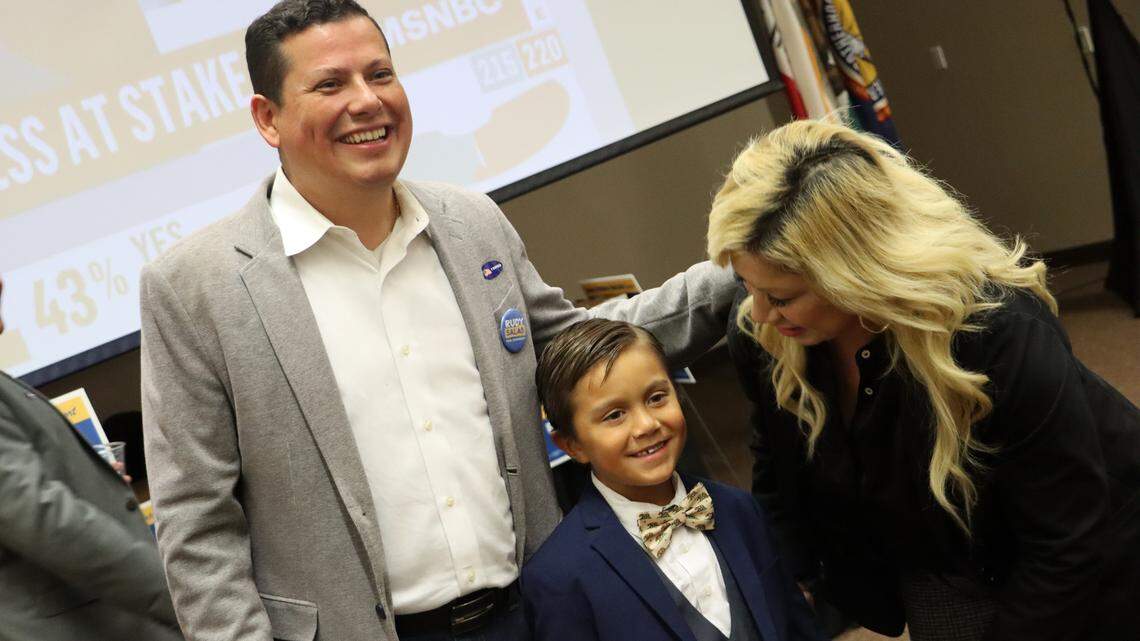
Much of California’s 22nd Congressional District debate centered on costs and income — from groceries, gas, medicine and housing to wages, unemployment and protecting small businesses.
Rep. David Valadao, R-Hanford, and former Assemblyman Rudy Salas, D-Bakersfield, squared off Wednesday as they vie for one of the nation’s most competitive congressional races could help determine whether Democrats or Republicans control the chamber in 2025.
Voters’ top issue in this part of the San Joaquin Valley, a politically purple agricultural hub, is the economy. A message that appeals to voters on reducing costs will be key in deciding which candidate prevails in this tossup rematch election.
Valadao, 47, argued at the debate that regulation in the state’s capitol, where Salas served for a decade, is a main reason for higher costs on San Joaquin Valley families. Salas, 47, countered that Congress could do more to alleviate high prices, and that Valadao didn’t support key measures to help.
“Rudy Salas has been there for 10 years, serving with Governor Newsom, and they continue to increase prices on folks,” Valadao said. “I mean, you see fuel prices at the highest level in the nation. We’ve got the highest fuel price of anywhere in the nation currently. We’ve got the highest housing prices. We’ve got the highest food costs. We’ve got the highest pretty much everything across the board.”
Congress and the state Legislature aren’t the top drivers of inflation and high prices, experts said.
“From basic economic principles, we know that the biggest things that influence inflation are overall supply and demand and the money supply,” said Elaine Peterson, an economics professor and director of the economics program at California State University, Stanislaus. “And the money supply in the United States is controlled by the Federal Reserve.”
“Big picture: You would not typically think of Congress, and you certainly wouldn’t think of the state Legislature, as being a major factor in affecting inflation,” said Derek Stimel, an associate professor of teaching economics at the University of California, Davis. “It’s usually other things well beyond that.”
Still, there are ways that the legislative bodies impact costs through policies. “The main ways we would think about that is through taxation changes or various government spending changes,” Stimel said.
Peterson said increasing the housing supply to keep up with demand would also alleviate costs. “One of the things I think that government can do is try to reduce some of the restrictions on supply and make it easier to increase the housing supply,” she said.
Advertisements and attacks from the candidates and different political groups have commented on Salas’ Assembly record on gas and other taxes and Valadao’s votes on health care, like the insulin cap, including at Wednesday’s debate.
“It’s making sure that we’re doing everything that we can to bring down those costs, right,” Salas responded Wednesday night. “Things that Mr. Valadao has failed to do in Congress — whether it’s the price of medicine, whether it’s just affordable housing, whether it’s any price to bring things down to alleviate the cost for actual people here in the Central Valley, he’s failed to do.”
It’s also important to recognize how little just one of 80 members in the California State Assembly and 435 in the U.S. House can do on prices. Said Stimel, “You’re limited, obviously, in terms of what you could do and how you can impact things.”
Assembly and taxes
Valadao alleged that while Salas voted against raising the gas tax in 2017, he voted on 38 other bills that would raise costs.
The jab was connected to a 2022 Fox News report that claimed Salas “voted for dozens of tax increases despite a pledge not to support tax hikes without voter approval.”
Salas was the only Assembly Democrat to vote against a gas tax increase in 2017, costing him a high profile committee chairmanship. He has cited his vote to describe his ability to go against his own party and lower fuel costs. In 2017, he told The Bee he opposed the hike because of a campaign promise not to support new taxes unless they went before voters for approval.
Fox reported that at least 38 times after voting no on raising the gas tax, Salas voted on legislation to affirm or introduce taxes and fees.
A Salas spokesperson at the time told the news outlet that GOP Assemblymembers also supported about half of the 38 bills, and the other legislation introduced fees, not taxes: “Several were fee increases on lawyers and toxic disposers. Others simply kept existing fees in place without an increase. And a few were small fees for various state licenses.”
The report cited several examples, such as his 2021 yes vote to set up the national suicide prevention hotline in the state. The law passed in 2022, implementing a monthly telecom fee, like that imposed for 911, of 8 cents for the first two years and a lifetime cap of 30 cents. Salas abstained from the 2022 vote.
As far as gas, California’s high prices are not only caused by the state’s taxes and fees, experts told state lawmakers last month.
California averaged the nation’s highest regular and mid-grade gas prices on Friday, according to AAA, and was second to Hawaii for premium and diesel. California’s strict clean fuel standards require a different gas blend that’s more expensive to produce than what’s used in other states.
“For example, when a hurricane will take out something that is supplying our gasoline, our formula, then you’ll see a spike in the energy costs here more than in other areas,” Peterson said.
Congress and insulin prices
Salas prodded at Valadao’s vote against capping insulin prices at $35 a month in 2022.
More people die of diabetes in Kern County than anywhere else in the state, debate moderators pointed out. Nearly 80% of Kern County residents are considered overweight or obese.
Valadao said he voted no because it was an arbitrary cap that would lead pharmacies and companies to buy prescription drugs from other countries where the medicine is cheaper and potentially worse.
“The idea that we’re going to inject ourselves with products from countries that are just meeting the price point, instead of actually making sure that we’re delivering a safe product that we can use as a medicine here in the Central Valley and across the nation, I think is a very important point that was not addressed,” he said.
To lower medicine costs across the board, he contended supporting tort and regulatory reform, transparency and competition.
The broad 2022 insulin cap did not make it out of Congress, but a $35 cap for Medicare recipients passed through the Inflation Reduction Act. Valadao alongside House Republicans also voted against this broad spending package.
Three pharmaceutical companies dominate the insulin market, and a lack of competition is part of why U.S. prices are some of the highest in the world, news project Changing America reported in 2022. Following the Medicare cap and years of pressure from lawmakers and advocates, the three companies agreed to cap co-pays for insulin at $35 a month, with the last company signing on in January 2024.
The downside of price caps is that they can lead to a shortage, Stimel said. For insulin, “People have to have that, and so price capping that kind of thing to kind of offset this market power makes sense.”
Economy and the San Joaquin Valley
The economy is the top issue for voters in this San Joaquin Valley district, followed by homelessness and immigration, according to an Emerson College poll sponsored by Nexstar. The poll was conducted at the end of September among 350 “very likely” voters in California’s 22nd.
Additionally, 62% of these voters reported having had to choose between paying for groceries or utilities. And 62% of respondents also said they’ve thought about leaving California due to the high cost of living.
California ranks 50th nationwide in housing affordability due to the high home prices, according to WalletHub’s Best States to Live In study. The state has the third highest weekly average on grocery prices in the most recent census data, which was collected in October of last year.
“California also ranks as one of the most expensive states for food prices,” said Chip Lupo, a writer and analyst at WalletHub. “High energy and transportation costs contribute greatly to California’s food inflation.”
“Congress and state legislatures can affect gas, housing, and food prices via subsidies, zoning laws, and price controls on essential goods,” Lupo said. “However, government intervention can only offer temporary solutions, as it cannot fully dictate prices. Those are ultimately determined by market forces and external factors such as global supply chains.”
This story was originally published October 4, 2024 at 3:06 PM with the headline "California House candidates spar on prices. What it means for tossup election."