Central Valley candidates in key California House races cast as moderate. Are they?
San Joaquin Valley candidates often pitch themselves as moderate and willing to put policy over party in California’s agricultural middle, where two Republican incumbents represent districts that Democratic President Joe Biden carried in the most recent presidential election.
But are they truly moderate? And what does that mean anyway?
Among nonpartisan accountability organizations, ProPublica ranked legislators through July 2024 on how often or not they voted against their party.
ProPublica had Rep. John Duarte, R-Modesto, leaning toward “often,” ranking 101th out of 435 for breaking with party. He did so 8.6% of the time.
Rep. David Valadao, R-Hanford, voted against the GOP majority “often,” ranking 27th out of 435, and doing so 14.7% of the time.
Another congressional watchdog, VoteView, places lawmakers on an ideological spectrum. Valadao and Duarte are more toward the middle than most of their fellow Republicans.
The Lugar Center’s Bipartisan Index also sets scores each session. Valadao had the 38th highest score and Duarte had the 201st out of all the House members in 2023.
The index looks at how often a lawmaker cosponsors a bill introduced by the opposite party and how often their own bills get cosponsors from the other party, with a higher score meaning this happened more often.
Duarte is the lowest rated Republican by Heritage Action for America, affiliated with the conservative Heritage Foundation. Valadao also gets a low rating. Three Republicans elected mid-term don’t have scores yet.
Duarte, who has only been in the House for one two-year session, gets 41%. Valadao gets 57% for this session, and a lifetime score of 47%. The average House Republican gets 73% this session. They devise the score based on votes and cosponsorships of bills that matter to the organization.
The records of the two Republican incumbents in tossup House of Representatives races appear to fit an overall trend: rising polarization and the decline, or change, of the elected moderate.
The San Joaquin Valley congressmen vote against party more than most Republicans. But it’s not that common for any member of Congress now. Voting records are far from the only thing that can help identify whether someone is overall moderate or not.
Over time, the parties in Congress have grown more cohesive and reduced bipartisan voting on legislation, said Samara Klar, a political science professor at the University of Arizona. Plus, politicians’ party positions have moved further away from each other, she said, “largely because we’re seeing less bridging between the two parties.”
But among voters, Klar said, “We actually don’t see any evidence that Americans themselves are becoming more ideologically extreme. Most Americans typically call themselves moderate, and that’s been the case for a long time.”
In summary, Klar said, “Candidates are becoming more extreme. Voters are not.”
Candidates
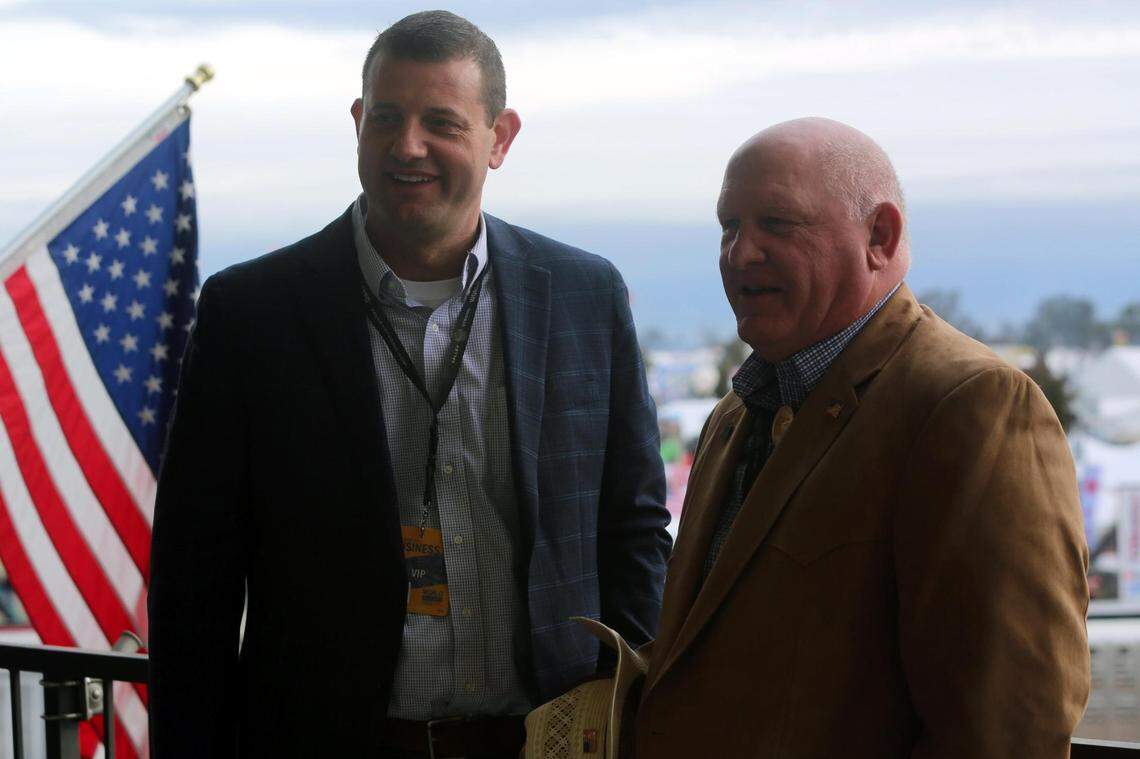
The tossup congressional districts are represented by Duarte and Valadao, who are often described as moderates, whether by colleagues, consultants, constituents, experts, the media or themselves.
In response to an inquiry about this topic last year, Valadao spokesperson Faith Mabry wrote, “Congressman Valadao is willing to work with anyone — whether they have an R or a D by their name — if it means getting results for the Central Valley. He will continue to be an independent voice in Congress who puts the needs of his constituents over partisan politics.”
Duarte said in an interview last month, “I’m definitely a moderate. If you look at Heritage Action and their rating of current sitting U.S. congressmen and women, I am the lowest Republican in all of Congress. So if that’s not a moderate, I don’t know what it is.”
“It makes it harder to fundraise because a lot of people who give money tend to be very partisan and very motivated from the further outside ends of the party,” he added.
Running against them are two Democrats also described as moderate or similarly willing to stand up to their party: former Assemblymen Adam Gray, D-Merced, and Rudy Salas, D-Bakersfield.
“I’ve shown voters that when you respect the other side, when you work with people, you can get stuff done,” Gray said in an interview last month.
All four candidates have bucked their party in memorable ways.
Valadao voted to impeach former President Donald Trump in 2021, leading him to face a pro-Trump Republican in primaries since. Duarte was one of two Republicans in 2023 who voted against GOP immigration legislation that had an employment eligibility requirement. Both are members of the bipartisan Problem Solvers Caucus.
Gray lost committee assignments over breaking with Assembly Democrats on water issues, and helped launch the bipartisan California Problem Solvers Caucus.
Salas voted against a gas tax increase, costing him a key committee chairmanship in 2017.
“I lost my chairmanship over it,” Salas told The Bee in 2022, “but it was the right thing to do.”
There are more tools that try to gauge congressional polarization than in the California State Assembly. A Politico report last week noted some Democrats’ surprise that Republicans were casting Gray and Salas as liberals.
The districts
Duarte and Gray compete in California’s 13th Congressional District and Valadao and Salas vie in California’s 22nd this November. These tossup districts are among several in California that could help determine whether Democrats or Republicans control the House in 2025. Democrats need to flip just four seats nationwide in November to gain a majority.
It’s particularly important for the Republicans to attract more left-leaning voters given the districts’ makeup.
Biden would have won both by more than 10 percentage points in 2020 had current legislative boundaries been in place (redistricting changed congressional maps based on 2020 census data). Each district has more Democrats registered than Republicans, with large proportions of no-party preference voters.
Being Independent or no-party-preference does not mean a voter is moderate, said Klar: “Independent voters are often not moderate at all. They have very partisan preferences, but they just don’t identify with either party.”
Duarte beat Gray in California’s 13th by fewer than 600 votes in 2022. Valadao beat Salas in California’s 22nd by 3 percentage points that year.
Split-ticket voting, when people choose candidates from different parties for different offices, has boosted support for Republican candidates here even as Democratic presidential candidates prevailed. Still, nonpartisan election analysts have said the national reduction in split-ticket voting will likely reach the San Joaquin Valley.
Turnout tends to have a strong impact in these Latino-majority voting-age districts. Presidential general elections have historically spurred the most turnout in the San Joaquin Valley, including with high turnout nationwide in 2020, but voters here are still typically less engaged than in other parts of California.
Decline in moderates
Defining moderates, and identifying who is one, is difficult, experts said — ranging from having centrist to very mixed views and being willing to compromise. The ideological spectrum is always shifting; someone who might come across as moderate now might not have been decades ago.
“The classic definition of moderate Republicans used to be that they were socially tolerant but fiscally conservative,” said Geoffrey Kabaservice, the vice president of political studies at the Niskanen Center, a center-right political think tank in Washington D.C. “That’s still kind of a working definition, but it’s a little harder in some ways to define what social tolerance is. It’s always a moving thing.”
Kabaservice, author of a book on the subject, said that the decline in the moderate has come since the Eisenhower administration in the 1950s. Trump has accelerated the change, altering who gets defined as a true Republican.
“One way to identify who is relatively moderate is that they’re getting primaried by somebody further to their right or further to the Trumpy populist edge of things,” said Kabaservice.
The party makeups have traded a lot overtime too, with more Republicans being non-college educated, working class, and Democrats being college educated and affluent, he said. Rhetoric and where people get their news has changed the political landscape, and made it more difficult for moderates to operate.
“It’s a much more divided country,” Kabaservice said.
Raising money is also important and donors have become more polarized, said Hans Noel, an associate professor of government at Georgetown University, forcing moderates to spend more time fundraising.
Rhetoric demonizing the other party has also made compromise difficult and given moderates less to do if they get to Congress. Now, it’s hard to determine who is centrist versus presenting as a moderate versus disliking the Republican Party shift under Trump, Noel said.
Whether polarization is driven by politicians or voters is hard to determine.
“Politicians, maybe they care about some of this stuff, but they really just want to get reelected,” Noel said. “So they are trying to follow the voters, and the voters are taking their cues from political leaders and people they trust, which includes politicians.”
Said Noel: “In order to get voters in those places to be comfortable with them, they have to avoid taking some of the core stands that their own party takes in order to build their own brand.”
This story was originally published October 1, 2024 at 2:03 PM with the headline "Central Valley candidates in key California House races cast as moderate. Are they?."