Modesto growth plans could spark another fight with Wood Colony residents
Les Johnson, a resident of Wood Colony for 64 years, reflected the views of residents who packed a meeting Wednesday at Hart-Ransom School near Modesto.
“I am not for any changes in Wood Colony,” he said. “No subdivisions. No industrial. Keep it farming. Keep it that way.”
Proposals for city encroachment into the historic farming area on the western fringe of Modesto ran into vocal opposition in 2014. The Modesto 2050 general plan update is setting up another round of fighting in the land use struggle.
About 120 people attended this week’s Wood Colony Municipal Advisory Council meeting to hear the city’s presentation on land use alternatives in the long-range growth plan. Vocal residents were not any more open to development than when they flooded City Council meetings in 2014.
Members of the MAC encouraged residents to submit comments to the city and to voice their opposition to key officials.
MAC vice chairman Todd Heinrich told the audience it will have an impact if large numbers are in attendance when the City Council considers the 2050 General Plan.
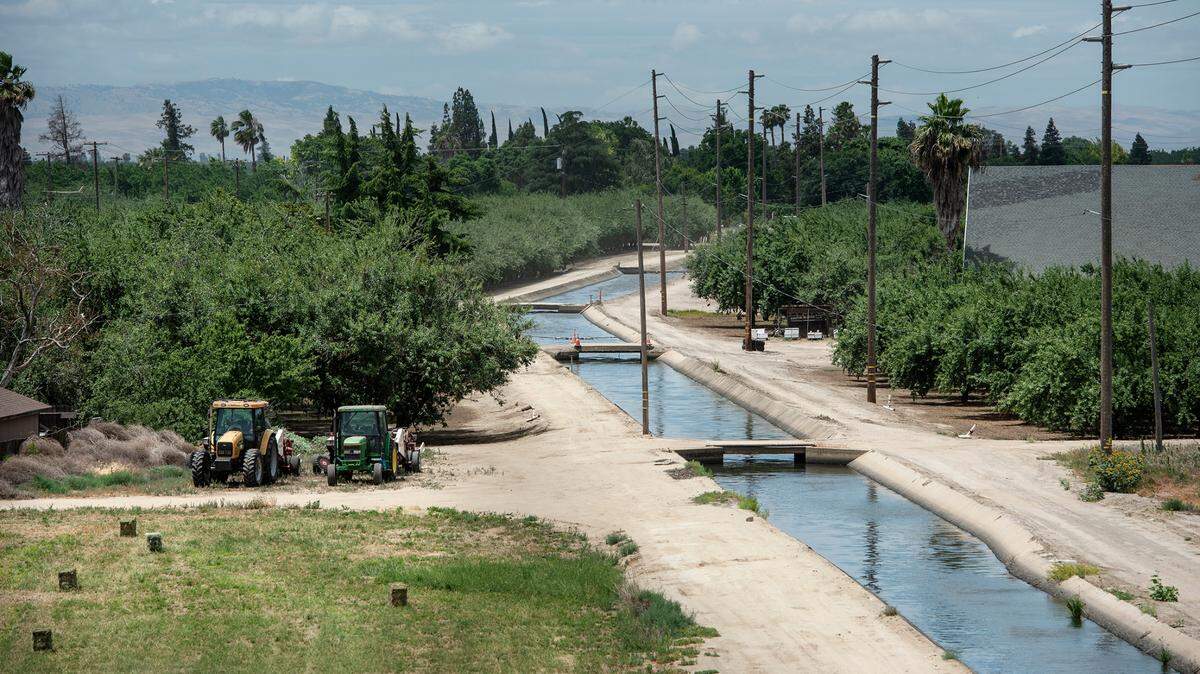
Wood Colony refers to an area where Old German Baptist church members established a settlement in the 1870s. Over the decades, the general area evolved into a community of farmers and ranchette owners who have fought to preserve their quality of life.
The city’s general plan update is regarded as a blueprint for Modesto’s growth through 2050. City officials say Modesto hasn’t grown much since the 1990s and suggest a bolder pattern of growth will increase general fund revenues.
Right now, Modesto’s general fund numbers don’t compare well with other cities. Modesto had $153.3 million of those expenditures in 2022, compared to $502.8 by Fresno, $311 million by Bakersfield and $255.8 million by Stockton. The funding supports public safety, parks and other daily operations.
The city’s presentation also shows that Modesto’s city limits have grown 36% since 1984, while Patterson has grown 482%, Riverbank 200% and Turlock and Ceres 119%. The four other small cities in Stanislaus County also have grown more than Modesto, according to the presentation.
The city is considering three alternative land use proposals for its Modesto 2050 General Plan, all of which could push city growth north of Kiernan Avenue between Stoddard Road and McHenry Avenue.
As far as Wood Colony is concerned, potential development in the “Beckwith Triangle” area has emerged again, with regional commercial development and business centers proposed across Highway 99 from Vintage Faire Mall.
Another alternative treads closely to Wood Colony territory by proposing business center and industrial development along the Highway 132 bypass route as far as Hart Road.
Heinrich said the Beckwith Triangle proposal is there only because a landowner wants to sell for development.
Heinrich said he believes city leaders favor the most aggressive of three growth options, which would add 13,860 acres to Modesto’s sphere of influence. That option would carpet another agricultural area, north of Modesto, with low-density housing between Kiernan Avenue and Ladd Road.
Jessica Hill, director of community and economic development for Modesto, said a 760-acre area in the middle of the territory west of Modesto, between Beckwith Road and Woodland Avenue, would not be touched by development. She identified the area with the original Wood Colony boundaries, but residents are adamant that Wood Colony today is a broader area than those 760 acres.
“We are a farming community,” said Municipal Advisory Council member Lina Ruggirello-Danzig. “We are part of Modesto’s legacy and need to be protected.”
Development to the west could snowball
Ruggirello-Danzig said she believes development in Beckwith Triangle will snowball and lead to paving of additional farmland. She said as many as 400 Wood Colony supporters attended the meetings in 2014 to urge the city to leave their community out of Modesto’s growth planning.
The turnout at Wednesday’s meeting suggested to her that the community remains passionate.
Hill said the city has held general plan workshops to receive public feedback, and it extended a Jan. 15 deadline for comments on the three land use alternatives. The city Planning Commission, perhaps in March, will choose one of the land use maps, and an environmental study will be conducted.
The City Council could consider the general plan update and make a decision on next steps in 2027, Hill said.
Wood Colony folks are not the only critics of the growth proposals unveiled at city workshops in December. Denny Jackman, a leader in Voters for Farmland, said in a late December statement that the growth proposals are a repeat of flawed planning.
“Of course small cities grow at a faster rate than the big Modesto,” Jackman said. “The Modesto voters have routinely voted against large annexations. They want a better Modesto, not a bigger Modesto.”