Modesto revises rule on masks at protests. ‘More unconstitutional,’ opponents say
AI-generated summary reviewed by our newsroom.
- Modesto council unanimously approved revised ordinance banning masks at protests.
- Revision narrows exceptions, bans hardshell helmets, limits umbrellas in heat.
- Civil liberties groups warn the policy is unconstitutional and may prompt litigation.
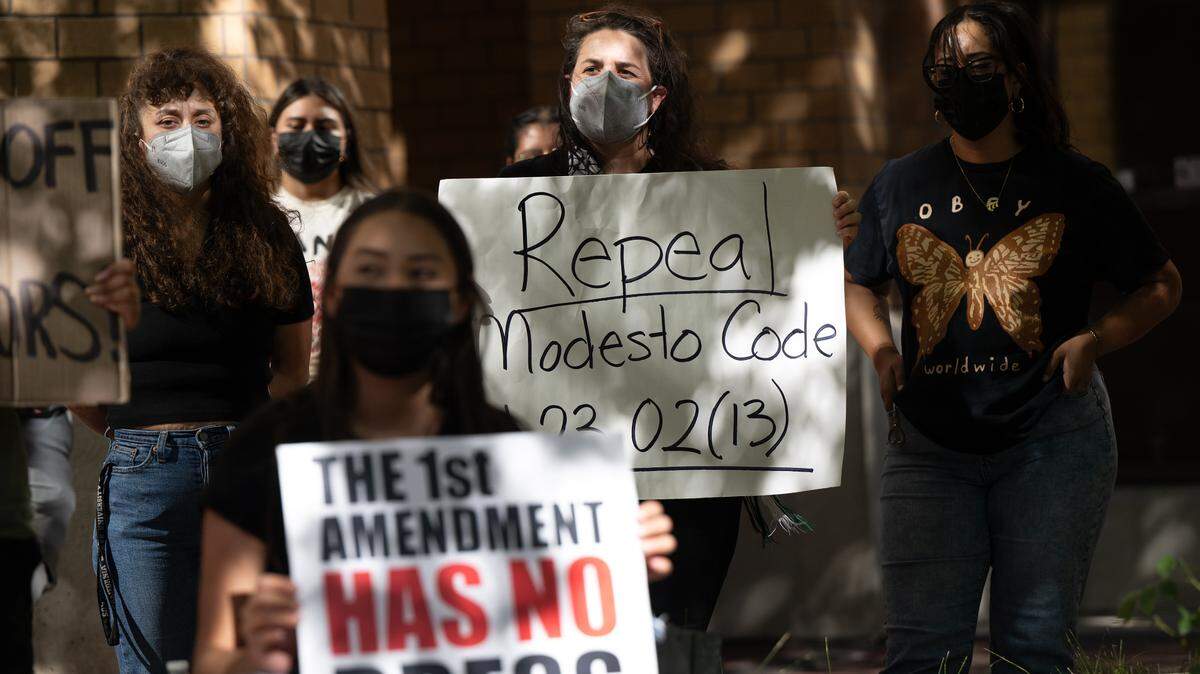
After an hour of public comment and zero discussion from the dais, the Modesto City Council on Tuesday night unanimously passed a revised public assembly ordinance that, among other restrictions, still prohibits masks at protests.
The revisions primarily clarify the exceptions to the face-covering ban, specify which types of helmets are barred and outline when umbrellas are allowed at demonstrations.
“No justice, no peace, no fascist police,” chanted several members of the public as they exited the chambers following the meeting’s adjournment.
Of the 19 public commenters, only two spoke in support of the ordinance.
“If someone feels strongly enough about something to protest publicly, they need to protest [while] showing their faces,” said Terhesa Gamboa.
The rest argued that the amended ordinance remains unconstitutional, criticized the community survey for lacking context about the ordinance and warned of the American Civil Liberties Union of Northern California and First Amendment Coalition’s potential lawsuit that would ultimately cost taxpayers.
What are the revisions?
The revised ordinance clarifies the exceptions to the face-covering restrictions, which allow religious garments such as hijabs and burkas, as well as medical coverings like surgical or disposable masks. It explicitly bans coverings such as balaclavas and ski masks.
The update also specifies that the rules do not apply to costumes that obscure the face when the covering is part of the “expressive function of the costume.”
Many public commenters mocked the costume amendment, saying it was vague about what qualifies as a costume.
“If I was going to come to a protest in a costume as a masked protester, for example, is now my mask finally a part of my expressive right to then wear that mask?” said public commenter Tom Helme. “That’s how ridiculous it sounds.”
Deborah Fox of the law firm Meyers Nave, which the city had retained for its First Amendment assistance, said the courts recognize costumes as elements of expressive activity, which is why it is an exemption to the ordinance. “You do not have a right to cover your face,” Fox said. “That is not a constitutional right.”
Regarding the ordinance’s ban on helmets, the revision clarifies that “hardshell” helmets, such as motorcycle and standard bicycle helmets, are prohibited, while “softshell” helmets are allowed.
For the rule prohibiting umbrellas when it’s not raining, the revision adds an exception for protection from extreme heat. Umbrellas used for weather conditions must be no larger than 16 inches and must have a blunt tip.
The revision’s purpose is to “reduce violence and vandalism by limiting [the] ability of masked individuals to use anonymity to avoid accountability,” according to Meyers Nave.
Added justification for ordinance
During the meeting, Fox and Modesto Police Chief Brandon Gillespie presented an overview of the proposed ordinance changes, provided a brief history of protests in Modesto and explained the rationale for the ordinance.
The city originally adopted the ordinance in 2019 at the Police Department’s request, ahead of a planned straight-pride rally.
“These revisions are done in order to provide clear guidance to a person of reasonable intelligence of what they can do and not do at a public protest, and also provides the chief and his officers with clear guidelines to the enforcement,” Fox said.
Gillespie shared photos and videos from Modesto protests over the past several years, showing demonstrators and counterprotesters wearing masks and tactical vests and carrying umbrellas and poles. He also played clips of officers asking protestors to remove masks or vests and issuing warnings about the ordinance during 2021 and 2022 protests.
He included footage of clashes between Proud Boys and antifa members. He said anonymity can embolden people even more to instigate a crowd.
“These are not hypotheticals. These are documented incidents from Modesto,” Gillespie said.
He also showed a video of a Black Lives Matter protest in Modesto in 2020, where protestors were seen throwing plastic water bottles at officers. Had the bottles been glass or metal, Gillespie said, officers would have been injured — hence the ordinance’s ban on those types of bottles at demonstrations.
“These images and videos are examples of what our officers have faced over the years,” Gillespie said.
Gillespie said that without the ordinance, violence at the protests could have been far worse. He added that the threat of violence can chill free speech by deterring people from protesting out of fear.
He argued that the revisions provide necessary clarity and that the ordinance is particularly important given the nationwide resurgence of protest activity.
John Mataka, a resident of Grayson, said it didn’t seem like the officers had much of an issue arresting the masked protestors shown in the photos and videos. He also said he didn’t notice any property destruction.
“I understand some of the stuff, like the tactical vest and the sticks. That’s only common sense. But masks, that’s another question,” Mataka said.
Revisions are worse
Prior to the meeting, the ACLU and the FAC sent a letter to the city, criticizing the proposed changes to the public assembly ordinance and calling it “more unconstitutional.”
“The revisions do nothing to address certain key ambiguities in the ordinance and instead lead to absurd results due to the revision’s differential treatment of speech based on content,” reads the letter.
The letter highlights examples where the revision inconsistently allows certain face coverings — like masked costumes — while prohibiting partial coverings such as bandanas or certain sports helmets. The ordinance also leaves some members of the public, particularly journalists who may wear personal protective gear at protests, vulnerable, the letter states.
“Helmets, vests, masks and respirators have helped prevent injury and interruption of newsgathering for an untold number of journalists who bravely report from protest events around the state even after police deploy crowd-control measures,” said Ginny LaRoe, advocacy director of the FAC. “When the next protest, rally or other public assembly occurs, Modesto’s journalists should not be forced to choose between protecting themselves from harm and risking arrest.”
The letter also defends protesters’ right to anonymous speech, saying the city misunderstands why people fear being identified — especially in an era of government surveillance, doxxing and risks to mixed-status immigrant families.
It writes that the city’s justification for a mask ban is also weak or contradictory, noting that MPD had never arrested anyone for wearing masks until the June 14 protests.
The groups had asked that the council reconsider approving the revised ordinance or face a potential legal challenge.
During public comment that preceded the vote, attendees echoed points made in the letter, with many emphasizing that protesters have a right to privacy. One commenter criticized the council, suggesting members were prioritizing political gain by appeasing constituents who support the ordinance.
Juan Telles, who attended the 2020 protests, said that although those demonstrations got chaotic, there had been a sense of trust between protestors and law enforcement at the time. He recalled wearing a mask and helping shield officers who were cornered.
Telles said that trust was broken during the June 14 protests, when five people were arrested for allegedly wearing masks.
“I feel like a lot of trust was lost between my thoughts about the Police Department and how they handled themselves that day, because it was very similar to how ICE is going into communities and taking folks that look like me,” Telles said.