New grading practices at Stanislaus schools aim to make an F more fair
What’s larger, Heba Morad asks her fourth-grade classroom as she rounds the room: three-fourths or two-thirds? She speaks slowly and clearly, pausing so every student has time to consider the answer. Students pull out markers and begin to draw arrows on the dry-erase boards on their desks. Yahia Shuaibi is quick and eagerly raises his hand with the answer.
He wasn’t always so fast.
When Yahia immigrated with his family from Yemen to Ceres three years ago, he didn’t speak English and struggled in school. “I used to be a zero,” he said with a smile. Now, he added proudly, he is a “three or a four.”
Part of Yahia’s evolution in school was inevitable, because children at his age are adept at learning new languages. Morad deserves credit, too: She has helped Yahia since he was in first grade, when the Ceres Unified School District initially hired her to be his tutor.
But another part of his success stems from an institutional change, a new grading program at Ceres Unified that is designed to help students like Yahia succeed. Instead of receiving the letter grades A, B, C, D and F, elementary students in grades four through six at Walter White Elementary School in Ceres now use numbers, zero to four.
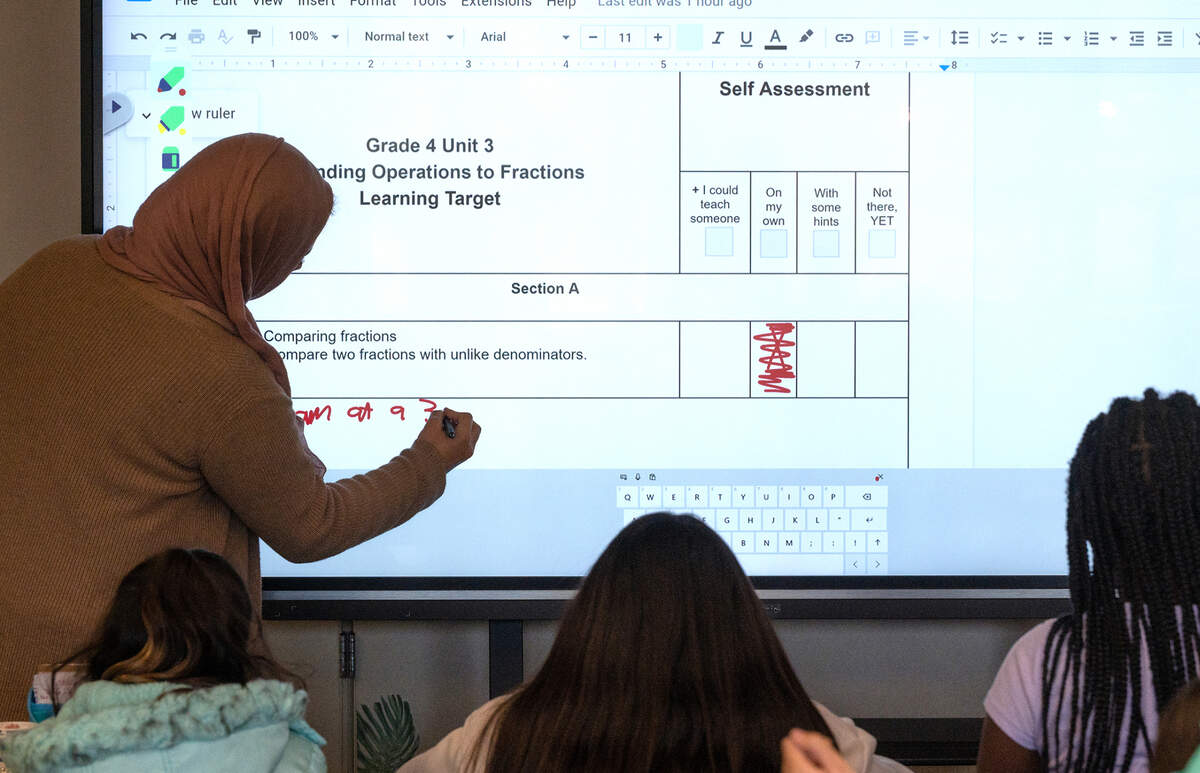
Last year, these alternative grading practices gained new momentum in Stanislaus County as a way of helping low-income students, English-language learners, students of color and other marginalized students to succeed. While each school district has taken its own approach, the through line is a focus on equity.
The new system in Morad’s classroom, known among educators as standards-based grading, is more than just window dressing.
Unlike letter grades, which often are based on a complex formula that includes exams, participation, behavior and extra credit, the numerical grading system focuses exclusively on the student learning, said Morad. As long as they can show “mastery” of the topic — and there are many ways to do that, she said — students will receive high grades.
“I can show mastery by making the video or I can show mastery by doing the website. I do mastery by my favorite way, which is by doing a piece of paper,” said Yahia.
The new system, Morad said, sets clear parameters that help students better understand their own performance and take stock in their own success:
“It’s different from A through F because if you ask a student why they’re at an 83 versus an 85, there’s no clarity. … But with the new grading scale, there’s so much clarity, where students are now telling you, ‘I’m at a three because X,Y,Z’.”

Where an F isn’t so bad
Many school districts in Stanislaus County have researched and tested new grading systems for years. Both Turlock Unified School District and Modesto City Schools already have implemented similar standards-based grading systems in their elementary schools. In Modesto, the numbered grading system is nearly 10 years old, said MCS public information officer Linda Mumma Solorio.
Now, some high school and junior high school teachers have begun piloting similar grading practices. Turlock Unified School District has implemented a new grading practice and plans to further standardize this year. Ceres Unified established an official framework this month for which every school must change its grading policies. Modesto City Schools is hosting a series of trainings and conversations with a scholar who studies equitable grading practices and plans to present an update on its plan at the Jan. 17 board meeting.
One commonality among Ceres and Turlock’s grading systems is a modified point system, either through a numbered system of zero to four similar to the elementary schools or a lettered system of A-F where an F is 50%, not 0%. (Modesto has yet to finalize its new system).
The goal is to give students a chance to recover from a low grade. In the traditional A-F grading system, every letter grade equates to a 10-point interval, e.g. 80-89 for a B, except for an F, which has a 60-point interval, 0-59. That scale makes it “almost impossible” for a student with a missing assignment — i.e., a zero — to recover, said Paul Rutishauser, director of secondary education with Ceres Unified. If a high school teacher chooses to use a 0-4 system, the end grade is converted into a letter grade for the purposes of report cards and college applications.

Morad isn’t worried about missing assignments in the new grading system. Instead, she’s concerned about why the student didn’t complete it. “If you miss an assignment,” she asked, “Is it because you already know how to do it? Is it too easy?”
In other cases, a missing assignment has more to do with a student’s personal life than his or her academic know-how, she said, remembering a time when she was in high school and missed an exam and a few assignments after a family member died. “I went from a B to a failing grade,” she said, adding that the teacher refused to give her make-up opportunities to show that she grasped the material.
Now, in her classroom, as long as students can prove they understand the material, they still can gain a high grade, even if an assignment is missing.
No zero or no consequences
Such “no-zero” policies are increasingly popular across the country, with large school districts in places like Philadelphia, Boise, and Prince George’s County, MD. They also have met considerable push-back. Experts at the Fordham Institute, a right-leaning think tank, echo the concerns of many parents and argue that these “no-zero” policies are lowering expectations for students. “If a student anticipates failing a test, project, or essay, how many will simply avoid any attempt, knowing that only a 50 percent awaits?” wrote Daniel Buck in a blog post this summer for the Fordham Institute. Douglas Reeves, the scholar and consultant who is training Modesto schools, wrote a rebuttal.
In Florida, one teacher quit after refusing to give students “50% for not handing anything in.” In Massachusetts, a school district rescinded its new grading practices a few years after it was implemented. The principal said that “kids just weren’t learning to be responsible.”
The new standards all emphasize that grades should be fair, consistent and accurately reflect students’ mastery of the topic, not their background, income, family situation or the teachers’ opinion of them. For example, the Turlock and Ceres school districts have pushed teachers away from including participation, effort or attendance as part of a student’s grade because these metrics do not reflect a student’s academic understanding and may leave room for bias if poorly defined.

There’s also an equity angle, he added, in which certain homework assignments might disproportionately favor certain students who have a safe, quiet place to finish their homework or the materials to do well on a project like a diorama. He clarified that Ceres junior and high schools may continue to assign homework but that the assignments probably are less frequent than years past.
Across the board, teachers and administrators are adamant that the new system maintains academic rigor.
“We have not found that grades are being watered down — in fact, the opposite,” said Shellie Santos, Turlock’s director of curriculum and instruction: “Grades are based on evidence of a student’s content knowledge and not environment or behavior.”

This story was originally published January 13, 2023 at 9:55 AM.