
Early-grade Modesto teachers protest: Too much testing
A drive to catch kids up and make sure they’re reading by third grade has put heavy pressure on early-grade classrooms. Modesto City Schools teachers say they are testing through much of every day, but administrators insist that tracking kids’ early progress is essential for effective teaching.
“Of the report card assessments provided by the district this school year, 15 out of the 34 standards are assessed one-on-one. Every time I call a student to my table to ‘show me what they know,’ I am no longer available to the 23 other learners in my classroom,” Kirschen Elementary first-grade teacher Jennifer Hayner told the school board Monday.
Hayner said she administered 2,387 tests – nearly 100 per student – during the 2013-14 school year, using recess, library time and even while students were standing in line for lunch. A packet of testing materials given to the board says kindergarten and first-grade testing takes up three months, in total, of the nine-month school year.
Teachers Jennifer McGrath and Erica Middough, with 18 and 21 years’ experience, respectively, told the board the district needs to trust its teachers to know what’s best for students.
“It’s time to drastically take and do away with our current assessments. It’s time to listen to and meet the needs of the students. It’s time to assess our students less and teach more,” they said in a jointly presented speech.
The teachers’ remarks met with widespread applause from hundreds of colleagues standing in the packed boardroom. Teachers also spoke at board meetings in November and February, Modesto Teachers Association President Doug Burton said in his office Wednesday.
“Morale is the lowest I’ve seen it in 24 years in the district,” Burton said. “Teachers are not complaining about having to get data. They’re complaining that the tail is wagging the dog,” he said, explaining data has become the focus, instead of children.
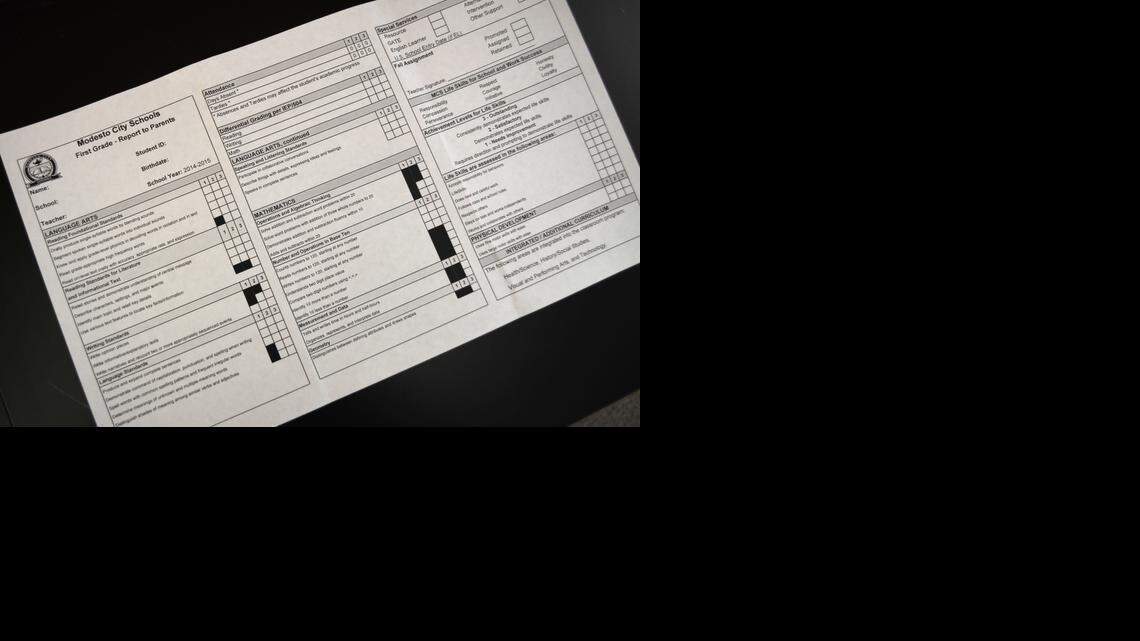
Teachers blame the testing push on report cards instituted last year in kindergarten and first grade, expanding this year to second through sixth grades. The so-called standards-based report cards dropped the old A-B-C system for a 1-to-4 ranking of skills kids are learning. “Along with that new report card came a massive amount of testing,” Hayner said.
Neighboring districts, including Ceres, Turlock and Riverbank, have used similar report cards for years. Their first-grade report cards show roughly the same number of skills being tracked.
But for Modesto teachers, the cards are new, Common Core standards are new and constantly checking kids’ progress on them has not yet become routine, said Associate Superintendent Ginger Johnson.
“I think, just, it’s lots of things coming together. We used to have one assessment. That’s what went on the report card. Now we’re looking for a body of work,” Johnson said, using teacher observations and analyzing classroom work.
Tracking what young students know is far more detailed and demanding today, she conceded. “When I taught first grade, I put a smiley face on the journal and ‘Remember your periods.’ I wasn't marking in: ‘The child wrote a complete sentence.’ There is a greater sophistication today,” Johnson said.
“(Teachers) keep talking about being a data-driven district. I’m not going to apologize for that. When I came – well, you saw the test scores. We weren’t doing very well,” she said. “We have 85 percent (low-income), and it’s amazing how many kids need intensive intervention at the get-go. If they aren’t reading and proficient by third grade, they are different students.”
Different as in struggling. Moving that needle, especially for poor kids and English learners, Johnson said, takes very focused teaching. “There is an emphasis on progress monitoring. Why wait to the end of the year to see if a child didn't make it?”
But 2,387 tests?
“That's craziness!” Johnson said. “Nobody should be doing that, and certainly nobody is asking them to.”
Much testing through second grade is done individually because students can’t reliably read yet, said Kimberly Newton, senior director of educational services. But, she added, the majority are quick checks and not repeated once kids show they can do it.
For example, writing tests can be done by examining the journals first-graders use. “They’re writing every day. We just need to be evaluating that product for expository writing standards,” Newton said.
The first mark on a first-grade report card notes how well the child “orally produces single-syllable words by blending sounds.” In other words, given a prompt of the sounds “c,” “a” and “t,” will he say back, “cat?” Newton explained. That can take a one-to-one test, but if the teacher has heard the child do it during regular class time, it can be checked off – done.
Listening to a child read a passage, or sound out a grid of vocabulary words, are examples of first-grade tests teachers have to give directly.
Beginning readers get a 1 on the report card, showing the skill is not there yet. A 2 means the child has some reading basics down. Earning a 3 signifies a full-fledged first-grade reader. A 4 means the student has progressed beyond what’s expected in first grade.
Administrators and teachers agree the faltering economy has had an impact in the classroom, adding another challenge. Getting to 3 – the “got this!” point – has gotten harder over the past few years.
“We have kids entering our school system with very, very high needs,” Johnson said. “Some of our schools are (reporting) 98 percent of kindergarten students already need intensive instruction.”
The district is holding an unabashedly hard line to meet those needs, Johnson said, mandating very focused teaching that takes constant monitoring to provide.
“It's pretty hard to hit a bull’s-eye if you don't have a target,” she said.
Bee education reporter Nan Austin can be reached at naustin@modbee.com or (209) 578-2339. Follow her on Twitter @NanAustin.
This story was originally published March 5, 2015 at 7:15 PM with the headline "Early-grade Modesto teachers protest: Too much testing."