
Turlock facing $216,000 fine for sewage discharge violations
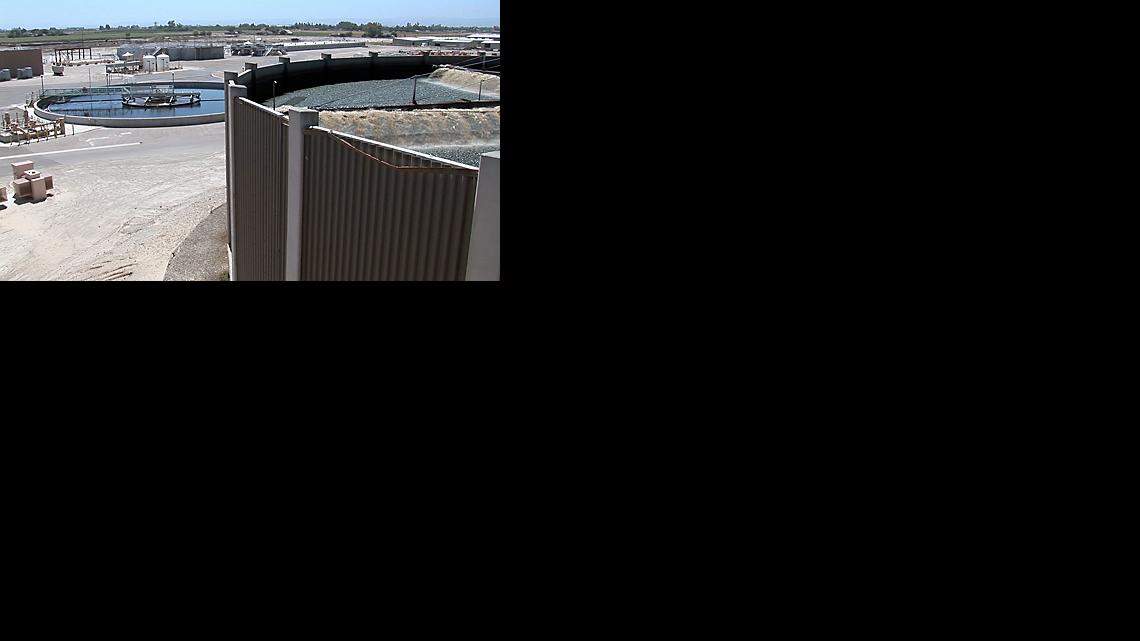
TURLOCK — The Central Valley Regional Water Quality Control Board has proposed a $216,000 fine against Turlock's waste-water treatment plant for 72 discharge violations into the San Joaquin River since January 2000.
Municipal Services Director Dan Madden said the fines are part and parcel of the sewer business and for the past three years the city has budgeted about $30,000 a year in anticipation of them.
Environmentalists said the violations are symptomatic of a larger problem in the Central Valley.
The waste-water treatment facility on South Walnut Road treats the flushings and waste water from Turlock, Keyes, Denair and part of Ceres, 13 million gallons a day.
The system exceeded limits for chlorine residual, pH, settleable solids, total coliform organisms, total suspended solids and turbidity, according to the water board.
The city is negotiating with the board on the number of violations, Madden said.
"To have 72 violations in an eight-year period, actually, isn't that bad," he said.
Some discharges from the sewer system have set minimums and maximums, such as 6.5 pH to 8.5 pH, Madden said. A probe floats in the river of treated waste and whenever the pH goes below 6.5 or above 8.5, regardless of duration, it counts as a violation, he said.
Plant employees collect samples, test them or send them to a lab, and the results are sent to the water board. Each violation is a mandatory $3,000 fine.
"It's virtually impossible to be 100 percent compliant 100 percent of the time," Madden said.
Eating tiny solids in the waste
At the South Walnut plant, 20-foot redwood grids — much like a lattice available at a home and garden store — act as a biological filter. Waste water is pumped over them in circular tanks. Green zoogleal slime — the stuff that grows on river rocks — covers every inch of the redwood and essentially eats tiny solids in the waste water, sinks and is then removed, making the water cleaner.
In October 2002, one of those towers collapsed, Madden said, and the treatment system went down. Once fixed, it took time for the slime to grow back, so even though the system was running, it wasn't at 100 percent, he said. After the tower collapse, the state recorded 16 violations in three months.
In May 2006, the treatment plant went from a secondary to a tertiary system where, after the biological process, waste water is pumped through a tertiary filter, another way to say a really fine screen. Any particles in the water larger than 5 microns are sifted out (for comparison, a period in this paragraph is 615 microns). When the new system was first turned on, the city racked up several more violations while employees worked out the kinks, Madden said.
Whatever the final number of violations and amount of the fine, state law allows for 50 percent of that money to be spent on a supplemental environmental project, Madden said. The city owns four acres on the San Joaquin River that could be cleaned up and turned into an educational site or nature walk, he said.
Also Wednesday, the water board proposed a $48,000 fine against Discovery Bay's waste-water treatment plant, a $60,000 fine to Lake County Sanitation District for sewage spills to Clear Lake, a $153,000 fine against Placer County Sewer Maintenance District No. 3 and a $2.1 million fine against Wil- liams for waste-water violations similar to Turlock's.
In 2004, Hilmar Cheese Co. racked up more than $4 million in similar fines for discharging liquid waste laden with four times the acceptable level of salts in a 120-acre dirt field next to the company's main building.
In 2006, the cheese giant agreed to pay $3 million, to be divided between the state and a Hilmar-commissioned study about ways to reduce salinity in waste water, enraging environmental groups, which called it a pay-to-pollute plan.
Hershey Foods Co. was told to expect $39,000 fines last month for 13 violations from January 2000 to 2008 in which 40 percent more effluent than allowed, including oils and grease, was pumped into the Oakdale Irrigation District's Riverbank Lateral Canal. The chocolate manufacturer had until Wednesday to comment on the charges.
Malfunctions behind violations
Equipment malfunctions and large amounts of toxic material entering treatment plants are the common reasons for most violations, said Jack DelConte, assistant executive officer of the water board. He couldn't speak on Turlock's situation.
"We regulate waste-water discharges to protect water quality, to protect the beneficial uses of surface water and on rivers, for domestic uses, business uses, fish and aquatic life, aesthetics," he said. "This is so the public has clean water."
California Sportfishing Protection Alliance closely monitors water issues across the state. Executive Director Bill Jennings went through the list of Turlock's discharge violations:
- Chlorine residual: "Highly toxic to aquatic life," he said.
Jennings said nothing Turlock discharged by itself would pose a serious problem, but Turlock isn't the only waste-water treatment plant on the San Joaquin River.
"Its symptomatic of a larger problem through the Central Valley, which is more and more people are coming to the valley and the mass loads to these waterways have dramatically increased," he said. "We've not invested properly in the infrastructure, in waste-water treatment plants, sufficiently. We're going to have to invest in treatment plants like roads. ... Well, think about that. What has happened to roads in the last 15 years?"
Bee staff writer Michael R. Shea can be reached at mshea@modbee.com or 578-2391.
This story was originally published March 27, 2008 at 12:33 AM with the headline "Turlock facing $216,000 fine for sewage discharge violations."