California housing advocates throw San Francisco party. What did they celebrate?
AI-generated summary reviewed by our newsroom.
- California YIMBY celebrated passage of laws related to CEQA and transit housing
- The organization pushed for Senate Bill 79, a controversial measure
- Skeptics worry that CEQA rollbacks may favor developers over affordable housing and input
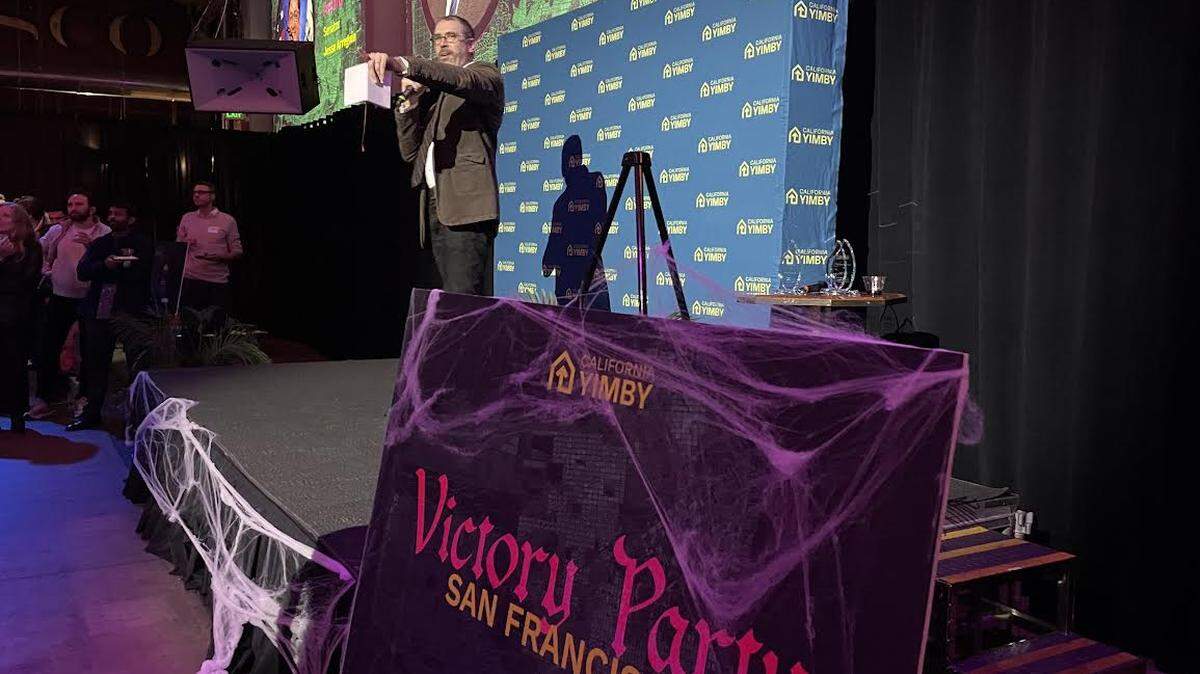
A spotlight illuminated and the DJ lowered the bass-thumping music, when Brian Hanlon stepped up to the stage in the San Francisco event space.
“Welcome to the most victorious of California YIMBY’s victory parties,” said Hanlon, CEO of the organization that aims to speed up home building in the state. The crowd of more than 100 people, many clutching drinks from the open bar, roared in approval.
State legislators this year passed several bills strongly supported by California YIMBY, which stands for “Yes in my backyard,” but two in particular had Hanlon beaming. One creates an exemption from a state environmental law for housing projects in urban areas. The other will require local governments to allow denser and taller housing developments near rail and bus stations — a version of a policy that Hanlon said he has wanted to pass since co-founding the organization eight years ago.
“2025,” he added, “was a year.”
Hanlon wasn’t trying to hide his glee. Neither did anyone else.
Thursday night’s party was an unabashed victory lap for the well-financed organization that has become a major player in the debate over how state leaders should address California’s housing needs.
Its approach — to clear what it sees as regulatory hurdles in land use, environmental and housing policies — has received support from Gov. Gavin Newsom all the way down to local community groups pushing for changes at city planning meetings.
Throughout the event center, there was a hum of excitement and satisfaction, as if it was filled with college seniors on the eve of graduation day.
“This feels like the pinnacle of housing policy in California,” said Ben Raderstorf, the co-president of House Sacramento, an organization that pushes for more home building in the city. He and more than a dozen other people were bused to San Francisco for the event.
Raderstorf, 33, said Sacramento leaders had already taken steps to make it easier to build transit-oriented housing developments across the city before the new state law, called Senate Bill 79, passed. And he was happy to see that it would happen at a larger scale.
“There were enormous structural obstacles that housing advocates had run into for years, and this was the year that it feels like housing policy broke through,” he said.
“But the work is not done,” Michael Turgeon, 30, quickly added. He is a board member of House Sacramento and also was on the bus from the capital city. “None of this really counts until you get people into homes.”
‘Almost everything right’
Bobby Garrity, lives in Southern California, and received an award Thursday for his persistent lobbying of state lawmakers on SB 79, so much so that legislative staff members even knew him by name.
“There is no place more blessed than California,” Garrity said after many in the crowd chanted “Bobby, Bobby” when he got on stage. “And we do almost everything right except for land use and transportation.”
In an interview after his speech, Garrity, 28, said he was troubled by how expensive it was to live in California. He moved to the state from New York several years ago.
He shared in the ambitious zeal buzzing in the room.
“My number one goal in this work and this movement is to end homelessness permanently,” Garrity said.
Skeptics who did not attend the victory party worry that the deregulatory policies California YIMBY is pushing for won’t lead to that and other lofty changes. Instead, they fear the new laws will just result in more money for developers and more high-priced apartments but not a bounty of affordable options.
One of the organization’s main pushes is to add exemptions to the California Environmental Quality Act for housing complexes. The major environmental law, known as CEQA, requires government agencies to consider the environmental consequences of projects before acting on them.
Many see the organization as unfairly painting the law as a boogeyman, contributing to a larger narrative that it is an obstacle not just on home building, but also for oil production and building manufacturing plants.
“We need an all-of-the-above approach,” said Asha Sharma, a state policy manager for the Leadership Counsel for Justice and Accountability. “It’s not affordable housing or public health. We think we need both and people deserve both.”
Differing views on CEQA
Hanlon, in an interview after his speech, agreed that CEQA was not the only reason for the state’s housing challenges, but he called it an important impediment. Opponents of housing developments have tried to use the law to delay or kill projects they don’t like. And, he went further: He said the law gets more praise than it ultimately deserves.
“California should be proud of the environmental work we’ve done,” he said. “But it’s not because of CEQA.”
Howard Penn, executive director of the Planning and Conservation League, doesn’t dispute that the law is misused from time to time. But he said it creates a review process that protects not just the environment but also people who live near a project. If issues aren’t addressed on the front end, local governments and communities will bear the brunt of extra costs and other negative effects.
“I’ve seen this proven over and over again, how important it is to provide public input,” Penn said in an interview Friday. “If you keep exempting CEQA, and bypassing CEQA, where’s the democracy — the public involvement — in these things?”
Those policy debates weren’t a part of the celebration in San Francisco. But they hung over the event.
State Sen. Scott Wiener, D-San Francisco, told the crowd, during his own speech, that the politics around state housing laws have shifted, but not dramatically. The senator is seen as one of California YIMBY’s key champions in the legislature and has received more than $10,000 in campaign contributions from the organization since 2021. He is also now running for Congress.
Wiener authored SB 79 and the measure received just enough votes to pass out of the Senate before going to Newsom. That was after it made it through the Assembly with just two votes to spare and after Wiener had amended the bill more than a dozen times. One of the key changes was to make it apply only to cities in more urban counties.
So, despite a year of major wins, the senator didn’t declare a complete victory.
“Onward we go,” he said. “I look forward to the fight. It continues, and I know we’re gonna win.”
But first California YIMBY plans to hold another victory party in December. This time in Los Angeles.
This story was originally published November 2, 2025 at 5:00 AM with the headline "California housing advocates throw San Francisco party. What did they celebrate?."