
Sports betting: How California casino tribes and online gambling firms are vying for your votes
Think of it as the Super Bowl of California politics, an extravaganza of hype, power and money.
As the November election looms, the Indian tribes that own California’s glittering casinos are waging an epic battle against a coalition of online gambling companies. At stake is whether legalized sports betting comes to California, and who gets to make money from it.
The two sides are saturating the airwaves to promote dueling initiatives they’ve qualified for the Nov. 8 ballot. While many of this year’s races in California are yawners — the governor’s re-election, notably, is all but decided — sports betting is shaping up as arguably the hottest political fight of the season.
The competitors have contributed roughly $370 million to their campaigns, making this already the costliest ballot-initiative fight in California history.
And it’s not even Labor Day. Get ready for a lot more advertising.
“Everybody’s so well funded, be prepared to watch,” said Ken Adams, a casino industry consultant in Reno.
“I don’t think it’s possible to get to November in California without being exposed to a huge amount of information about these initiatives.”
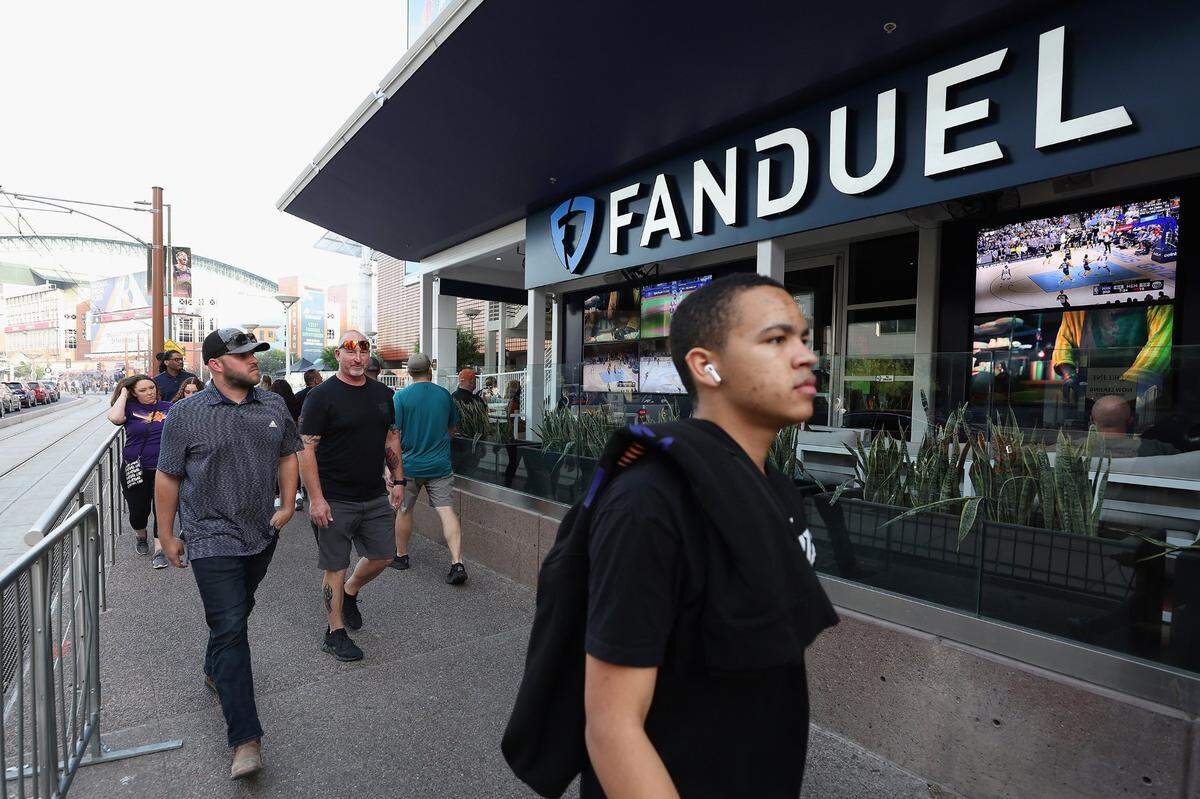
Legalized sports betting has been sweeping the nation — and California’s population of 40 million represents one of the last great untapped markets. The online gambling industry, led by DraftKings and FanDuel, has been itching to get into California for years and is trying to rally voters behind Proposition 27, which would legalize online and mobile-phone sports wagering.
While the initiative is about sports betting, the Yes on 27 advertising says little about gambling. Instead, the campaign says Proposition 27 would help tribes that so far haven’t profited from gambling. In addition, the Proposition 27 campaign says its plan would “finally address homelessness in California” through new tax revenues.
The plan would raise as much as $500 million a year for the state, according to an estimate by the Legislative Analyst’s Office.
The tribes’ version of sports betting, Proposition 26, is a more modest affair. Californians could bet legally on sports, as long as they place their wagers at tribal casinos or the state’s four privately-owned horse tracks. The initiative would also legalize roulette and dice games at the casinos.
The tribes would have to renegotiate their gaming compacts with the state, and it’s not clear how much new money would be generated for the state treasury. The legislative analyst said it’s probably in the tens of millions — a fraction of what online betting would create.
Casino tribes protect their turf
The tribes have raised $118 million to spread a campaign message that’s about their Proposition 26 and more about the alleged evils of the FanDuel/DraftKings plan.
For one thing, the tribes say the online companies would take practically all of the profits and ship them to their out-of-state shareholders, leaving just a few crumbs for the homeless.
They also say the online initiative would erode their hard-won economic gains and tribal sovereignty. In the two decades since voters approved full-fledged Indian gaming, dozens of tribes have graduated from dusty bingo parlors to Vegas-style casinos, lifting themselves out of poverty. Now they’re asking voters to keep faith with them.
“We’ve been blessed, through the support of the voters of the state of California, to have our brick and mortars,” said Chairman Anthony Roberts of the Yocha Dehe Wintun Nation, owner of Cache Creek Casino Resort in northern Yolo County. “It just goes back to ... making sure we’re protecting our sovereignty and our rights.”
Roberts’ tribe has poured $22 million into Proposition 26.
The Yes on 27 campaign denies that it’s trying to undermine the tribes. Any online gaming company wanting to take bets in California would have to sign a partnership agreement with one of the tribes. The tribes could offer online sports betting on their own, without a partnership deal. Three small tribes have endorsed Proposition 27.
The differences between the two propositions are pretty clear — but the fight over sports betting has more subplots than a Giants-Dodgers playoff series.
Homeless advocates are split on Proposition 27 and its promise to address the crisis. The tribes are divided into three coalitions — the main group supporting Proposition 26, another supporting Proposition 27 and a third group that has eyes on a 2024 ballot initiative. For good measure, there’s a side skirmish between the main bloc of casino tribes and their longtime rivals, California’s card rooms.
Amid the confusion, one thing is clear: Online sports betting would represent a staggering expansion of gambling in California.
Tens of billions of dollars would likely be wagered. The online companies’ share, after paying off the winning bets, would come to an estimated $3.2 billion a year, said D.J. Leary, director of business development at market research firm Eilers & Krejcik Gaming.

“You exponentially increase the number of people betting on sports,” said Richard Auxier, an analyst with the Urban Institute think tank.
In the latest sign that professional sports has embraced gambling — after resisting for years — Major League Baseball endorsed Proposition 27 and its plan for online wagering. Baseball called it a vehicle for creating a “safe and responsible online sports betting market in California — a state with millions of MLB fans looking for alternatives to illegal offshore betting sites.”
Future of sports betting: Online
In their fight against Proposition 27, the tribes argue that online betting would push gambling into dangerous new territory: If DraftKings and FanDuel have their way, every kid with a smart phone could bet on sports.
But the tribes aren’t necessarily opposed to online sports gambling. They would just rather keep it in-person for the time being.
“They’re not blind, they’re not being obstructionist,” said tribal gaming consultant Victor Rocha, a member of the Pechanga Band of Luiseño Indians, which owns a casino in Riverside County and supports Proposition 26. “They want to take it in incremental steps.”
The tribes aren’t walking in unison, however.
A coalition led by the San Manuel Band of Mission Indians, owner of a casino near San Bernardino, has raised more than $66 million to fight the DraftKings/FanDuel plan. But it isn’t contributing to the tribes’ Proposition 26. Instead, it’s pushing ahead with an alternate plan, geared toward the 2024 elections.
These tribes recently submitted signatures for a 2024 ballot initiative that would legalize both in-person and online sports betting — all under the control of the tribes. State officials have begun the process of checking the validity of the signatures.
The San Manuel group’s spokesman, Rob Stutzman, said the tribes don’t necessarily plan to rush into online sports betting. The 2024 initiative “provides optionality going forward,” he said.
What about underage gambling on smart phones? The San Manuel tribe says it could operate online betting safely — and keep the kids out.
Gamblers would have to register in person at tribal facilities, with ID in hand, before they would be allowed to place online bets, said Frank Sizemore, San Manuel’s chief operating officer.
Sacramento-area tribe dives into gambling politics
Finding a parking space — or an idle slot machine — wasn’t easy the other night at Sky River Casino in Elk Grove.
Thousands of patrons flocked to the just-opened $500 million gambling hall on a weekday evening, clogging the sprawling casino floor and sending parking-lot attendants scrambling for extra pylons.
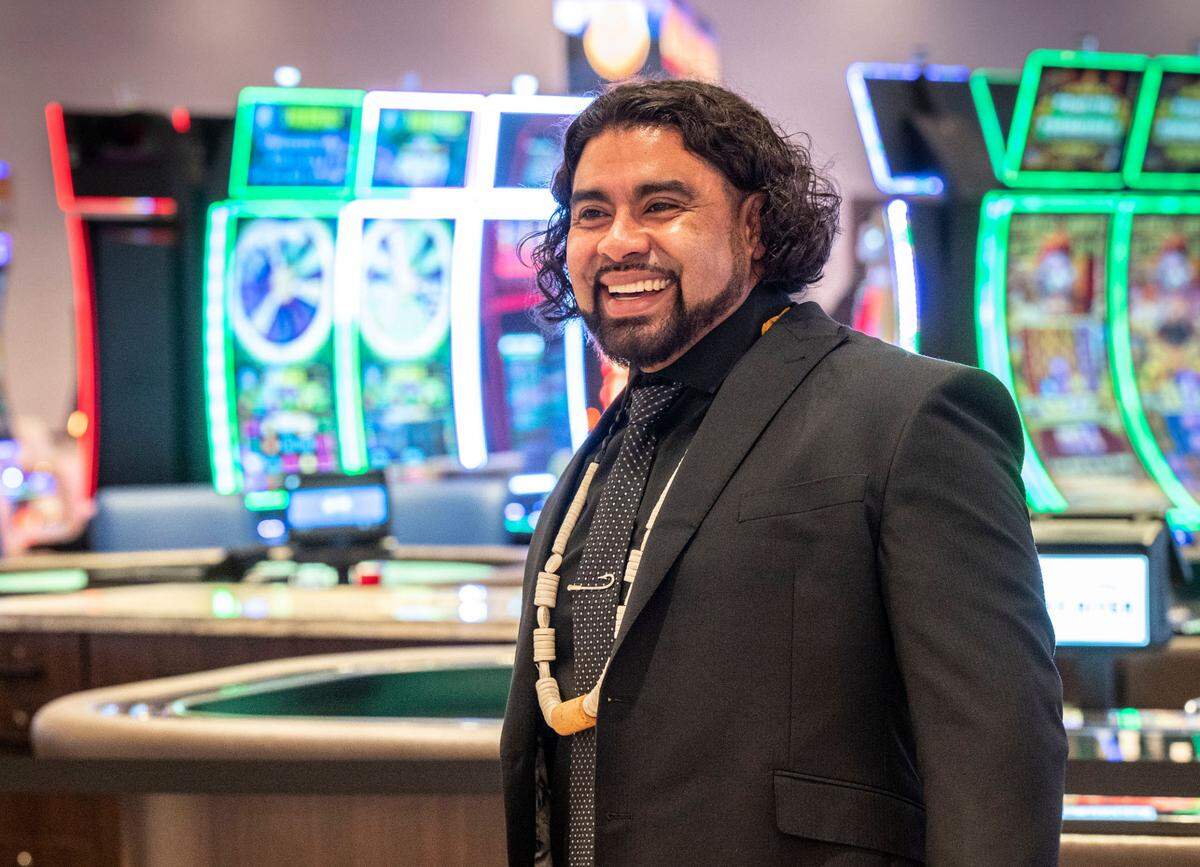
Anyone seeking a break from the sensory overload could step into the high-roller room, with its minimum $100 bets on blackjack. Those needing nourishment could choose between $9 chicken tenders at the food court, a $108 Porterhouse at the steakhouse and practically everything in between.
Most tribal casinos are far removed from population centers. But an enviable location — just off Highway 99 in a booming Sacramento suburb — gives Sky River the potential to become a major player in the region’s casino scene.
Its owner, the Wilton Rancheria, has already become a political player.
Wilton has contributed $50,000 toward defeating Proposition 27, the plan promoted by the online gambling companies. The tribe’s chairman, Jesus Tarango, appears in No on 27 advertising, telling viewers the DraftKings/FanDuel plan “would break the promise” voters made on tribal gambling years ago.
Tarango also co-signed the documents filed with the Attorney General’s Office detailing San Manuel’s proposed 2024 ballot initiative — the plan for in-person and online wagering under tribal control.
So is the Wilton tribe making room on the casino floor for sports betting? Tarango won’t answer that.
“We are focusing all our efforts on the Vote No on Prop. 27 campaign to defeat the out-of-state corporations’ online sports wagering measure,” he said in a written statement to The Sacramento Bee.
The tribe that’s dominated the region’s gambling market for years — the United Auburn Indian Community, owner of Thunder Valley in Lincoln — is staying on the sidelines. It hasn’t contributed to any of the sports-betting initiatives.
“We have not taken a position,” said Doug Elmets, spokesman for Thunder Valley’s owner, the United Auburn Indian Community.
Three California tribes join online firms
Meanwhile, three tribes have joined the Yes on 27 campaign, aligning themselves with the online gambling companies.
Their action speaks to a schism of sorts that’s existed for years among California tribes. The tribes with major casinos (defined as operating at least 350 slot machines) are required to contribute to a revenue-sharing fund. The roughly $150 million a year is split among those with fewer than 350 slots — or no casino at all.
Despite this financial support, the tribes that have joined Yes on 27 say they’ve been “left in the dust,” to quote the advertising — and online betting would finally give them a shot at a big payout.
“We’re proud to have a number of tribes in support of our initiative,” said Nathan Click, a spokesman for Yes on 27.
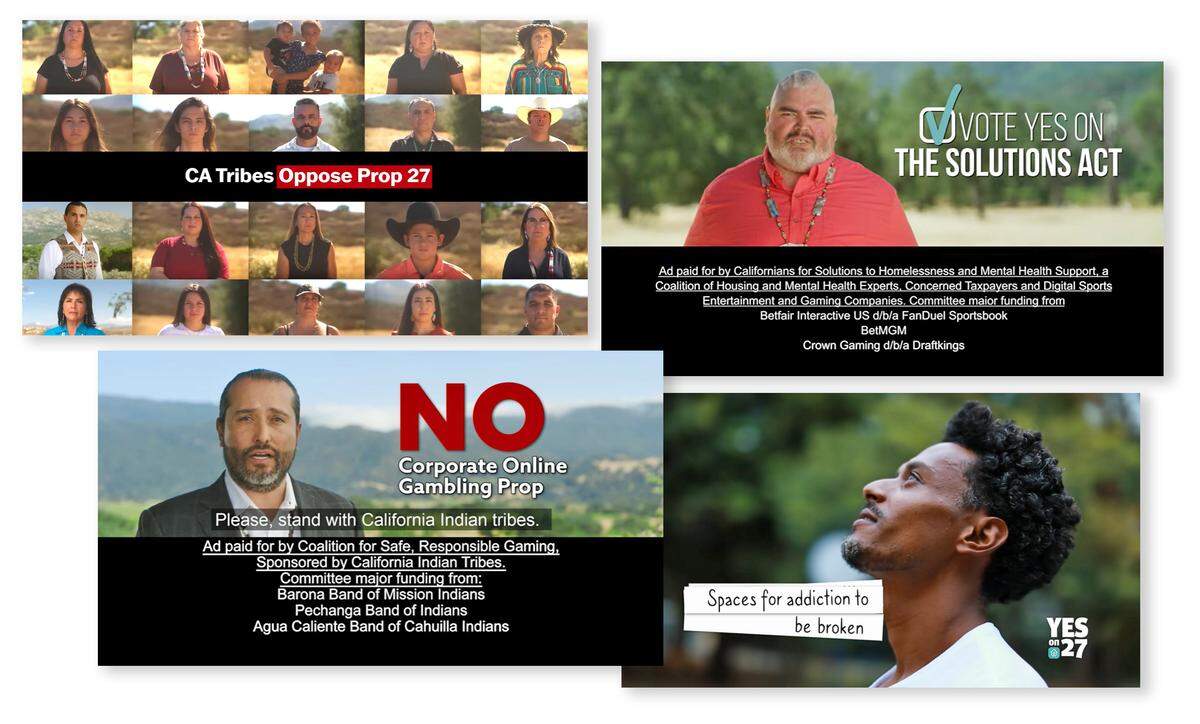
These small tribes have become the face of Proposition 27. One of their leaders, Moke Simon, is featured prominently in the campaign’s advertising. He was the main speaker on Proposition 27’s behalf during a recent legislative hearing about sports betting, along with the CEO of a homeless-advocacy group from Costa Mesa.
None of the executives from the online gambling companies attended, Click said. It was more important to have witnesses testify on the impact of revenues generated by online betting, he said.
Simon’s tribe, the Middletown Rancheria of Pomo Indians, has been stymied in its efforts to expand its modest Twin Pine Casino. The federal Interior Department has twice rejected the tribe’s agreement with Gov. Gavin Newsom to more than triple the number of slot machines it could operate. (The feds said the deal gave the state too much control over the tribe’s affairs).
The struggling tribe sees salvation online.
“We absolutely would like to get into e-commerce and the mobile betting,” Simon said. “This is just an opportunity for our tribe to make a decision, to make a sovereign decision, on how to move forward.”
Simon said his endorsement of Proposition 27 doesn’t signal a major rift with other tribes. “This is one issue we stand separate on,” he told lawmakers at the informational hearing.
Homeless advocates aren’t united, either.
Multiple homeless advocate organizations have endorsed the DraftKings/FanDuel plan. So have mayors of several cities beset with homelessness crises, including Darrell Steinberg of Sacramento, Libby Schaaf of Oakland and Jerry Dyer of Fresno.
But some homeless advocates have branded Proposition 27 a cynical ploy that won’t solve the problem. The online companies would take their profits out of state and leave just a few crumbs for homeless programs, they argue.
The online corporations “are using homelessness to sweeten their attempt to (legalize) sports gambling,” said Kendra Lewis of the Sacramento Housing Alliance.
Gov. Gavin Newsom, speaking last week at a new housing site aimed at homeless populations in Los Angeles, essentially dismissed Proposition 27 as a solution to the crisis.
While the new state budget already commits more than $10 billion to homeless programs, “perhaps that initiative will provide a few dollars,” Newsom said. “It is not a homeless initiative, and I know Angelenos can read between the lines and they know better.”
He added that he’s neither opposing or supporting Proposition 27.
Then there’s the animal-rights lobby. Multiple groups have come out against Proposition 26 and its legalization of sports betting at four horse tracks: Golden Gate Fields in Berkeley and Southern California’s Santa Anita Park, Del Mar Race Track and Los Alamitos Race Course.
“Prop 26 provides a financial ‘shot in the arm’ to private horse racing tracks with no requirement or accountability towards increasing animal safety,” said Jill Tucker, CEO of California Animal Welfare Association.
California card rooms fight tribes
There’s one more player tossing chips into the sports-betting fight: California’s 84 card rooms.
Card rooms have been around since the 1930s but operate in the shadows of the Vegas-style tribal casinos. Their combined revenue is about $850 million a year, a fraction of what the tribes rake in.
The tribes hold the best hand, legally. Not only have they been granted exclusive right to operate slot machines, they alone are permitted to act as “the bank” — that is, take a financial stake in their games.
The card rooms have resorted to using third-party companies that handle the actual wagers at their blackjack tables and other games. The employees of these third-party companies don’t handle any cards; instead they collect the wagers and pay out the winnings. They pay the card room a fee for each hand played, based on how much has been bet. That fee represents the sole revenue the card rooms make from gambling.
The tribes consider this workaround a sham that violates the prohibition on “banked” games at card rooms — and have been badgering state officials for years to crack down.
With Proposition 26, they’re attempting to take matters into their own hands. If it passes, the tribes would be allowed to sue the card rooms for alleged illegalities if the state Department of Justice won’t act.
“We’ve been given the right by the voters here in California to play ... Las Vegas-style games on our tribal lands and we feel like they’re breaking the law by playing those games in their businesses, and that’s the bottom line,” said Roberts, the Yocha Dehe chairman.
The card rooms consider this provision of Proposition 26 a “poison pill” that threatens their livelihoods — and are fighting back. Their trade group, the California Gaming Association, has raised more than $41 million to fight Proposition 26.
“The poison pill will allow limitless lawsuits against highly regulated gaming establishments, just to increase market share,” said Becky Warren, a spokeswoman for the card rooms.
I. Nelson Rose, an expert on tribal-gaming laws, said the tribes may have overplayed their hand by going after the card rooms. With their jobs on the line, municipal employees’ unions in cities that rely heavily on card room tax revenue are coming out against Proposition 26, creating a potentially powerful opponent, Rose said.
From the tribes’ standpoint, “it was a fight that was completely unnecessary,” Rose said.
Casino tribes a major political force
In 2000, California’s Indian tribes persuaded voters to pass Proposition 1a, which gave them the exclusive right to operate Vegas-style casinos with slot machines and table games. Now more than 60 tribal casinos are in the state, generating an estimated $8 billion to $9 billion in annual revenue.
They’ve used this money to build schools and clinics, diversify their economic base and flex their political muscles. The San Manuel tribe owns the Residence Inn hotel a block from the Capitol — a fitting investment given how influential the Indians have become in legislative affairs. In 2020 the tribes defeated a bill, supported by the NFL, NBA and Major League Baseball, that would have legalized online sports betting.
Now they face another potentially powerful opponent.
In 2018 the U.S. Supreme Court legalized sports betting outside Nevada for the first time. Sports betting, either online or in person, has been legalized in 34 states and the District of Columbia since then — fueling remarkable growth among a handful of companies such as BetMGM and Barstool Sportsbook. FanDuel says it has 12 million registered bettors. DraftKings’ revenue jumped 44% in the first half of the year, to $883 million, although the company is still losing money.
The online companies have kicked in $150 million this year to support Proposition 27 and fight the tribes’ Proposition 26. Plus there’s another $41 million contributed by the card rooms trying to beat the tribes.
The tribes, meanwhile, have contributed more than $180 million to their campaigns,.
That’s a total of about $370 million — and that doesn’t count the $15 million San Manuel has already spent on its proposed 2024 ballot initiative.
Compare that with the $40 million spent on Proposition 1a, the successful tribal-gaming initiative in 2000. Or, for that matter, the old ballot-initiative record of $205 million spent just two years ago, when Uber and Lyft convinced voters to overturn a law requiring the ride-hailing companies to treat their drivers as employees. (A judge tossed out the results; the gig-economy companies have appealed.)
What will happen in November? In early August the tribes released polling data showing the online companies’ Proposition 27 trailing badly. Kathy Fairbanks, a spokeswoman for the tribes, declined to release polling results regarding the tribes’ initiative.
Adams, the casino consultant from Reno, said he likes the tribes’ chances.
“The tribes are not novices at politics in California,” Adams said. “The tribes are pretty good at this, they know California and they know their neighbors.”
Both could fail. On those occasions when voters are faced with competing initiatives, they sometimes reject both — as when Californians soundly defeated two proposals governing prescription drug prices in 2005.
“Historically, confusion contributes to ‘no’ votes on ballot initiatives,” said Stutzman, the San Manuel tribe’s campaign spokesman.
What if the opposite happens, and both 26 and 27 pass? It’s not out of the question. In 1988 voters approved two conflicting propositions on campaign finance reform. The state Supreme Court ruled that the initiative getting the most votes prevailed.
Anticipating this possible outcome, the online gambling companies inserted language in Proposition 27 declaring that their plan doesn’t really compete with the tribes’ initiative. If both pass, each side would be allowed to offer sports betting.
“We took great care in drafting our measure to make sure there are no grounds for arguing they are in conflict,” said Click, the Yes on 27 spokesman.
Experts believe the tribes wouldn’t stand for that — and would immediately file a lawsuit to prevent the online companies from taking bets.
“I would assume the briefs have already been written,” Adams said. “On both sides.”
This story was originally published August 31, 2022 at 5:00 AM with the headline "Sports betting: How California casino tribes and online gambling firms are vying for your votes."