Is a Madera station still in the works for high-speed rail? Here’s what’s planned
When the California High-Speed Rail Authority approved issuing a request for companies to plan and design four bullet-train stations along the future interim operating line between Merced and Bakersfield, one location that wasn’t part of the package was a connecting station in Madera.
A Madera station was first introduced in the rail authority’s 2016 business plan after local leaders complained that the community was planned to be little more than a “fly-by” area for high-speed trains ripping through the Valley between Fresno and Merced.
In the 2022 business plan, adopted by the rail authority’s board of directors April 27, Madera is still on the books for a station – just not as elaborate as what’s planned for Fresno, Merced, Hanford or Bakersfield.
Instead, the San Joaquin Joint Powers Authority, which oversees the administration of the Amtrak San Joaquin trains that flow through the Valley between Bakersfield and Stockton, is handing the process of relocating Madera’s existing Amtrak station and upgrading it to handle future high-speed rail traffic.
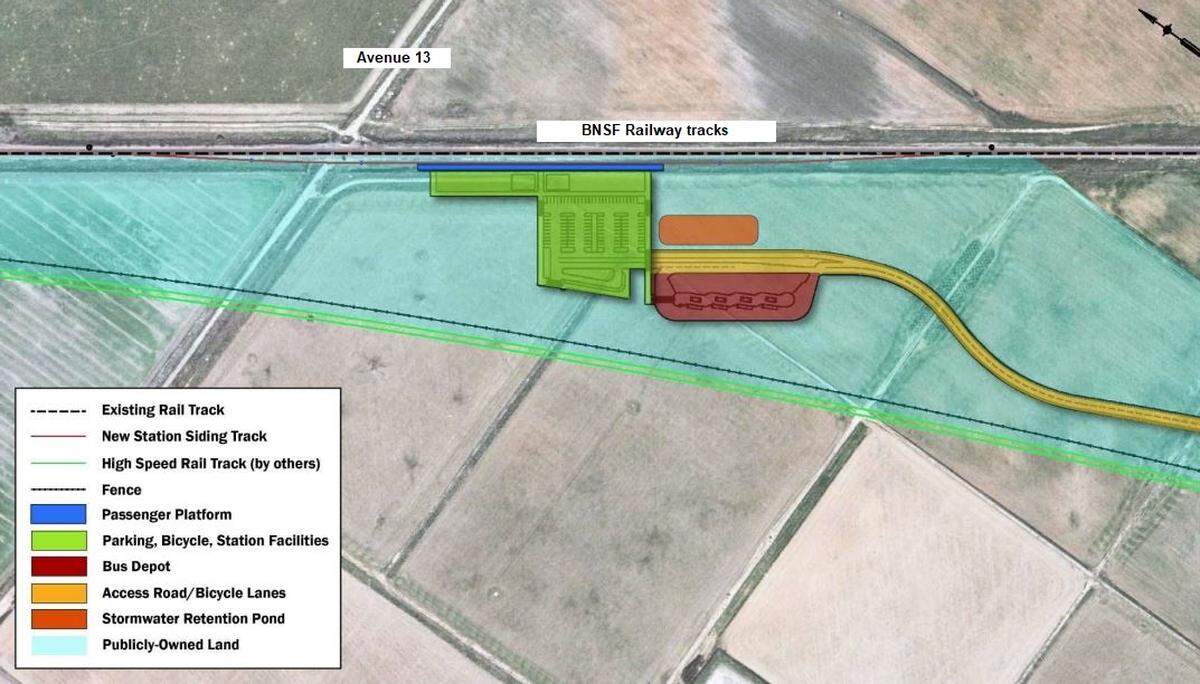
Madera’s Amtrak station now sits alongside the BNSF Railway tracks near Road 26 north of Madera. Under plans approved last year, the San Joaquin JPA will relocate the facility by about 7 1/2 miles, between Avenues 12 and 13, not far from the Madera Community College Center southeast of Madera.
When it opens, expected in 2024, the new station will be where passengers aboard Amtrak trains can connect with bus services to nearby communities. When high-speed rail service begins, now expected in 2029 or 2030, Amtrak’s San Joaquin trains would no longer stop in Madera, instead continuing on to Merced for connections to high-speed rail and other train and bus services.
As many as 18 high-speed trains daily would serve the Madera stations and feed its bus connections.
“The existing Madera San Joaquins station, which is nearly three miles north of Madera, has extremely low ridership and lacks connecting bus service in the area due to its location,” a project overview states. The Avenue 12 location, it adds, will “better meet regional goals of improving ridership and connectivity.”
The advantages of the Avenue 12 site include that it is already a primary transportation corridor in Madera County, and has good access to Highway 99 with a recently upgraded Avenue 12 interchange. It is also expected to better accommodate growth in southeastern Madera County and northern Fresno County.
The environmental review completed last year for the relocation project estimates that Amtrak ridership at the Madera station – currently the second lowest on the San Joaquins line from Bakersfield in the south to Stockton, Oakland and Sacramento – could more than double at Avenue 12 to more than 103,000 “on/off” actions (boardings and alightings) in 2025, compared to just over 40,000 in a 2025 scenario in which the station stays where it is.
In 2019, the most recent full year before the COVID-19 pandemic diminished train ridership on the San Joaquins line, the Madera station at Road 26 had just over 27,000 on/off actions, or about 75 per day.
In 2018, the California State Transportation Agency awarded more than $26 million to the San Joaquin JPA for the Madera station relocation efforts.
Development and construction costs in 2020 were forecast to be about $24.9 million for Phase 1 to handle only Amtrak operations with a passenger boarding platform, a building with restrooms and ticket machines, a parking lot and a parking area for transfer buses.
The cost of a Phase 2 expansion to accommodate future high-speed rail operations is forecast at about $130 million, said Dan Leavitt, manager of regional initiatives for the San Joaquin JPA.
“The HSR improvements proposed would not accommodate service increased beyond interim operations (between Merced and Bakersfield),” according to the environmental review. But, it adds, “the improvements could be expanded and would not preclude any future expansion of the relocated station in Madera by (the state high-speed rail agency) necessary to accommodate expanded service” beyond the San Joaquin Valley.
Last month, Madera County was awarded a $450,000 planning grant from the California Department of Transportation to develop a broader transportation plan to allow for a clearer vision for transit options and transit-oriented development along the Avenue 12 area in Madera County.
Leavitt told The Fresno Bee on May 2 that his agency is working with Caltrans to apply to the federal government for a “mega grant” to help cover the cost of the Phase 2 station expansion in Madera. The two agencies hope to get about 60% of the $130 million cost from President Joe Biden’s infrastructure package for the station, with the state matching the remaining 40% of the cost.
The joint application is due to the federal government by May 23, Leavitt added.
This story was originally published May 3, 2022 at 5:00 AM with the headline "Is a Madera station still in the works for high-speed rail? Here’s what’s planned."