What is hyperthermia that killed Mariposa family on hike? How often it occurs, how to avoid
A family of three, and likely their dog, died from heat while hiking in Sierra National Forest two months ago, the Mariposa County Sheriff’s Office announced Thursday.
The official cause of death – hyperthermia and probable dehydration due to environmental exposure – came as a shock to many.
“Hyperthermia is the abnormally-high body temperature caused by failure of heat-regulating mechanisms. So in general, the more severe hyperthermia is heatstroke,” Mariposa County Sheriff Jeremy Briese said about how Mariposa residents Jonathan Gerrish, Ellen Chung and their 1-year-old daughter, Aurelia “Miju” Chung-Gerrish, died in August during a day hike in the Hites Cove area of Devil’s Gulch, southwest of Yosemite National Park.
The dog’s death remains undetermined, but investigators believe it was likely also heat-related.
Briese said hyperthermia “can have damages to the brain, can have damages to other organs, can cause muscle cramps, fatigue, dizziness, weakness, and ultimately cause death.”
These are the first heat-related deaths that Briese said he’s aware of in Mariposa County, at least over his 20 years with the sheriff’s office.
How hot was it when Gerrish and Chung family were hiking?
Briese said temperatures jumped from the mid-70s to over 100 degrees in the Hites Cove area on Aug. 15 when the Gerrish-Chung family was hiking there.
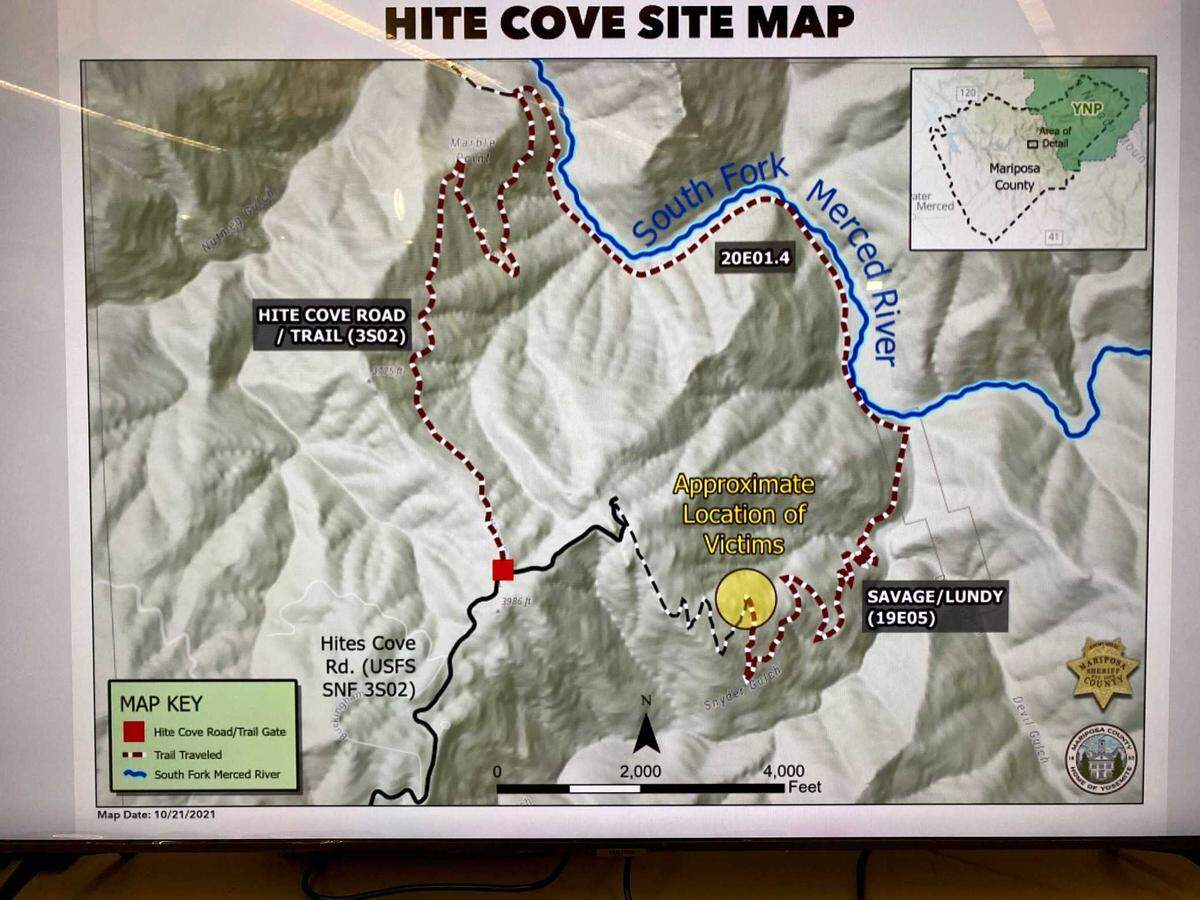
The 8-mile loop hike they were on ranged from about 1,800 to 3,800 feet in elevation, Briese said. The family was found dead Aug. 17 along the Savage-Lundy Trail, just 1.6 miles from their truck after nearly completing their hike.
There was an empty CamelBak with them and no other water, along with some formula in a baby bottle, Briese said.
Gerrish and Chung were described by friends as outdoor lovers and experienced hikers.
Briese said temperatures reached between 107 and 109 degrees as they were believed to be climbing back up the steep, exposed hillside from the south fork of the Merced River.
A member of the search and rescue team working in that area the week their bodies were found was also treated for a heat-related issue, Briese said.
The National Weather Service were among many agencies that provided information to the sheriff’s office in their investigation.
NWS data from stations closest to the Savage-Lundy Trail – in Jerseydale, Bootjack and Triangle Road – recorded Aug. 15 temperatures in the 70s, 80s and 90s.
But those stations sit at higher elevations than along the south fork of the Merced River. Temperatures would have been hotter there, and with “light wind, no clouds” on Aug. 15, said meteorologist Colin McKellar with NWS at Hanford.
McKellar said the Jerseydale station (around 3,700 feet in elevation) is the closest to where the family was found dead. It recorded highs of around 96 and 97 degrees on Aug. 15, and it would typically be about five degrees hotter at an elevation between 1,500 and 2,000 feet, he said.
McKellar said overall temperatures throughout the foothills that day were typically between 100 and 105 degrees, and that “you can get hotter temperatures within different microclimates.”
He estimates average high temperatures in the Hites Cove area for mid-August to be between the low and mid-90s.
How many people die from heat each year in the United States?
Also this August, a 32-year-old man died in Zion National Park after complaining of heat exhaustion, and a 37-year-old man was found dead in the Bay Area after potentially dying of heatstroke, according to data from his smartwatch, officials said.
There’s an average of 702 heat-related deaths annually in the U.S., according to a report published last year by the Centers for Disease Control and Prevention that looked at data from 2004 to 2018.
Other estimates are more than 1,300 deaths per year in the country due to extreme heat, the U.S. Environmental Protection Agency reported.
“Heat is the leading weather-related killer in the United States,” the EPA wrote in a report titled Climate Change Indicators: Heat-Related Deaths.
Of that 702 annual heat-related deaths listed in the CDC report, heat was described as the underlying cause of death 59% of the time, meaning it “initiated the chain of events that led directly and inevitably to death.”
In the other 41%, heat was described as a contributing cause of death. The underlying cause in those cases included major cardiovascular diseases, about half the time, or drug overdoses and alcohol poisoning, about 18% of the time.
No drugs or alcohol was found in the bodies of the deceased Mariposa family, toxicologists determined, and no preexisting health conditions were shared.
Most in the U.S. who died of heat-related causes were male, the CDC reported, accounting for 7,341 deaths compared to 3,186 female deaths from 2004 to 2018. The male age groups with the most heat-related fatalities during those years were between 55 and 64 (1,420 deaths), between 45 and 54 (1,407 deaths), and between 65 and 74 (1,096 deaths).
Gerrish was 45, Chung was 30, their baby was 1, and their dog was 8 when they died.
Most who died of heat-related illness were described in the CDC report as white and non-Hispanic (6,602 deaths, men and women). When looking at their “level of urbanization,” people in “large central metro” areas had the most heat-related deaths: 4,402.
“Deaths attributed to natural heat exposure represent a continuing public health concern,” the CDC report states.
The EPA said heat-related deaths and illness are expected to increase due to extreme heat events becoming more frequent and intense. As one example, there was a spike in heat-related deaths in 2006, which was one of the hottest years on record in the contiguous 48 states, EPA reported.
This year has been another hot one for California. Gov. Gavin Newsom declared a statewide drought emergency on Tuesday.
EPA said it’s hard to know the full extent of heat-related deaths and illness. In another example, the agency said studies of the 1995 heat wave event in Chicago suggest there may have been hundreds more deaths than were actually reported as “heat-related” on death certificates.
Symptoms of heatstroke, and how to prevent it
CDC said warning signs of heatstroke include an extremely high body temperature (above 103 degrees); red, hot, and dry skin (no sweating); a rapid, strong pulse; throbbing headache; dizziness; nausea; confusion; and unconsciousness. Call 911 if heatstroke is suspected.
The National Institutes of Health said to do the following for someone suffering from heat-related illness:
- Get them into a shady, air conditioned or other cool place and urge them to lie down.
- Encourage them to shower, bathe or sponge off with cool water.
- Apply a cold, wet cloth to the wrists, neck, armpits and/or groin. “These are places where blood passes close to the surface of the skin, and the cold cloths can help cool the blood.”
- If the person can swallow safely, offer fluids such as water, fruit and vegetable juices. Avoid alcohol and caffeine.
CDC said to continue cooling efforts until the body temperature drops to 101 or 102 degrees.
“The body normally cools itself by sweating,” the CDC said. “But under some conditions, sweating just isn’t enough. In such cases, a person’s body temperature rises rapidly,” what can jump to 106 degrees or higher within 10 to 15 minutes.
The average normal body temperature generally is 98.6 degrees. Heatstroke happens when the body is unable to control its temperature.
The agency said several factors can limit the body from cooling itself during extremely hot weather, including high humidity, which keeps sweat from evaporating quickly.
“Old age, youth (age 0-4), obesity, fever, dehydration, heart disease, mental illness, poor circulation, sunburn, and prescription drug use and alcohol use” can also limit the body’s ability to regulate temperature.
Briese described the Gerrish-Chung family as young and healthy.
“This is a real tragedy,” he said of their deaths.
The National Park Service shared a number of tips to beat the heat while hiking, including protecting skin, hiking early in the day or in the evening, and staying hydrated.
Carol Ewing Garber, professor of movement science at Columbia University, told NPR that in general, it’s still safe to exercise when it’s hot, but you have to be careful.
“That midday sun can add as much as 20 degrees or more to the actual air temperature,” Garber said. “You really have to be careful about that.”
This story was originally published October 23, 2021 at 9:51 AM with the headline "What is hyperthermia that killed Mariposa family on hike? How often it occurs, how to avoid."