
Coronavirus updates: California sets death record; Newsom talks with Dr. Fauci
Health officials remain exceptionally concerned about the coming weeks of the coronavirus pandemic, with infections already soaring in California and the state bracing for a crush of hospitalizations following the Christmas and New Year holidays.
Gov. Gavin Newsom in a Wednesday morning news release proposed spending $2 billion to help safely open school campuses from pandemic shutdowns, with early emphasis on transitional kindergarten through sixth-grade students.
And on Wednesday afternoon, Newsom joined Dr. Anthony Fauci, the nation’s leading infectious disease expert for a virtual conversation.
Concerning strain confirmed in California, Newsom says
Newsom at the beginning of his discussion with Fauci announced that midday Wednesday, the state received word that it has confirmed a case of the concerning new strain of COVID-19 that scientists believe may be more contagious.
That case was identified in Southern California, the governor said.
The strain was first confirmed in the U.S. just one day earlier, Colorado Gov. Jared Polis announced Tuesday.
The strain, first identified in the United Kingdom, is believed to be more contagious and possibly up to 70% more transmissible, but there is no evidence that it is deadlier or resistant to vaccines. It has been confirmed in several countries.
California by the numbers: Nearly 25,000 dead
In the state of 40 million residents, more than 2.2 million have tested positive and just under 25,000 have died to date, according to the California Department of Public Health. About one quarter of those cases, 550,000 of them, have come in the past two weeks, along with nearly 3,500 of the fatalities.
California on Wednesday reported a single-day record with 432 new fatalities, buoyed by 227 in Los Angeles County, breaking the previous statewide record of 379 set Dec. 16.
With that, the two-week daily average for virus deaths has jumped to 248, more than 100 higher than the peak of the summer surge.
The surge has gripped California for about two months. The state is now averaging more than 40,000 cases per day, a rate 10 times higher than that of late October. Testing capacity has increased, but not nearly to that extent — the rate of diagnostic tests returning positive has ballooned in the same span from 3% to more than 12%, indicating much more prevalent true spread of the disease.
The state entered November with just over 2,500 COVID-19 patients in hospital beds, including 700 in intensive care units. Now there are over 20,000 hospitalized with the disease, including nearly 4,400 in intensive care, pushing ICU capacities to the brink.
Hospitals in the vast regions of Southern California, home to 20 million people, and the San Joaquin Valley, home to 7 million, have had aggregate ICU availability of 0% for close to two weeks, according to CDPH.
The crush of severely ill patients has forced some Southern California hospitals into the early phases of what state health chief Dr. Mark Ghaly on Tuesday called “crisis care” mode — a spectrum of last-resort protocols ranging from things like drastic changes to staff-to-patient ratios to, in the most extreme scenarios, rationing and triage of medical care.
Most hospitals statewide are, as of this week, one step below crisis level in what Ghaly called “contingency” mode.
“This is where you start to see space in a hospital that is (normally) used for other types of care … now being used to serve COVID patients,” he said.
When will regions’ stay-at-home orders be lifted?
Ghaly in Tuesday’s news briefing confirmed that Southern California and the San Joaquin Valley would continue in the state’s tight stay-at-home restrictions — which include closures of restaurant dining both indoor and outdoor, plus personal care services and other businesses deemed non-essential — until further notice.
As for the three other regions, CDPH as of Wednesday reported the Bay Area at 7.5% ICU availability, Greater Sacramento at 17.4% and Northern California at 31.5%. Northern California, where 685,000 people live, has not entered the regional stay-at-home order.
After an initial three-week period, regions will be released from the order once state health officials mathematically project ICU availability will be at or above 15% four weeks into the future.
Greater Sacramento, which has been in the stay-at-home order since Dec. 11, will see its three-week window end Friday. The Bay Area’s will end Jan. 8. The state will provide ICU projections once those preliminary periods end.
Vaccines behind schedule nationwide. What about California?
Vaccines by Pfizer and Moderna were approved in the U.S. for emergency use on a record timeline in part of a remarkable campaign aimed at ending the COVID-19 pandemic, with both shots given the OK by the Food and Drug Administration earlier this month.
However, there have been recent snags early in the distribution and shot-administering phases of “Operation Warp Speed” — the Trump administration’s plan to get a vast majority of Americans inoculated by late June 2021.
That plan included having 20 million Americans vaccinated by the end of 2020. But with just a few days left in the year, only about 2.1 million in the U.S. had received a vaccine dose as of Tuesday morning, according to the Centers for Disease Control and Prevention.
Roughly 9.3 million additional doses have been distributed to health care providers but have not yet been administered. Both the Pfizer and Moderna vaccine are two-shot regimens, with the doses given a few weeks apart.
Shots are being allocated to states based on population — meaning California is receiving a plurality of the initial rounds.
Newsom said on Monday that the state is projected to end 2020 having received about 1.8 million doses, after initially expecting 2.1 million. Of those, about 261,000 doses had been administered through this past Saturday.
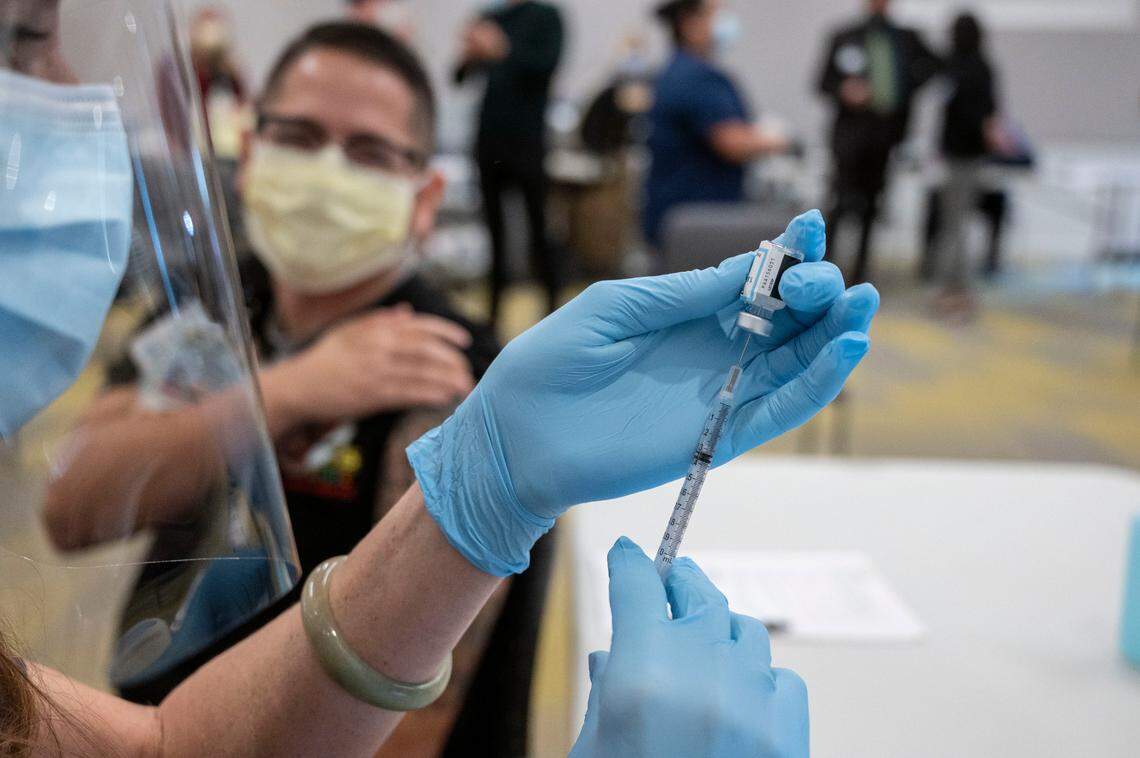
California’s first tier of Phase “1a” shots are dedicated to front-line health workers who deal directly with COVID-19 patients. There have already been some controversies involving hospital administrators receiving doses ahead of doctors or medical residents, an error to which Stanford recently admitted and apologized.
Newsom has also promised heavy sanctions for doctors who let friends or family members skip the line.
Residents of long-term care facilities, such as skilled nursing homes, are next within Phase 1a. California has entered a partnership with pharmacy chains CVS and Walgreens to administer vaccines in those settings.
President-elect Joe Biden this week criticized the current pace of vaccine rollout.
“If it continues to move as it is now, it’s going to take years, not months, to vaccinate the American people,” Biden said Tuesday afternoon.
Biden has frequently referred to a 100-day plan, and says one of the goals of his administration will be to have 100 million shots administered at the end of his first 100 days in office, which would be the beginning of May.
California in an FAQ page on its COVID-19 website says the earliest estimate for wide vaccine availability among the general public is spring 2021, though the state estimates this is subject to change depending on how smoothly the nationwide rollout proceeds.
Relief application window opens for California small businesses
A $500 million grant relief program for California small businesses opened its application window Wednesday morning.
The aid program, which is facilitated through chambers of commerce and other local organizations, is open to both for-profit and non-profit businesses. Grants run up to a maximum of $25,000 per business.
There are two rounds in the grant program. The window to apply in the first round ends Jan. 8, with notifications to approved businesses starting as early as Jan. 13.
Dates for the second round have yet to be determined, but the state says one completed application will be considered in both rounds of distribution; applying multiple times will delay the application process.
Foothills deaths rising dramatically
Some of the more modestly populated counties within the 13-county Greater Sacramento region, located in the foothills east and northeast of the capital, have seen far more virus deaths in the past month than in the previous nine months combined.
El Dorado County, which reported just four COVID-19 deaths from March through mid-November — one in July, one in August and two in September — says at least 17 residents died of the virus between Nov. 25 and Dec. 18, according to the county health office.
In Nevada County, 41 of 50 confirmed deaths have been reported in December, state data show.
Butte County reports 31 of its 90 virus deaths as having occurred between Nov. 22 and Dec. 22.
COVID-19 has now killed more Butte residents than the 2018 Camp Fire, California’s deadliest ever wildfire at 85 fatalities.
Latest Sacramento-area numbers: Death toll near 1,200
The six counties that make up the bulk of Greater Sacramento — Sacramento, El Dorado, Placer, Sutter, Yolo and Yuba counties — Tuesday surpassed 100,000 confirmed, cumulative COVID-19 cases over the course of the pandemic. More than 1,150 residents of those six counties have died of the disease.
Sacramento County has reported a total of 63,898 infections since the onset of the pandemic, and 833 residents have died of COVID-19. County health officials on Monday added 3,361 additional cases for a four-day reporting period including Christmas and the weekend, along with 18 newly reported virus deaths, followed by 767 cases and six fatalities Tuesday.
By date of death occurrence, the county now reports 158 deaths for Dec. 1 through Dec. 22, including 149 in just the first 18 days of the month. December has surpassed the 144 from November to become the second-deadliest month of the pandemic for Sacramento County residents. The current month remains on track to surpass 200, well exceeding the 181 deaths from August.
Virus hospitalizations in Sacramento County have fluctuated over the past week but declined by about 10%. The total in hospital beds fell from a record-high 518 reported one week ago to 452 in Sunday’s update, then increased back to 484 by Tuesday, and has now fallen back to 451.
State data showed 92 ICU patients countywide as of Wednesday, down one from Tuesday, but with available ICU beds dropping from 101 to 86.
The county reports that 461 of its deaths and just under 35,000 of its confirmed cases have been residents of the city of Sacramento.
Placer County health officials have reported a total of 13,272 infections and 125 deaths. The county reported 793 new cases and five new deaths for the four-day period of Christmas through Monday, followed by 217 cases and no new deaths Tuesday.
State data show Placer’s hospitalized total soaring to another record of 216 confirmed COVID-19 patients, increasing by 10 from Tuesday to Wednesday, while the ICU total fell from 28 to 22. Even so, the state reported 18 ICU beds left available in Placer, down one from Tuesday.
Yolo County has reported a total of 7,955 cases and 109 deaths. Yolo reported 147 new cases Tuesday after just 18 on Monday, according to the county’s dashboard. The county’s most recently reported death came last Thursday.
State data showed Yolo with 22 virus patients in hospital beds including six in ICUs, down from 29 and 13 on Monday. The state reports 21 ICU beds available in Yolo County.
El Dorado County has reported 5,613 positive test results and 21 deaths. The county reported 104 new cases and three deaths Tuesday, a day after 414 new cases and five additional deaths were added for the four-day reporting window that included Christmas.
Health officials say 29 people are hospitalized with the virus as of Wednesday, up three from Tuesday, with the ICU total growing from nine to 10. State data showed four ICU beds available, up one compared to Tuesday.
In Sutter County, at least 6,290 people have been infected and 49 have died. The county added 253 cases and three deaths in a four-day update on Monday, then reported 51 cases and no deaths Tuesday. Sutter said 55 residents were hospitalized Tuesday including 12 in intensive care, up from 53 and 11 on Monday.
Neighboring Yuba County has reported 3,826 infections and 18 dead, with 177 new infections and one fatality reported over the holiday weekend followed by 20 new cases and one new fatality on Tuesday. Twenty-five Yuba residents were reportedly hospitalized Tuesday, including eight in intensive care.
Not all of those patients are necessarily hospitalized in-county, but the only hospital serving the bi-county region — Adventist-Rideout in Marysville — hit a record-high 72 virus patients in Wednesday’s state update, up from 67 on Tuesday. The county had 18 virus patients in ICU beds, another record, with just one ICU bed still available.
A hospital spokesperson confirmed to The Bee this week that California National Guard personnel have assisted in Adventist-Rideout’s emergency department “for several weeks” due to hospital staff being stretched then.
This story was originally published December 30, 2020 at 9:03 AM with the headline "Coronavirus updates: California sets death record; Newsom talks with Dr. Fauci."
