
Enormous prehistoric birds with 20-foot wingspans ‘ruled’ Earth’s oceans, fossils show
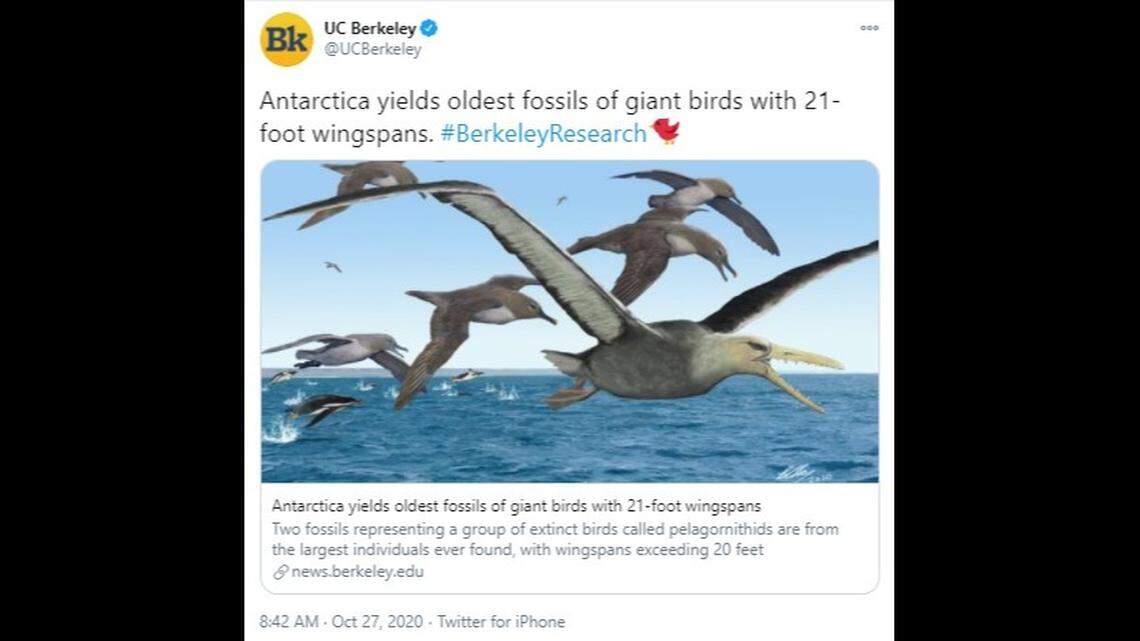
After the dinosaurs went extinct about 65 million years ago, “the largest bird that ever flew” hunted Earth’s oceans, according to University of California researchers.
A study published in the journal Scientific Reports by researchers from UC Berkeley details how fossils, as old as 50 million years, found in Antarctica revealed just how big these ancient birds were.
“Our fossil discovery, with its estimate of a 5-to-6-meter wingspan — nearly 20 feet — shows that birds evolved to a truly gigantic size relatively quickly after the extinction of the dinosaurs and ruled over the oceans for millions of years,” said Peter Kloess, an author of the study and a graduate student with the UC Museum of Paleontology, according to Berkeley News.
The fossils were recovered from Seymour Island in the 1980s and they “represent the oldest giant members of an extinct group of birds that patrolled the southern oceans with wingspans of up to 21 feet,” Berkeley News said in a news release. The ancient birds were called pelagornithids, which were “much like today’s albatrosses and traveled widely over Earth’s oceans for at least 60 million years,” according to the release.
The fossils analyzed in Kloess’s study were 40 to 50 million years old and showed “that the larger pelagornithids arose just after life rebounded ... when the relatives of birds, the dinosaurs, went extinct,” the release said. A collection of fossils found on Seymour Island included a “portion of a bird’s foot” and “part of a jaw bone.”
The jaw bone fossil revealed the birds had “pseudoteeth,” which are “bony protrusions” that “helped the birds snag squid and fish from the sea as they soared for ... weeks at a time over much of Earth’s oceans,” the release said. The size of the jaw suggests the birds were the largest of the “bony-toothed bird group,” according to the release.
At the time of the birds’ life, about 50 million years ago, Antarctica was a lot warmer than the “forbidding, icy continent we know today,” the release said.
“In a lifestyle likely similar to living albatrosses, the giant extinct pelagornithids, with their very long-pointed wings, would have flown widely over the ancient open seas, which had yet to be dominated by whales and seals, in search of squid, fish and other seafood to catch with their beaks lined with sharp pseudoteeth,” said Thomas Stidham, one of the study’s authors and a professor at the Institute of Vertebrate Paleontology and Paleoanthropology, according to the release. “The big ones are nearly twice the size of albatrosses, and these bony-toothed birds would have been formidable predators that evolved to be at the top of their ecosystem.”
This story was originally published October 27, 2020 at 3:02 PM with the headline "Enormous prehistoric birds with 20-foot wingspans ‘ruled’ Earth’s oceans, fossils show."