California’s air quality is the worst in the nation right now. How to protect yourself
Update 12:30 p.m. Wednesday: Californians continue to experience unhealthy levels air pollution from wildfires.
Conditions have slightly improved in major cities including Sacramento and Fresno, still air quality officials continue to recommend residents stay indoors.
Air monitors continue to register hazardous levels of PM 2.5 and ozone in parts of the Central San Joaquin Valley up into the foothills in Madera County and north, in communities of Mendocino and Humbolt counties.
The air quality index reached 492 at Bass Lake Wednesday morning. Anything over 50 is considered moderately unhealthy and over 300 is considered hazardous.
Original story: Californians were experiencing the worst air quality in the nation Tuesday, as wildfires across the West produce dangerous levels of smoke that can damage developing lungs and increase risk of heart attack and stroke.
Over 1 million acres in the state are on fire or have recently burned, according to a CalFire incident map. Those send plumes of thick smoke wafting across large regions of California and neighboring states.
Air quality monitors have registered levels of particulate matter and ozone that are unhealthy or hazardous to public health, with more Californians experiencing dangerous concentrations of air pollution than residents of any other state in the nation, based on U.S. Environmental Protective Agency maps on AirNow.gov.
Dust from high winds contributed to high levels of particulate matter throughout the state.
The risk to health is heightened in some areas of the state, particularly in the Sacramento and central San Joaquin valleys. Residents in Mendocino County and parts of the Central Valley should stay indoors with an air filter or leave the area to protect their health from a dangerous combination of air pollution.
Air quality from PM 2.5 and ozone was considered hazardous Tuesday afternoon in Sacramento, Antioch, Stockton, Modesto and Victorville, for example, meaning there is a health risk for everyone who breathes the air without precaution.
A review of international, population-level studies of the public health effects of exposure to wildfire smoke found growing evidence of increased mortality and hospitalizations in the days and weeks following wildfires, according to a summary published in Environmental Health Perspectives in 2016.
While the review suggested that the full health risks of wildfire smoke are unknown, the research reviewed suggests there is increased risk of repeated exposure. Meaning people living in a state or region prone to wildfire may experience respiratory and cardiovascular events from the cumulative effect of repeated exposure.
Based on that growing evidence, California emergency departments and hospitals may see an increase in patients suffering from asthma, chronic obstructive pulmonary disease, and heart attack in the near future.
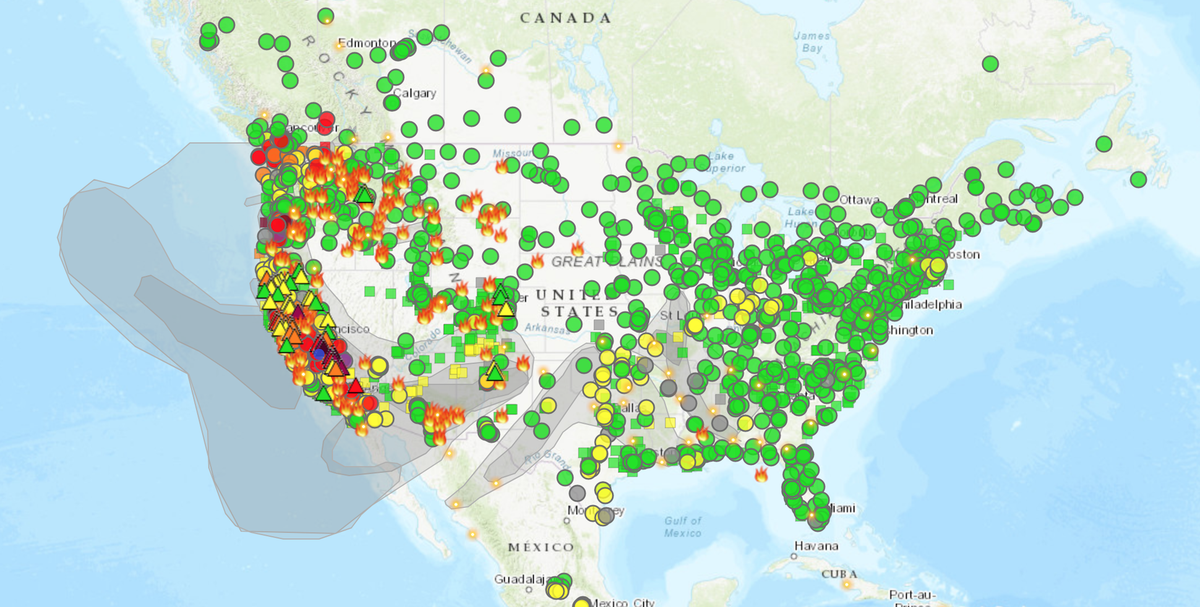
Is the air quality safe where you live?
Some towns experience worse air quality than others depending on wind patterns and additional sources of particulate matter.
Central California is impacted by smoke from the 144,000-acre Creek Fire in Fresno County and several fires burning about 400,000 acres south and east of San Jose.
Swaths of Northern California are under a plume of smoke from the uncontained Hull Fire burning forestland near Mendocino, as well as another lightning complex that’s burned 375,000-acres in several smaller fires between Fairfield and Clearlake.
To view the air quality in your region or town based on data from government monitors, visit gispub.epa.gov/airnow.
To see air quality and smoke patterns specifically from wildfire smoke, visit fire.airnow.gov.
To see real-time air quality measurements at a neighborhood level, visit purpleair.com/map.
How to protect yourself and family from bad air quality
Poor air quality can have short-term effects, or effects that last a lifetime.
Particulate matter is tiny particles small enough to travel past your upper respiratory system into your lungs and cardiovascular system. Pollution considered PM 2.5 can cause permanent damage in developing lungs, or can trigger heart or respiratory incidents.
Here’s what public health officials recommend as protection:
- If faced with heavy smoke and ash from a nearby fire, consider leaving the area.
- If the air is unhealthy from wildfire smoke and the sky looks hazy, avoid strenuous activity outside. That means don’t let the kids play outside and don’t go running.
- Stay indoors and close all the doors and windows. Consider purchasing a portable air cleaner or efficient HVAC system. Or, consider the cheaper DIY alternative with a homemade filtered fan.
- If you must go outside, wear an N95 respirator mask.
Learn more at www.epa.gov/indoor-air-quality-iaq/wildfires-and-indoor-air-quality-iaq#_What_Can_I.
This story was updated Wednesday afternoon to include more detail about what caused high levels of particulate matter.
This story was originally published September 8, 2020 at 6:16 PM with the headline "California’s air quality is the worst in the nation right now. How to protect yourself."