Solar panels atop canals? UC Merced study finds big potential. What do MID, TID think?
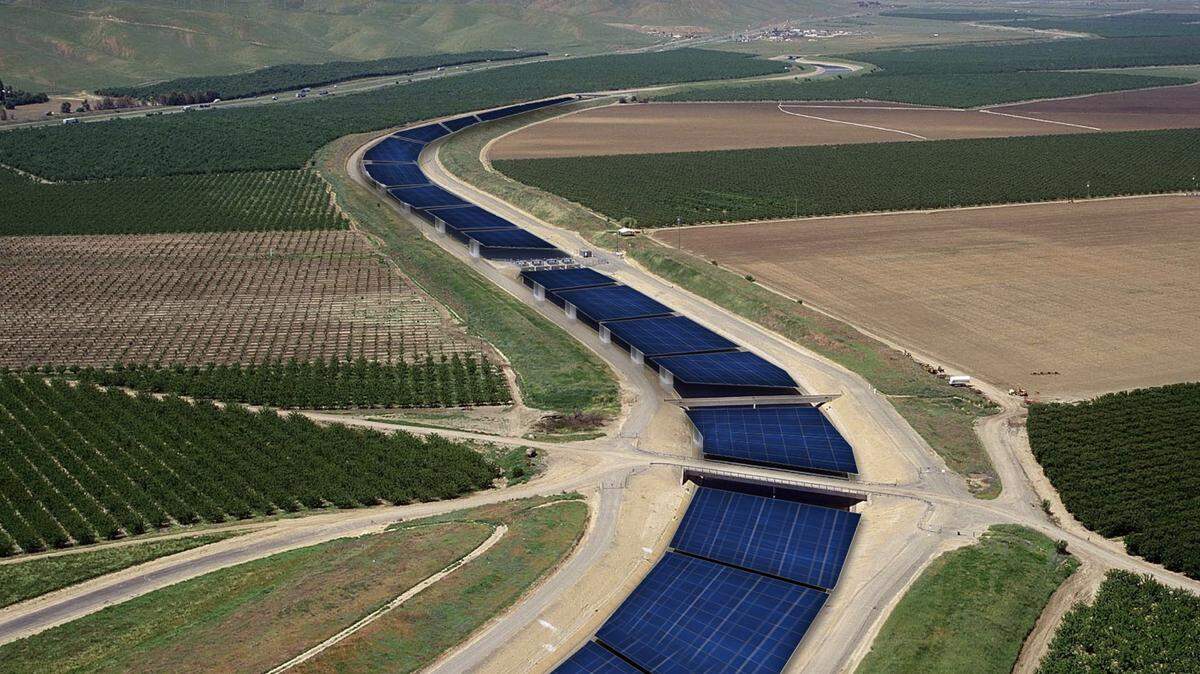
Placing solar panels atop Central Valley canals could get the state halfway to its goal for climate-friendly power by 2030, a new study suggests.
And the panels could reduce enough evaporation from the canals to irrigate about 50,000 acres, the researchers said. They are from the Merced and Santa Cruz campuses of the University of California.
The idea has already drawn interest from the Turlock Irrigation District, as one of several options for boosting the solar part of its electricity supply.
The proposal also has tentative support from spokespersons for the state and federal canal systems that move vast volumes of water in the Valley.
The study was published last month in the journal Nature Sustainabililty. It had support from NRG Energy, a company based in Princeton, N.J., and Citizen Group, a marketing firm in Berkeley.
“It has really stimulated the imagination of a lot of people that this could be a very elegant solution serving various issues,” said Jordan Harris, senior board advisor for Citizen Group, in a phone interview.
Harris also is co-founder and CEO of Solar AquaGrid LLC, created to advance the concept.
‘Decarbonizing our economy’
Solar is a key part of shifting the state from the fossil fuel emissions that contribute to a general warming of the planet. As of 2019, it accounted for 15.7% of the power generated in the state, up from 0.7% in 2010, according to the California Energy Commission.
The panels are on rooftops, in farm fields and in deserts and other natural areas. The study authors said canals could greatly boost the production without disturbing more land.
They said cables or trusses could hold the panels above the water surface, with enough room for canal maintenance workers. The power could feed into the overall grid, or be used nearby, such as in the massive pumps along some state and federal canals.
The researchers did not build a model of a canal with solar panels atop it. Instead, they assessed eight locations up and down the Valley for sunshine, power prices, evaporation rates and other factors. They concluded that the idea is worth pursuing based on the benefits.
This includes about 13 gigawatts of electrical capacity, one sixth of the state’s current generation, if all 4,000 or so miles of canal had panels. This is about half of what the state aims to get from all non-carbon sources by 2030.
The evaporation savings could amount to about 193,300 acre-feet a year, enough water for about 55,000 acres, the study said. California has about 9 million total irrigated acres.
That same amount of water could meet the residential demand by about 2 million people.
The next step could be a demonstration project on perhaps a mile of actual canal, co-author Roger Bales said in a phone interview. He is an engineering professor at UC Merced.
“We need solar energy all over the state to achieve our goal of decarbonizing our economy,” Bales said.
The study noted that the canal panels could replace some of the diesel engines that run well pumps, a source of Valley air pollution. And they said the shading could reduce algae growth in the water, a maintenance expense.
TID has more solar in mind
TID and the Modesto Irrigation District both supply electricity to city dwellers as well as water to farms. And some of their canals have transmission lines along them, potentially supplied by the panels.
The TID staff is including canal panels in an analysis of a possible solar project within district boundaries, spokesman Brandon McMillian said by email. It could go to the board by year’s end, he said.
“While utilizing existing infrastructure and property may offer financial upside to our customers, it also presents potential challenges regarding the operations and maintenance of our irrigation system,” McMillan said.
TID got 7.4% of its power from solar as of 2019, much of it purchased from the desert portion of Kern County.
MID does not have a canal project in mind but is aware of the idea. It got 2.4% of its power from solar in 2019, including an array on north McHenry Avenue.
“The real world application of UC Merced’s work is largely unknown, and we look forward to carefully analyzing the results of possible application at a large scale in California,” spokeswoman Melissa Williams said by email.
MID and TID each get 17% of their power from wind, much of it from the Pacific Northwest.
State and federal canals are longest
The state Department of Water Resources initially opposed the idea because the panels would interfere with operation of the California Aqueduct.
But a spokesman said Monday that that position was based on previous studies.
“The concept certainly deserves a closer look,” said an email from Ryan Endean, acting deputy director of public affairs. “The department is committed to exploring all opportunities to embrace renewable energy to reduce our carbon footprint and the department welcomes new ideas for improving the operations of the aqueduct.”
The 400-mile aqueduct delivers water from the Sacramento-San Joaquin Delta to users in the Valley and Southern California. The latest study examined three pumping sites – in western Merced, Fresno and Kern counties – that could get solar panels.
The federal Central Valley Project has three sites that got a look in the study – in Colusa County, the Rancho Seco area near Sacramento, and the Pleasant Valley area west of Fresno.
The U.S. Bureau of Reclamation, which runs the CVP, has not reviewed the study, spokeswoman Mary Lee Knecht said by email.
“However, we are always interested in innovative solutions for renewable energy and addressing the changing climate,” she said.
The study’s lead author was Brandi McKuin, a postdoctoral scholar at UC Santa Cruz. She noted in a press release that the evaporation savings could be as much as 82%.
“That amount of water can make a significant difference in water-short regions,” she said.
NRG Energy, the other study partner, is involved in nuclear and fossil-fuel generation as well as renewables.
This story was originally published April 4, 2021 at 5:24 AM.