Floyd Zaiger of Modesto invented the pluot and did plenty more for fruit lovers
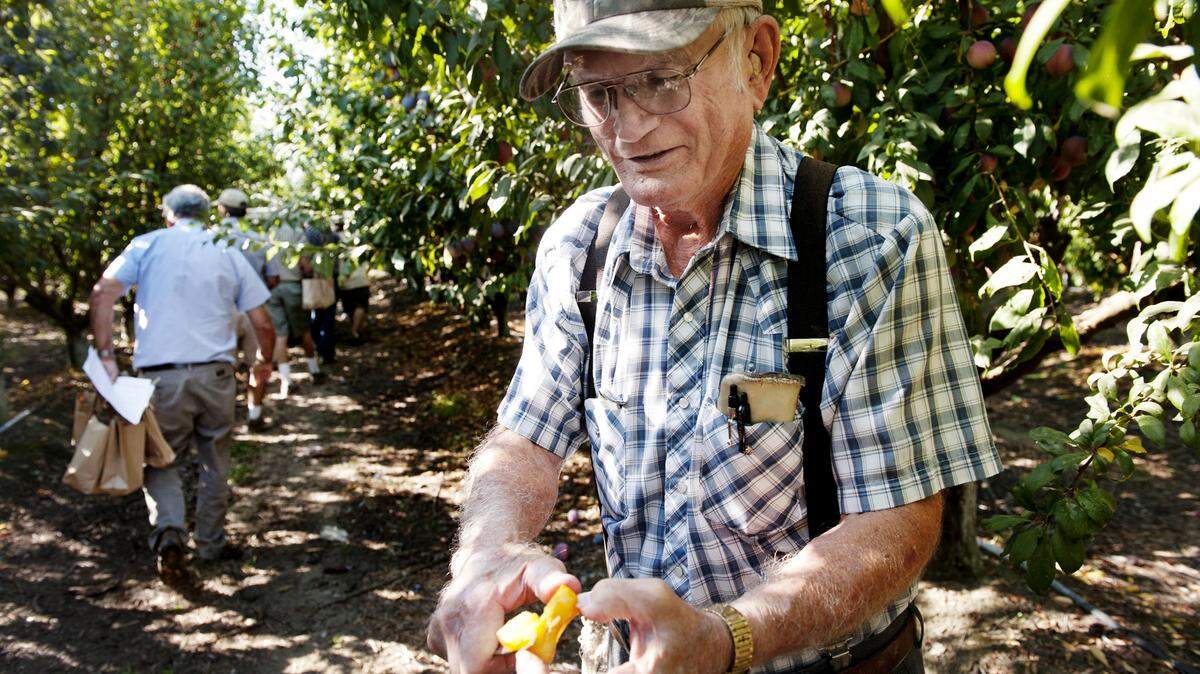
Floyd Zaiger transformed the stone fruit industry from his farm just west of Modesto. Experts the world over praised the peaches, plums and other crops he bred. Everyday shoppers enjoyed them, too.
Zaiger died June 2 at his home. He was 94 and had suffered from heart disease, daughter Leith Gardner said.
Zaiger is perhaps best known for inventing the pluot, a plum-apricot cross that is now a summer staple, but his hundreds of patented varieties did plenty more.
Certain peaches taste sweeter because Zaiger bred some of the acidity out of them. White nectarines, which used to spoil quickly, can withstand the journey from orchard to kitchen counter. The apricot harvest, most of it in Stanislaus County, goes deeper into summer than it used to.
“He enjoyed that the products he developed had done so well all over the world,” his daughter said.
Zaiger’s 120-acre breeding grounds along Grimes Avenue have drawn visitors from around the globe. Fruit growers, grocery store managers and others come to taste the latest. A crew for a Martha Stewart TV show once filmed a segment there.
Gardner and brothers Grant and Gary Zaiger carried on the business, Zaiger Genetics, along with three of Floyd’s six grandchildren. He also had 10 great-grandchildren.
His wife, Betty Zaiger, died in 2010. She had helped him get started as a breeder in the 1950s. They later owned a small chain of retail garden centers.
Nebraska native
Zaiger told his life story in a 2009 book by Chip Brantley, “The Perfect Fruit: Good Breeding, Bad Seeds and the Hunt for the Elusive Pluot.”
He was born Chris Floyd Zaiger in Kennard, Nebraska, on April 26, 1926. The family moved to Oregon in the late 1930s.
The Zaigers ended up in Modesto during World War II because Floyd’s brother, Doliver, recuperated from his war wounds at the former Hammond General Hospital. Floyd trained as an Army paratrooper near the end of the war.
His interest in plant propagation started with a visit to Dave Wilson Nursery in Modesto — not to buy plants, but to pump some of the gasoline the business also sold. (The nursery would later move to much larger quarters near Hickman and become the marketer of Zaiger’s creations.)
Zaiger enrolled at Modesto Junior College, then transferred to the University of California, Davis, to study plant physiology. It was in Davis that he met Betty, who was working as a bookkeeper for Woolworth. They married in 1950.
Zaiger got a teaching job at MJC, and the couple made their home at a rundown nursery that they restored. Floyd started propagating azaleas, the start of a retail business that would last until 1990.
‘The old-fashioned way’
Zaiger apprenticed with Fred Anderson of Le Grand, dubbed the “father of the modern nectarine.” Anderson in turn had studied under Luther Burbank, creator of the Santa Rosa plum and many other varieties.
The name Zaiger Genetics suggests genes spliced in a laboratory, but this company is decidedly low-tech. To achieve certain traits, such as flavor or length of season, workers start by extracting pollen from one variety and brushing it onto the blossoms of another. If the resulting fruit looks promising, its pit is planted to produce a new seedling. The young branches are then grafted onto established trees, known as rootstock, that have their own desired traits.
“We do everything the old-fashioned way, primarily because that’s the way the public will accept it,” Zaiger told The Modesto Bee during a 2009 visit.
It can take up to 15 years of this trial and error to yield a marketable fruit, Brantley wrote. “Floyd knew that fruit breeding was an old man’s game whose progress was best measured on a long clock. It was a trade best not dabbled in, something you had to treat like a calling.”
Lauded in France and elsewhere
Zaiger received numerous awards for his work, from admirers near and far. The Stanislaus County Ag Hall of Fame inducted him in 2004. France named him a chevalier, similar to a knight, in 1981, and in 1997 promoted him to the Order of Agricultural Merit.
Another visit by The Bee in 2013 elicited yet more praise. “The Zaiger family is the most influential and creative plant breeders of our time,” said Eric Wuhl of Family Tree Farms in Reedley, Fresno County. “Without Floyd Zaiger, we don’t make a profit.”
The family held a private memorial service but hopes to have a public celebration of Zaiger’s life when the COVID-19 restrictions ease, his daughter said.
Memorial donations can be made to the Floyd and Betty Zaiger Scholarship Fund at MJC. It is mainly for agriculture students.
This story was originally published June 20, 2020 at 2:02 PM.