
Raker Act changed Tuolumne River’s course 100 years ago
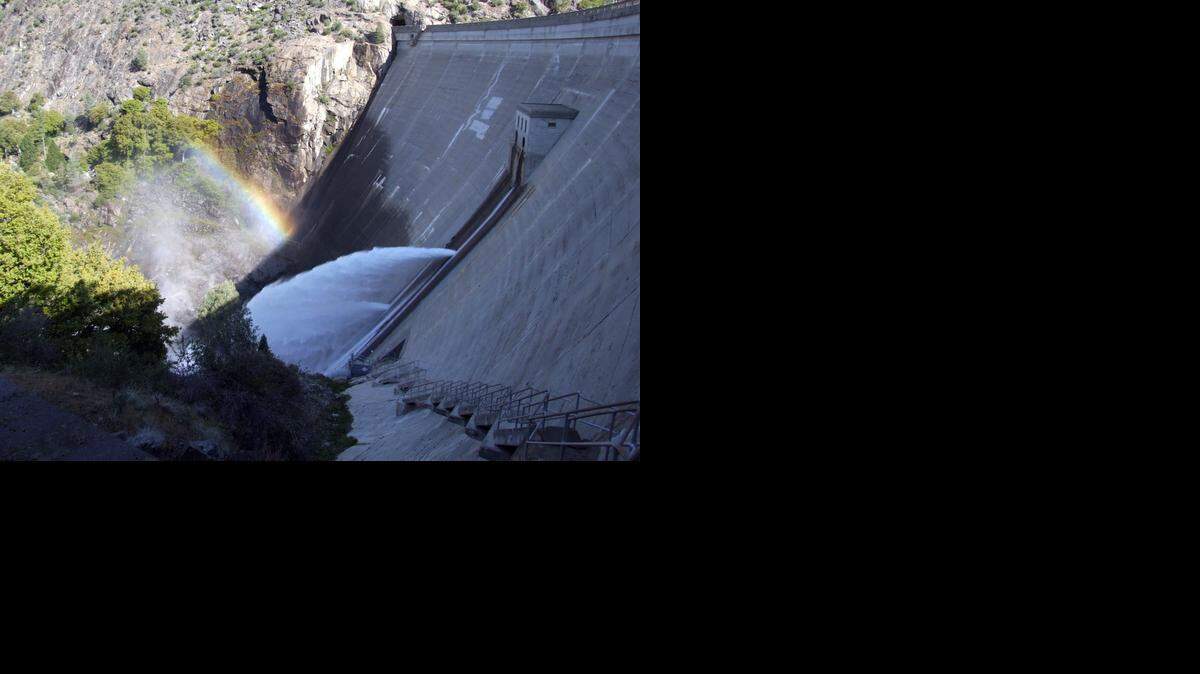
San Francisco has a place of honor for a pen wielded by President Woodrow Wilson a century ago today.
He used it to sign the Raker Act, which allowed the city to divert some of the Tuolumne River upstream of the Modesto and Turlock irrigation districts.
The signing on Dec. 19, 1913, came over the objection of district residents worried that San Francisco would take water they needed for farming – an issue that has resurfaced in recent years. And it capped a battle with John Muir and other people aghast at the city’s plan for a dam inside Yosemite National Park.
San Francisco is marking the 100th anniversary with a yearlong display of the pen at its City Hall. To supporters, it’s a fitting tribute, for from that pen flowed a water supply that has helped make the Bay Area one of the wealthiest places on Earth.
“From Silicon Valley to San Francisco, our rich regional history and economy was made possible through the efficient, clean and reliable delivery of water and hydropower,” said Harlan Kelly, general manager of the San Francisco Public Utilities Commission, in an emailed statement this week.
MID and TID did not dry up when the city built its Hetch Hetchy Water and Power System, diverting about an eighth of the Tuolumne’s flow for use in four Bay Area counties. The districts remain the largest users of the river, and they cooperate with San Francisco in managing river and reservoir levels.
The concerns about a water grab were addressed in Section 9(b) of the act. It says the city “shall recognize the prior rights” of MID and TID, which date to just after the 1887 founding of the two districts.
But in the dozen years leading up to the signing, starting with San Francisco’s 1901 filing for Tuolumne water rights, district residents feared the worst. A 1904 editorial in the Stanislaus County News warned that the city “would lay hold of and carry off large quantities of this vivifying fluid, upon which the very life of our valley here depends, and leave us the aridity and desolation which is our doom if needed moisture be denied us.”
That quote is in “The Greening of Paradise Valley,” a history of MID written by Dwight Barnes for the district’s centennial in 1987.
Muir, who helped create the national park in 1890, railed against the reservoir planned for Hetch Hetchy Valley, which he thought to be as magnificent as Yosemite Valley to the south. “These temple destroyers, devotees of ravaging commercialism, seem to have a perfect contempt for Nature, and, instead of lifting their eyes to the God of the mountains, lift them to the Almighty Dollar,” he wrote in a 1912 book on the park. “Dam Hetch Hetchy! As well dam for water-tanks the people’s cathedrals and churches, for no holier temple has ever been consecrated by the heart of man.”
Raker Act’s roots
San Francisco had looked at several other Northern California rivers before deciding on the Tuolumne. The 1906 earthquake and fire helped make the city’s case for a supply much larger than what it received from Bay Area watersheds.
The planners liked the reservoir site in Yosemite because the watershed above it is mostly wilderness and less prone to contamination than lower elevations. A location that high also boosted the amount of hydropower from the system.
To get past National Park Service limits on development, San Francisco relied on a bill introduced in early 1913 by Rep. John Raker of Manteca, whose district included Yosemite. Officials from MID and TID negotiated for provisions that recognized their prior rights. Meanwhile, Muir and his allies stirred up opposition in newspapers and magazines around the nation – one of the first great causes of the environmental movement.
The House of Representatives passed the Raker Act on Sept. 13, 1913, followed by the Senate on Dec. 6. Thirteen days later, Wilson signed it. It would take until 1923 for San Francisco to complete the Hetch Hetchy Reservoir and until 1934 for the water to start flowing in a set of big pipes to the Bay Area. Other water storage and hydropower plants were added later.
Meanwhile, MID and TID built the original Don Pedro Reservoir in the 1920s to hold water that the city, as required by the Raker Act, passed along from the upper watershed. The current, much bigger Don Pedro followed in 1971, funded with San Francisco’s help because it streamlined these transfers.
The districts and city still square off at times, such as in 2005, when San Francisco looked at boosting the capacity of the Bay Area-bound pipelines. But they have largely worked together to ensure that the Tuolumne provides farm and city water and hydropower when they are needed, and that the reservoirs have enough room to control floods.
San Francisco has not completely shaken the label of water-grabber. Two years ago, MID proposed selling about 1 percent of its supply to help the city through dry years. Despite the very high price and guarantees that the water was available, many residents opposed the move and the district dropped it. San Francisco has since been talking with the Oakdale Irrigation District about a dry-year supplement from the Stanislaus River, with little controversy.
Restore Hetch Hetchy?
The Raker Act centennial has renewed calls to drain a reservoir that sits about 300 feet above the floor of Hetch Hetchy Valley when full. Advocates say San Francisco can modify its remaining waterworks on the Tuolumne to make up for the loss and meet some of the demand with water conservation and recycling.
They lost one battle last year, when San Francisco voters rejected a ballot measure ordering city officials to do detailed studies on the idea, but they carry on. “San Francisco may have a ‘green’ reputation, but if we wait for the city to reconsider its water system, we may be waiting another century,” wrote Spreck Rosekrans, executive director of Restore Hetch Hetchy, on The Sacramento Bee opinion pages in October.
The Raker Act is vilified by many, but it actually reflected some of the ideals of the Progressive Movement that swept the nation a century ago, according to TID historian Alan Paterson. These included ownership of water and power systems by the public, rather than wealthy private interests, and honest government. Paterson noted that a San Francisco mayor went to prison a few years earlier for trying to secretly profit from a water project on another river.
Paterson has a whole chapter on the Raker Act in “Land, Water and Power: A History of the Turlock Irrigation District,” published for TID’s 1987 centennial.
Both he and MID historian Barnes said the act stemmed from a belief at the time in conservation over preservation – that water, timber and other resources should be used wisely, not locked away. Gifford Pinchot, father of the national forest system, said as much in testimony on the Raker Act: “I believe that if we had nothing else to consider than the delight of the few men and women who would yearly go into the Hetch Hetchy Valley, then it should be left in its natural condition, … (but) I have never been able to see that there was any reasonable argument against the use of this water supply by San Francisco.”
This story was originally published December 18, 2013 at 9:21 PM with the headline "Raker Act changed Tuolumne River’s course 100 years ago."