
Alice Cooper brings the man, and the myth, to Stockton
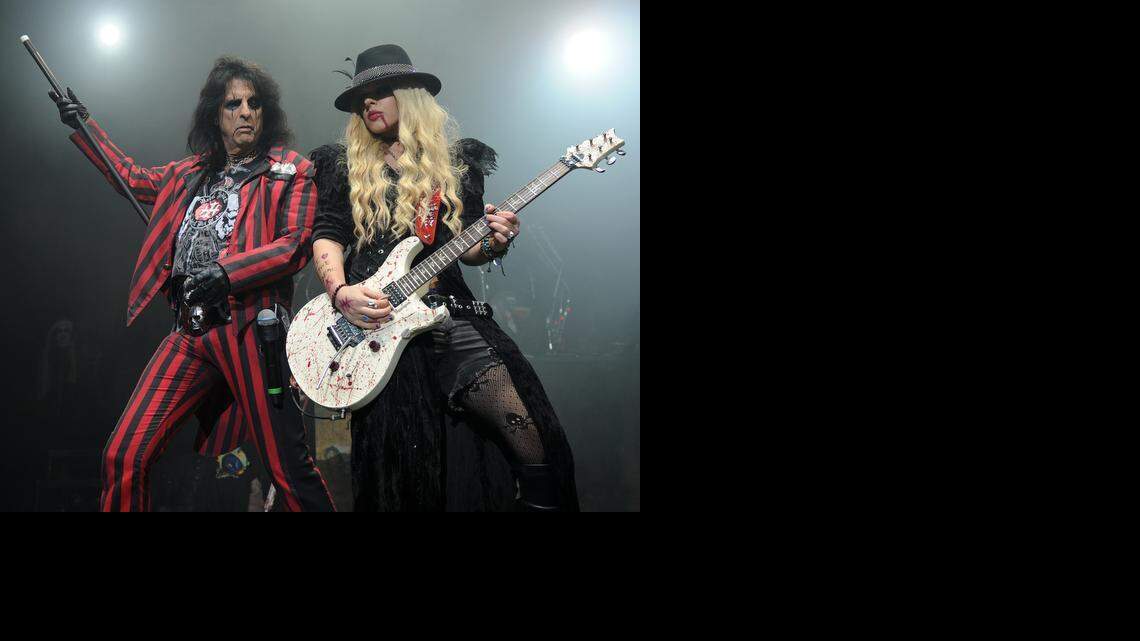
The legend of Alice Cooper suggests the shock-rock godfather is coming to the Central Valley a month too late.
The horror-loving, snake-wearing, blood-spurting Alice Cooper of lore seems a better fit for the Halloween season. But the reality of Alice Cooper is that the hard-rock icon is a perfect fit for his Thanksgiving-time show at Stockton’s Bob Hope Theatre on Tuesday.
While he may be the grand villain of metal onstage, Cooper in real life is a 66-year-old Christian married family man who loves to play golf – so probably not unlike some of the folks you may be sitting across the turkey from soon.
But Cooper, who was born Vincent Furnier, long has made a distinction between the man and the myth. The myth is who will be coming to the Stockton stage this week. The man will be who comes off the stage once the music ends.
“I have a good working relationship with Alice. There was a time when there was a gray area about where I started and where Alice ended. I was a highly functional alcoholic, but it was killing me inside,” Cooper said in an interview with The Bee from the road in Omaha.
“Then there was a point I had to say I am not going to throw up blood every morning,” he said. “It’s the same crossroad Steven Tyler, Ozzy Osbourne, everyone else who is still alive had to go through. The reason I’m alive is because I got ahold of the lifestyle. I realized there had to be a separation. Alice had to be this character I played that never left the stage. As soon as curtain comes down, Alice stays there. I go on with my life.”
Cooper has been clean and sober for more than 30 years. He has been married to his wife, Sheryl Goddard, since 1976 and they have three children together. The seeming dichotomy between the larger-than-life rock star and Cooper’s home life do not faze him. In fact, he said, it makes his work even stronger these days.
“I’ve been very, very open about Alice. I talk about Christianity, the fact I’m Christian. That doesn’t mean I can’t play a character like Alice Cooper,” he said. “I think people have the wrong concept of Christianity sometimes. They think once you are Christian, you can never do anything wrong. It’s just the opposite: You try to live the lifestyle and fail, but you keep trying. I’ve been very, very open about who I am in this business. The crazy thing is it seems now when I play Alice, I have a lot more control and a lot more fun playing him.”
Cooper calls his stage show a kind of metal vaudeville act. But instead of acrobats, plate spinners and trained animals, Cooper’s shows have guillotines, severed heads and electric chairs.
The urban legend of Cooper concerts helped the band grow in its early days. In a time before Twitter, Instagram and YouTube, the word-of-mouth surrounding his shows helped build excitement.
“We were already mythical by our second album. It was the legend of Alice Cooper and we hadn’t even started yet. Now with everything being so immediate, people get over it quicker,” he said. “Back then, if I played Detroit with an 8-foot snake, the next day it was a 20-foot snake and it killed someone. By time we were to the next city, our legend was already three times bigger than what really happened.”
But he also is acutely aware that audiences today are different than audiences when his band hit it big in the 1970s.
“When I say shock is dead, it’s because if I got my head cut off on stage in the ’70s, that was really offensive to a lot of parents. As was wearing makeup and everything else. They didn’t want their kids to look like us,” he said. “Now you turn on CNN and see a guy getting his head cut off for real. Reality is much more shocking than anything Marilyn Manson or Alice Cooper can do. Now we use moments of theatricality for shock value in the show.”
Still, there are things even the man in the black eyeliner with a hangman’s noose around his neck won’t do. Cooper’s show may feature gory imagery, but it’s more about stagecraft than real scandal.
“The trick to doing shock is to keep it so it’s in bounds,” he said. “To me, you’ll never hear the F-bomb on my stage and never see nude girls on my stage. To me, that’s not shocking. The idea is to trick the audience, make them think one thing happens and something else happens. It’s more illusion than shock. We want to be bigger than life.”
With hits including “School’s Out,” “I’m Eighteen,” “No More Mr. Nice Guy” and “Welcome to My Nightmare,” Cooper’s sound also long has been more accessible melodically than his ghoulish image might imply. He has sold more than 50 million albums worldwide, and in 2011 he and the original members of the Alice Cooper band were inducted into the Rock and Roll Hall of Fame.
The new documentary “Super Duper Alice Cooper” released this year seeks to shed more light on what got the artist to where he is today. Cooper sat down for almost 30 hours of interviews with the filmmakers. His life has been framed as a Dr. Jekyll and Mr. Hyde story in the film. He also talks at length about his drug and alcohol days, including his cocaine abuse.
“It really tells the true story. A lot of times, you do a documentary or interview and they take what they think you are,” he said. “I trusted them to make a really tasty documentary. It’s about me and Alice, the character I play. There are moments of really uncomfortable things because I figured you can’t sweep things under the rug. You have to talk about them. But in the end, Alice wins. Because there’s no alcohol, no drugs and the show is better than ever.”
Cooper even has paid his good fortune forward with a variety of philanthropic projects. Fifteen years ago, he started the nonprofit, faith-based Solid Rock Foundation, which runs the Rock Teen Center in Phoenix, where he lives. The group works with teenagers at risk, and the 30,000-square-foot center offers free music, dance and art classes to youths. Around 50 to 100 teens visit the center daily.
“Any kid can learn guitars, drums, singing there. It’s a great hangout where they won’t be involved in selling meth, buying drugs,” he said. “Everything is more dangerous than when I was a kid. Drugs are more dangerous. Sex is more dangerous. A lot of these kids are from gangland and born into it. I tell them being in a band is like being in a gang, except that you’re being creative and not being shot at.”
The self-professed “Golf Monster” (the title of his 2007 memoir) helps to fund the foundation with an annual celebrity tournament, Alice Cooper’s Rock & Roll Golf Classic. When not on the links, his touring schedule still keeps him on the road six months out of the year.
Saturday marks the end of his run as the high-octane opening act for the farewell tour of fellow metal legends Mötley Crüe. Cooper immediately dives from that stadium tour into his solo Raise the Dead tour. His solo theater dates, including the stop at the 2,042-seat Stockton site, are in smaller venues than some of his past appearances in arenas around the world.
But he said he enjoys the more intimate settings more these days than the vast openness of arenas. Just don’t expect him to tone down the theatrics in the smaller spaces.
“The funny thing with me, I’ve been doing this for so long that if I had a choice of playing an arena or theater, I’d say theater,” he said. “Our show fits in theater. We bring it all. We can do big outdoor venues; we did one with 150,000 people in Sweden this summer. But I love playing our show in a theater because everyone can see every detail. When you play massive shows, you see it on screen. When Alice is in the straitjacket, I want the audience to feel the claustrophobia of that. I think the shows are much more intense in a theater. All that sound and all that staging and all that lighting is compacted in a small place.”
Cooper especially enjoyed the seeming irony of playing at the Bob Hope Theatre, named after one of the country’s most beloved, family-friendly entertainers.
“Bob Hope would be turning over in his grave,” he said, before conceding to reality again. “Actually, I knew Bob Hope. We were in Friars Club together.”
Bee staff writer Marijke Rowland can be reached at mrowland@modbee.com or (209) 578-2284. Follow her on Twitter @marijkerowland.
Alice Cooper
When: 8 p.m. Tuesday
Where: Bob Hope Theatre, 242 E. Main St., Stockton
Tickets: $39.50-$59.50
Call: (209) 373-1400
Online: www.stocktonlive.com
This story was originally published November 20, 2014 at 1:00 AM with the headline "Alice Cooper brings the man, and the myth, to Stockton."