As California’s workforce grows, a bureaucratic trend emerges: More managers
Since 2019, California has been on a hiring spree.
Under Gov. Gavin Newsom, the size of the state’s workforce has grown by roughly 20,000 employees, according to California’s human resources department — but that growth hasn’t happened uniformly across the classes of civil service.
While the number of rank-and-file employees has increased by 4% from 2019 to 2024, according to annual payroll data, the number of supervisors rose about 10% and the number of managers has grown by 32%.
Three out of four state workers were classified as rank-and-file employees. Managers, who have the highest average pay among employee groups, made up 3% of the state’s workforce. Supervisors, who have the next-highest average pay, and other employees excluded from joining unions, unlike rank-and-file workers, made up the rest of California’s nearly 250,000-person workforce.
This swelling of managers and administrators is a common occurrence in both public and private sectors, said Michele Zanini, a management researcher and co-author of “Humanocracy,” a book about making organizations more innovative. The number of people who are in positions of management or administration is a key marker of bureaucratic growth.
“The whole idea that we have too many people working in government, it’s actually not quite true,” Zanini said, speaking broadly about this trend observed across governments. “It’s more like we might have kind of the wrong sorts of people” - too many talkers and not enough doers.
Government bloat at the federal level has been cited by President Donald Trump and his allies to justify slashing jobs and departments’ scope. In the first three months of his presidency, his agency heads have fired tens of thousands of public servants and prompted legal battles challenging those dismissals. The cost associated with firing employees could stretch beyond $135 billion this fiscal year, the New York Times reported last week.
Recent budget challenges have pushed Newsom to reduce the states’ payroll expenses by directing departments to eliminate vacant positions, but California has not taken steps as drastic as the Trump administration’s to trim the size of government.
In fact, it’s done the opposite in the last six years. A latent result of that growth is the steady decrease of the ratio of rank-and-file employees to managers working for California.
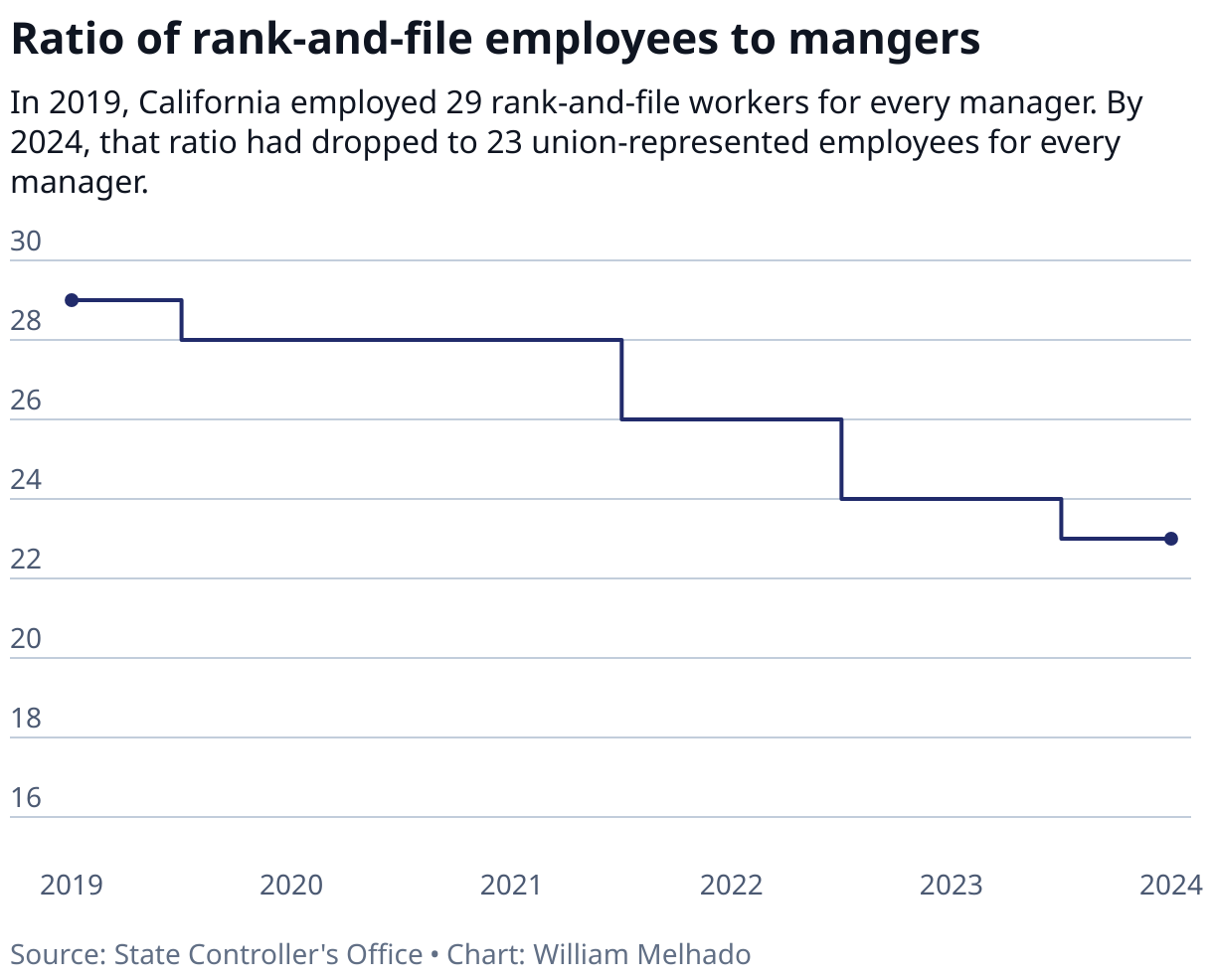
Confirming the accuracy of the findings that managers and supervisors have been hired at higher rates in recent years, CalHR attributed this trend to several factors including the increasing complexity of state work and the start of new programs.
Zanini pointed out that as mandates are added and new positions are created, organizations become more Byzantine, full of overlapping, competing rules. Rarely are those regulations sunsetted.
“The ratchet only goes in one direction,” Zanini said.
California mirrors federal government
The outsize growth in management in recent years is not limited to California state government.
Over the last quarter century, the federal government’s full-time workforce has grown by about 240,000 people. Nearly all of that growth has been in management and administrative roles, according to Zanini’s analysis of federal employment data.
California’s workforce has grown relative to the state’s population in recent years. In fiscal year 2021-22 the number of state employees per 100,000 residents reached its highest point in 50 years. Even considering California’s population growth, the relative proportion of state employees has continued trending up since 2021.
The most common managerial or supervisory positions at the state showed marked increases between 2019 and 2024. The number of staff service managers I and II, which are usually classified as supervisors, grew by 61% and 54% respectively over that time period. The number of Career Executive Assignment’s — high-ranking state executives, which are usually managers — increased by about 29%.
Camille Travis, a CalHR spokesperson, pointed to several factors as possible reasons for the outsized growth of managers and supervisors: “economic pressures to pay higher wages, budgeting strategies and increasing complexity of work in the state programs.”
The state expected some growth of supervisors and managers as the state’s workforce began growing. Travis said those jobs are necessary to start new programs and expand missions at departments statewide.
Travis said CalHR periodically reviews departments’ classification data to look for areas of concern in how agencies allocate positions. In instances when positions are accidentally misallocated, departments report them to CalHR and develop a Corrective Action Plan. She added that recently CalHR has moved away from advising agencies to adopt strict staff-to-management ratios because those can hurt smaller departments by preventing them from hiring necessary staff.
CalHR would be concerned from a human resources perspective if this trend continued unchecked, Travis said. The Corrective Action Plan is in place to prevent unbalanced staff-to-management ratios in the long term, she said.
In Zanini’s research on the federal government, he’s encountered similar justifications for the higher numbers of managers.
Often in government, including California, employees’ salaries are capped based on their classification. When workers ask for raises, their bosses can get around those salary limits by promoting employees to higher positions, a process Zanini refers to as “grade inflation.”
When promotions into management are the primary way to increase pay, organizations end up creating managers just to reward and retain people, he said.
On the explanation that government work is increasingly complex, Zanini is skeptical. He said there are several examples of large-scale companies, such as Haier, the Chinese appliance manufacturing giant, that operate effectively with relatively little managerial oversight and minimal staff functions such as human resources.
Additionally, if the number of managerial and administrative jobs — which are traditionally assumed to be more “cognitive” in nature than front line positions — is growing at an outsized rate, Zanini wonders why aren’t other similarly knowledge-intensive roles in fields like science and engineering also increasing.
Work might be more complex, but people today are more skilled, and technology provides tools that can make workers more effective, Zanini said.
“It’s not at all clear to me that you need more managers to coordinate,” he said, unless their main job is coordinating other managers.
Bureaucratic bloat
Higher education is perhaps the best example of bureaucratic bloat.
For example, students and labor groups have criticized the state’s largest university system for what they see as excessive growth of administrators. Between 2004 and 2014, the University of California system’s managers and senior professionals grew by 60%.
Professor Emeritus Robert Sutton, an organizational psychologist at Stanford Engineering, said over time it’s natural for the ratio of administrators to front-line workers to increase within organizations.
“All complex bureaucracies, including government, fight this,” he said.
As organizations add more layers and more complexity, it makes it harder to get things done, Sutton said. To get something approved it has to go through more people until it gets to the top and those people higher in the hierarchy tend to be more detached from the direct labor.
“Sometimes I joke that if you wait long enough, you will end up with an organization that has one direct employee and thousands of people who oversee that one person,” Sutton said.
This is a common frustration among rank-and-file state workers, said Anica Walls, the president of SEIU Local 1000, the largest union that represents these employees.
Members have noticed an increase in bureaucracy and red tape in recent years, Walls said. As an example, she said the union regularly receives complaints from members about how supervisors are micromanaging employees’ use of sick days.
Walls also noted the widening gap between managers and front-line workers. She said some managers don’t have a good understanding of the day-to-day operations of their divisions.
“They’re just far removed from the actual work being done in their unit,” Walls said.
Sutton said middle managers are a “double-edged sword.”
While they can create unnecessary bottlenecks, he argued these managers are a necessary part of larger organizations because hierarchical layers ensure that managers at the top are not overwhelmed supervising hundreds of workers.
Over the last six years, the state has had to adapt to external factors such as the COVID-19 pandemic and devastating wildfires, said Nick Schroeder, a public employment analyst at the nonpartisan Legislative Analyst’s Office. Part of those changes, he noted, included the transition to remote work in 2020.
“Just the way that the state workforce operates has fundamentally changed from 2019,” Schroeder said. “It kind of makes sense that there’d be a shift in the distribution of the workforce.”
This story was originally published April 30, 2025 at 5:00 AM with the headline "As California’s workforce grows, a bureaucratic trend emerges: More managers."