
Another unnecessary death at the hands of impatient Modesto police
Add Paul Chavez Jr. to the list of people who should not have died at the hands of law enforcement officers.
The 30-year-old man was drunk, holding a trailer hitch and not obeying orders as he shuffled toward two Modesto police officers on July 14, as seen on video footage. When Chavez did not respond, other than to mutter “no,” officer Sergio Valencia deployed a nonlethal taser. That didn’t seem to affect Chavez, and six seconds later officer Sam Muncy shot him twice with his service revolver — a very lethal weapon.
When three investigations wrap up, probably months from now, authorities may conclude that the killing was justified. Some will accept that, because a heavy iron trailer hitch could do harm if swung by a seemingly healthy 30-year-old man. Others will say it’s a stretch to call Chavez armed at all. Who brings a trailer hitch to a gun fight? And never raises it?
The legal definition of “justified” has been parsed from every possible angle, and will again for this use-of-deadly-force incident. But this is what matters: It wasn’t necessary.
Of the entire range of possible reactions that Muncy had at his disposal, he chose the absolute extreme.
He might have tried his taser. He might have backed away and monitored Chavez while waiting for other officers to arrive. He might have tried talking to Chavez; that tactic seemed to work for another Modesto officer only 10 days before, for more than 30 minutes — until it didn’t, ending with a knife wound to the hand of the officer who shot the man having a mental crisis, putting him in the hospital.
That officer, Jacob Mertz, was the soul of patience until forced to pull a trigger. Muncy decided to shoot first and ask questions later. What a difference in approach, and what a tragic difference in outcome.
This wasn’t suicide by cop
It wasn’t necessary to shoot and kill Chavez to protect others in the neighborhood, none of whom appeared to be in imminent danger. It wasn’t necessary to kill him to stop him in the act of swinging that hitch at the officers, because he wasn’t swinging it — he just held it.
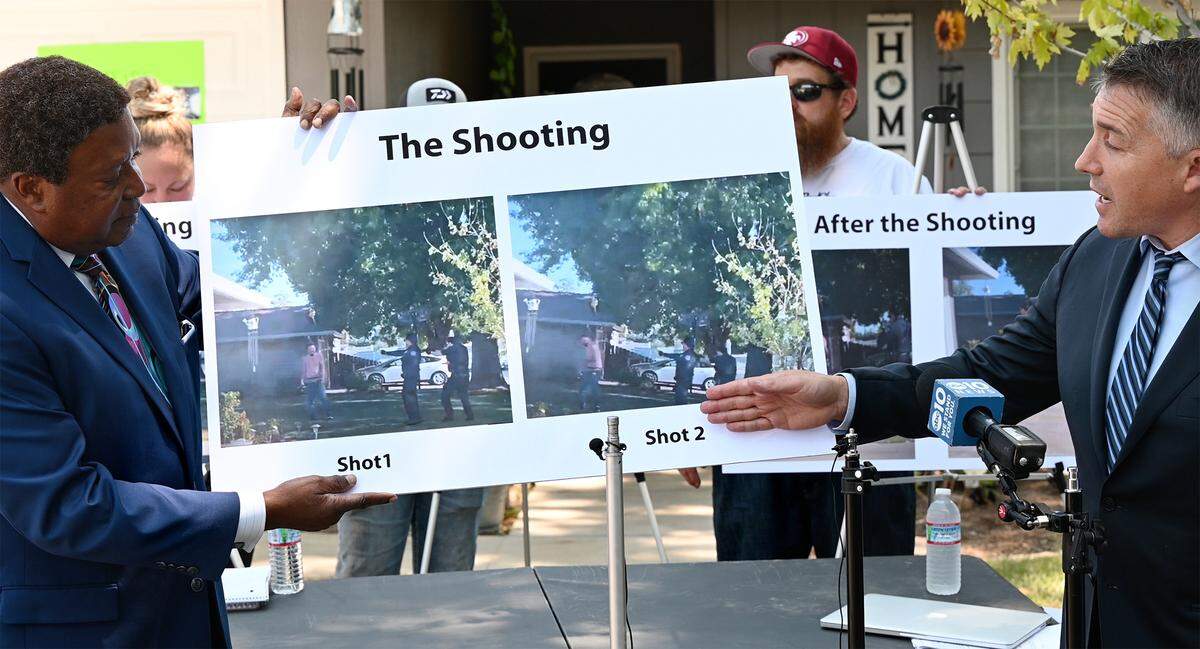
The urgency of Muncy’s verbal commands immediately after firing — repeatedly yelling with agitation for the man he just shot to get on the ground — is telling. Nothing short of exact and immediate compliance by an extremely intoxicated, mortally wounded target could appease this officer.
In an interview last week, Modesto Police Chief Brandon Gillespie talked about “16 to 18” of his officers who had just completed 40 hours of crisis intervention training, including review of deescalation techniques. Please tell us, Chief, that Muncy was not among them. It’s difficult to imagine an officer newly sensitized to calming a given situation choosing instead the most drastic and violent recourse in his arsenal.
The Bee once again calls for law enforcement officers to see people less as threats that must be neutralized and more as human beings in need.
When such a death occurs, no one wins.
- Chavez’s surviving wife and three children mourn, and sue (they filed a federal lawsuit).
- Muncy — who along with another officer in 2017 shot and killed a man who had just struck the other officer with a glass bong — at best is deemed justified in killing Chavez, and at worst faces job discipline and possible accountability in a court of law. Either way, he has to live with the memory of taking another life.
- The Modesto Police Department takes yet another public relations hit. It’s only been 16 months since Gillespie fired then-officer Joseph Lamantia for killing unarmed Trevor Seever at a west Modesto church; Lamantia still faces manslaughter prosecution.
- Muncy’s fellow officers — who perform a dangerous, difficult job, usually with dignity — feel the strain of more scrutiny, and the burden that comes with loss of public trust. Most officers never fire service weapons in the line of duty, because that always should be a last resort and not an impulse to be justified later.
- City Hall faces the enormous task of convincing taxpayers to put a higher sales tax on themselves partly to shore up public safety, even as trust in police falters.
- People are left wondering if they should call police when a family member abuses a substance or suffers a mental crisis, knowing it could mean a death sentence.
Suffering with mental illness is not a crime. Being too drunk to think straight usually isn’t a crime worthy of death, depending on circumstances.
Call for civilian review, police auditor
Holding numerous meetings to talk about reinventing how policing is done in Modesto, as city leaders are doing with the ongoing Forward Together initiative, is all well and good. But it amounts to a lot of talk if officers keep killing people needlessly.
Mayor Sue Zwahlen and her council members must take seriously recommendations from their Forward Together work group, including establishing a civilian review board and hiring an independent police auditor. Those recommendations, to be vetted in public at a council workshop at 5:30 p.m. on Aug. 11, will produce real reform.
Leaders must also clearly explain to voters how higher sales tax translates to a safer community.
The chief must find the resources to put the rest of his employees through crisis intervention training, as soon as humanly possible.
And officers must see themselves less as warriors and more as public servants.
This story was originally published July 27, 2022 at 10:00 AM.